
Marine life guide of Peru · Urotrygonidae
Blotched stingray
Urotrygon chilensis (Günther, 1872)
- Names in Peru
- Raya con espina
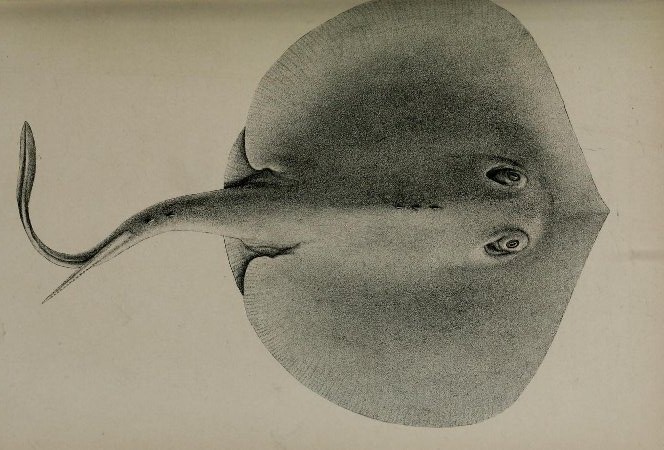
Species account
Summary
Urotrygon chilensis is a small ray of the family Urotrygonidae, in the order Myliobatiformes [1]. It lives on shallow coastal sandy bottoms, mostly between 10 and 60 m deep [2], and ranges from the Gulf of California to Chile [3]. The checklist of chondrichthyans of the Peruvian sea includes it [4]. It is not the target of a directed fishery, but it is often caught in trawls and bottom gillnets [3], and its global category on the IUCN Red List is Near Threatened [5].
Identification and similar species
It is a ray with a roughly rhomboid disc that is wider than long, with straight front edges and rounded side and rear edges that cover half of the pelvic fins [3]. The eyes and spiracles are the same size, spines run along the body to the tail, and the tail is longer than the disc [3]. Like most rays of its family, it has a well-developed tail fin and one or more long, venomous spines on the tail [3].
It is small. In the southern Gulf of California, among 606 specimens, females measured 11.4 to 51.6 cm in total length and males 11.2 to 41.3 cm [6]. In the central and southern Mexican Pacific, 423 specimens measured 6.3 to 47.3 cm [3].
6 species of the genus Urotrygon have been recorded in Peru, and the country's chondrichthyan checklist includes this one on the basis of the 2001 catalogue by Chirichigno and Cornejo [4].
Distribution and habitat
It ranges from the Gulf of California to Chile [3], and the updated checklist of chondrichthyans of the Peruvian sea includes it [4]. The specimens studied in the southern Gulf of California came from shrimp trawls and from small-scale gillnet fishing, at depths of 3 to 41 m [6].
It lives mostly on shallow coastal sandy bottoms, between 10 and 60 m [2]. The round rays of its family are mostly benthic and inhabit soft bottoms of estuaries and bays, in tropical and temperate waters [3].
Biology
It is an aplacental live-bearing ray whose embryos receive food from the mother during gestation (matrotrophic development) [2]. In the southern Gulf of California, the size at which half of the individuals were mature was 27.5 cm in females and 25.3 cm in males, and females reached a larger size than males [6].
Gestation was estimated at 6 months, and the presence of pregnant females, the size of oocytes and embryos and the smallest young across the year point to 2 reproductive periods a year; pups are born at 11.2 to 15.6 cm in total length [6]. Mean fecundity was 2.14 embryos per female and the maximum was 6, in a female of 51.6 cm [6]. These figures, the size at maturity and the reproductive cycle differ between regions of the Mexican Pacific, which suggests separate populations [6].
In the southeastern Mexican Pacific, the ages of 696 specimens were read from vertebral sections: females were 0 to 14 years old and males 0 to 12, and growth bands form once a year [2]. The authors conclude that it is a slow-growing species with a relatively short life compared with other elasmobranchs [2].
Ecology
In the Mexican Pacific, 423 stomachs examined yielded 15 prey groups, mostly crustaceans, followed by fishes and molluscs [3]. In Sinaloa, small burrowing crustaceans dominated: peracarids with 38.4 % and cladocerans with 29.3 % of the index of relative importance, followed by polychaetes with 22.7 % [3]. In Michoacán and Guerrero, by contrast, penaeid shrimps made up about 60 % of the index (64.6 % and 58.3 %), again followed by polychaetes [3].
Of the stomachs, 58.6 % were empty [3]. Its trophic position estimated from stomach contents was 3.51 in the north and 3.56 in the south, and the authors describe it as a specialist predator that changes prey according to what is available, a mesopredator of soft bottoms [3].
Conservation
Its global category on the IUCN Red List is Near Threatened [5].
There is no directed fishery for this ray, but it is caught incidentally in trawls and bottom gillnets [3]. In the Mexican Pacific it is an abundant bycatch of the shrimp trawl fishery and is almost always discarded because it has no commercial value, so there are no landing records [6]. The authors note that its abundance does not appear to be affected despite the catches, perhaps because of an r-type life strategy [6].
Human relevance
References (6)
- Froese, R., Pauly, D. (2026). Urotrygon chilensis (Günther, 1872). World Register of Marine Species. https://www.marinespecies.org/aphia.php?p=taxdetails&id=283115 (accessed 2026-10-21)
- Guzmán-Castellanos, A.B., Morales-Bojórquez, E., Aguirre-Villaseñor, H. et al. (2025). Model Selection Applied to Growth of the Stingray Urotrygon chilensis (Günther, 1872) in the Southeastern Mexican Pacific. Fishes, 232. doi:10.3390/fishes10050232 (accessed 2026-10-21)
- Oñate-González, E.C., Amezcua, F., Buszkiewicz, J. et al. (2017). Trophic ecology of the blotched stingray, Urotrygon chilensis (Elasmobranchii: Myliobatiformes: Urotrygonidae), in three areas of the Mexican Pacific. Acta Ichthyologica et Piscatoria, 185-196. doi:10.3750/AIEP/02099 (accessed 2026-10-21)
- Cornejo, R., Vélez-Zuazo, X., González-Pestana, A. et al. (2015). An updated checklist of Chondrichthyes from the southeast Pacific off Peru. Check List, 1809. doi:10.15560/11.6.1809 (accessed 2026-10-21)
- Kyne, P.M., Charvet, P., Areano, E.M. et al. (2020). Urotrygon chilensis: Kyne, P.M., Charvet, P., Areano, E.M., Cevallos, A., Espinoza, M., González, A., Herman, K., Mejía-Falla, P.A., Morales-Saldaña, J.M., Navia, A.F. & Velez-Zuazo, X. The IUCN Red List of Threatened Species 2020: e.T44647A124436667. doi:10.2305/IUCN.UK.2020-3.RLTS.T44647A124436667.en (accessed 2026-10-21)
- Alvarez-Fuentes, C.J., Tovar-Ávila, J., Payan-Alejo, J. et al. (2023). Reproductive Ecology of the Chilean Round Ray (Urotrygon chilensis, Günther, 1872) in the Southern Gulf of California. Fishes, 193. doi:10.3390/fishes8040193 (accessed 2026-10-21)