
Sharks, rays and chimaeras · Urotrygonidae
Blotched stingray
Urotrygon chilensis (Günther, 1872)
Spanish: Raya con espina
- Names in Peru
- Raya con espina
- Peruvian Register of Marine Species
- Listed in PeRMS (IMARPE)
Species account
Summary
Urotrygon chilensis is a small ray of the family Urotrygonidae, in the order Myliobatiformes [1]. It lives on shallow coastal sandy bottoms, mostly between 10 and 60 m deep [2], and ranges from the Gulf of California to Chile [3]. The checklist of chondrichthyans of the Peruvian sea includes it [4]. It is not the target of a directed fishery, but it is often caught in trawls and bottom gillnets [3], and its global category on the IUCN Red List is Near Threatened [5].
Identification and similar species
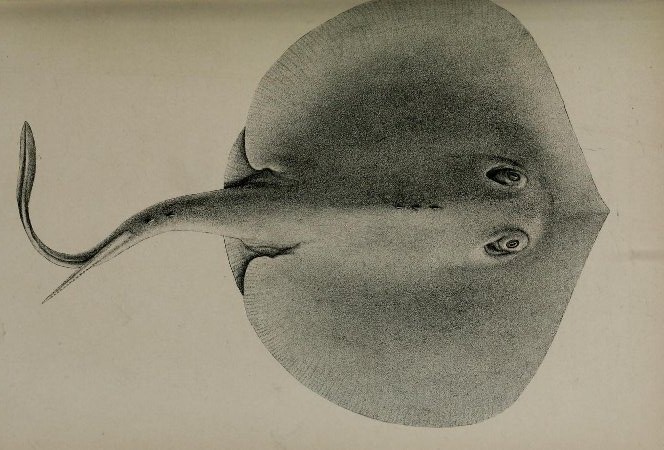
It is a ray with a roughly rhomboid disc that is wider than long, with straight front edges and rounded side and rear edges that cover half of the pelvic fins [3]. The eyes and spiracles are the same size, spines run along the body to the tail, and the tail is longer than the disc [3]. Like most rays of its family, it has a well-developed tail fin and one or more long, venomous spines on the tail [3].
It is small. In the southern Gulf of California, among 606 specimens, females measured 11.4 to 51.6 cm in total length and males 11.2 to 41.3 cm [6]. In the central and southern Mexican Pacific, 423 specimens measured 6.3 to 47.3 cm [3].
6 species of the genus Urotrygon have been recorded in Peru, and the country's chondrichthyan checklist includes this one on the basis of the 2001 catalogue by Chirichigno and Cornejo [4].
Distribution and habitat
It ranges from the Gulf of California to Chile [3], and the updated checklist of chondrichthyans of the Peruvian sea includes it [4]. The specimens studied in the southern Gulf of California came from shrimp trawls and from small-scale gillnet fishing, at depths of 3 to 41 m [6].
It lives mostly on shallow coastal sandy bottoms, between 10 and 60 m [2]. The round rays of its family are mostly benthic and inhabit soft bottoms of estuaries and bays, in tropical and temperate waters [3].
Biology
It is an aplacental live-bearing ray whose embryos receive food from the mother during gestation (matrotrophic development) [2]. In the southern Gulf of California, the size at which half of the individuals were mature was 27.5 cm in females and 25.3 cm in males, and females reached a larger size than males [6].
Gestation was estimated at 6 months, and the presence of pregnant females, the size of oocytes and embryos and the smallest young across the year point to 2 reproductive periods a year; pups are born at 11.2 to 15.6 cm in total length [6]. Mean fecundity was 2.14 embryos per female and the maximum was 6, in a female of 51.6 cm [6]. These figures, the size at maturity and the reproductive cycle differ between regions of the Mexican Pacific, which suggests separate populations [6].
In the southeastern Mexican Pacific, the ages of 696 specimens were read from vertebral sections: females were 0 to 14 years old and males 0 to 12, and growth bands form once a year [2]. The authors conclude that it is a slow-growing species with a relatively short life compared with other elasmobranchs [2].
Ecology
In the Mexican Pacific, 423 stomachs examined yielded 15 prey groups, mostly crustaceans, followed by fishes and molluscs [3]. In Sinaloa, small burrowing crustaceans dominated: peracarids with 38.4 % and cladocerans with 29.3 % of the index of relative importance, followed by polychaetes with 22.7 % [3]. In Michoacán and Guerrero, by contrast, penaeid shrimps made up about 60 % of the index (64.6 % and 58.3 %), again followed by polychaetes [3].
Of the stomachs, 58.6 % were empty [3]. Its trophic position estimated from stomach contents was 3.51 in the north and 3.56 in the south, and the authors describe it as a specialist predator that changes prey according to what is available, a mesopredator of soft bottoms [3].
Conservation
Its global category on the IUCN Red List is Near Threatened [5].
There is no directed fishery for this ray, but it is caught incidentally in trawls and bottom gillnets [3]. In the Mexican Pacific it is an abundant bycatch of the shrimp trawl fishery and is almost always discarded because it has no commercial value, so there are no landing records [6]. The authors note that its abundance does not appear to be affected despite the catches, perhaps because of an r-type life strategy [6].
Human relevance
References (6)
- Froese, R., Pauly, D. (2026). Urotrygon chilensis (Günther, 1872). World Register of Marine Species. https://www.marinespecies.org/aphia.php?p=taxdetails&id=283115 (accessed 2026-10-21)
- Guzmán-Castellanos, A.B., Morales-Bojórquez, E., Aguirre-Villaseñor, H. et al. (2025). Model Selection Applied to Growth of the Stingray Urotrygon chilensis (Günther, 1872) in the Southeastern Mexican Pacific. Fishes, 232. doi:10.3390/fishes10050232 (accessed 2026-10-21)
- Oñate-González, E.C., Amezcua, F., Buszkiewicz, J. et al. (2017). Trophic ecology of the blotched stingray, Urotrygon chilensis (Elasmobranchii: Myliobatiformes: Urotrygonidae), in three areas of the Mexican Pacific. Acta Ichthyologica et Piscatoria, 185-196. doi:10.3750/AIEP/02099 (accessed 2026-10-21)
- Cornejo, R., Vélez-Zuazo, X., González-Pestana, A. et al. (2015). An updated checklist of Chondrichthyes from the southeast Pacific off Peru. Check List, 1809. doi:10.15560/11.6.1809 (accessed 2026-10-21)
- Kyne, P.M., Charvet, P., Areano, E.M. et al. (2020). Urotrygon chilensis: Kyne, P.M., Charvet, P., Areano, E.M., Cevallos, A., Espinoza, M., González, A., Herman, K., Mejía-Falla, P.A., Morales-Saldaña, J.M., Navia, A.F. & Velez-Zuazo, X. The IUCN Red List of Threatened Species 2020: e.T44647A124436667. doi:10.2305/IUCN.UK.2020-3.RLTS.T44647A124436667.en (accessed 2026-10-21)
- Alvarez-Fuentes, C.J., Tovar-Ávila, J., Payan-Alejo, J. et al. (2023). Reproductive Ecology of the Chilean Round Ray (Urotrygon chilensis, Günther, 1872) in the Southern Gulf of California. Fishes, 193. doi:10.3390/fishes8040193 (accessed 2026-10-21)
More pictures
If you come across it
Protected or threatened species. Watch it without touching, feeding, chasing or taking it, and keep the recommended viewing distances.
Where it has been recorded
- Filled: scientific records, or confirmed by a curator
- Hatched: isolated record
- Dotted outline: no scientific records and no curator's confirmation (an ORKA sighting is not drawn here)
- Tropical northern sea
Scientific records (2 records)
- Cold southern sea
Scientific records (3 records)
From openly licensed OBIS and GBIF records (CC0 or CC BY). How each list is built.
Related species
From the same genus (Urotrygon) and from the same family (Urotrygonidae).
Urotrygon caudispinosus
IUCN status: Not evaluated
Urotrygon peruanus
IUCN status: Not evaluated
Urotrygon serrula
IUCN status: Not evaluated
Panamic stingray
Urotrygon aspidura
IUCN status: NT · Near ThreatenedSpiny stingray
Urotrygon munda
IUCN status: NT · Near Threatened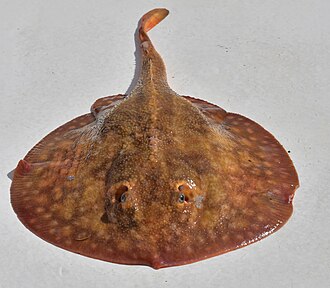
Tumbes Round Stingray
Urobatis tumbesensis
IUCN status: VU · Vulnerable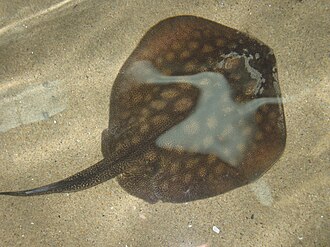
Round stingray
Urobatis halleri
IUCN status: LC · Least Concern
Leopard round stingray
Urobatis pardalis
IUCN status: LC · Least Concern
Names and sources
In Spanish
- Raya con espina — Peru; fishbase · main name
- Raya redonda moteada — WoRMS
In English
- Blotched stingray — WoRMS
- Chilean round ray — Wikidata
- Thorny Round Stingray — Wikidata
Classification
Learn more
Conservation status: Near Threatened (IUCN Red List, according to Wikidata). Taxonomy: PeRMS / WoRMS (CC BY 4.0).