
Marine life guide of Peru · Belonidae
California needlefish
Strongylura exilis (Girard, 1854)
- Names in Peru
- Aguja · Marao de California · Pez aguja · Picuda
Species account
Summary
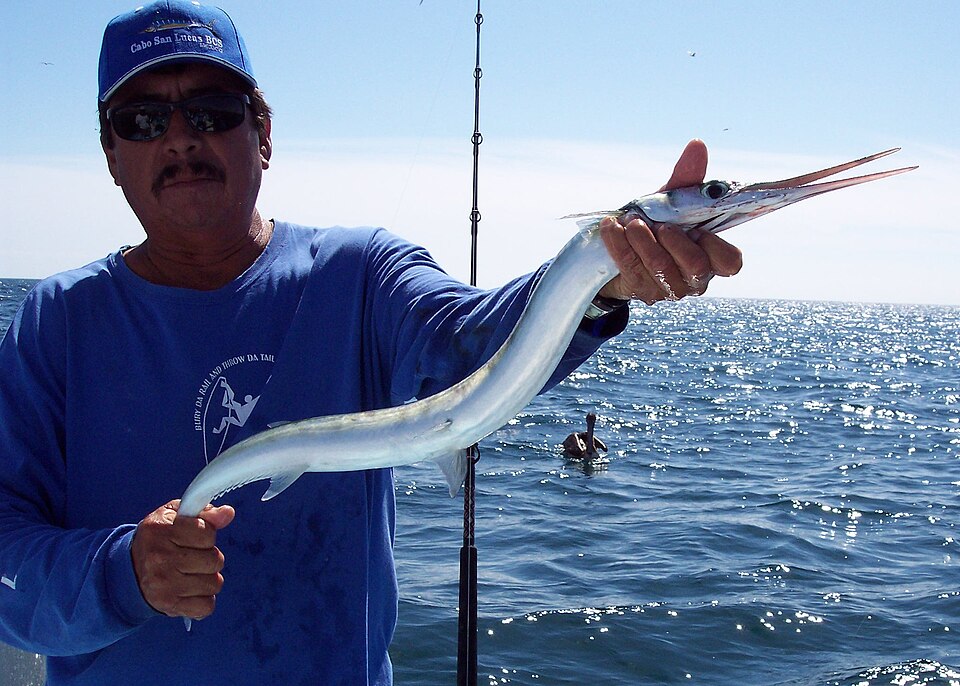
Strongylura exilis, described by Girard in 1854, is a needlefish with an elongate body and a beak-like snout that lives in coastal waters of the eastern Pacific, from San Francisco, in California, to Peru, including the Galápagos Islands [1],[2]. It can reach 91 cm in total length and lives in small schools near the surface [2],[3].
Globally the IUCN rates it Least Concern, according to the 2018 assessment [4]. Much of what is known about its early development comes from an aquarium rearing study published in 1988 [3].
Etymology
The genus name, Strongylura, comes from the Greek strongylos, meaning round, and oura, meaning tail, according to the etymology FishBase gives [2].
Identification and similar species
It is an elongate fish. The dorsal fin has 13 to 17 soft rays and the anal fin 16 to 19, with no spines in either; the tail fin is slightly notched and the skeleton has 67 to 74 vertebrae [2].
Young fish change shape a great deal as they grow. At hatching they measure between 6 and 9 mm and the mouth is slightly subterminal to nearly equal in both jaws; the lower jaw then lengthens faster than the upper one, producing a phase with a half-grown beak that peaks at about 24 mm of body length, when the difference between the two jaws equals 27 % of that length [3]. Colour changes too: the larva, covered at hatching in yellow and black pigment, comes to have a green back on a black ground and silvery flanks [3].
Distribution and habitat
The species occupies the eastern Pacific between San Francisco, in California, and Peru, and includes the Galápagos Islands [2],[3]. It has been recorded in sea, brackish and fresh water, from the surface down to 100 m depth [2].
It is usually seen in bays and harbours, near the surface and in small groups [3]; it is also common in coastal areas and mangrove lagoons [2]. The adults used for the rearing study were caught in 1979 with a beach seine over sandy bottom, north of the Scripps Institution pier, in California [3].
Biology
It is oviparous. The eggs are spherical, measure between 2.4 and 2.7 mm and carry 28 to 40 long filaments spread over the shell; the filaments of neighbouring eggs tangle into sticky masses that stay attached to vegetation or floating objects [3],[2]. The mature females in the study measured between 500 and 636 mm standard length, and the males 435 and 480 mm [3].
In water at 19 to 21 °C, hatching took place between 10 and 19 days after fertilisation. At hatching the larvae already had working eyes, jaws and digestive tract, absorbed the yolk sac by about day 3 and, fed brine shrimp nauplii (Artemia) in captivity, grew about 1 mm per day [3].
Teeth begin to form on day 2 of life, and by about day 10 there is a row of large, widely spaced teeth with small ones between them. The pelvic fins are the last to complete their 6 rays, between days 18 and 39, later than in any other known needlefish (belonid) [3].
Ecology
Adults form small schools and feed mainly on small fishes; their estimated trophic level is 4.5 [2].
The larvae are neustonic, that is, they live right at the water surface [2]. In the aquarium, newly hatched larvae took brine shrimp nauplii at once and larger ones took chopped squid, which does not show what they eat at sea [3].
Conservation
Health, toxicological and chemical relevance
Not medical advice. For a sting, a poisoning or an allergy, seek medical care.
FishBase describes it as harmless to people [2].
Human relevance
References (4)
- Froese, R., Pauly, D. (2026). Strongylura exilis (Girard, 1854). World Register of Marine Species. https://www.marinespecies.org/aphia.php?p=taxdetails&id=275978 (accessed 2026-10-25)
- Froese, R., Pauly, D. (2026). Strongylura exilis, Californian needlefish. FishBase. https://www.fishbase.se/summary/Strongylura-exilis (accessed 2026-10-25)
- Ambrose, D.A., Moser, H.G. (1988). Rearing, development, and early life history of the California Needlefish, Strongylura exilis. Revue française d'Aquariologie 15(2); NOAA National Marine Fisheries Service, Southwest Fisheries Center, 43-48. https://storage.googleapis.com/nmfs_odp_swfsc/Publications/Files/CR/1988/8803.pdf (accessed 2026-10-25)
- Collette, B.B., Acero, A. (2018). Strongylura exilis: Collette, B.B. & Acero, A. The IUCN Red List of Threatened Species. doi:10.2305/iucn.uk.2019-2.rlts.t183294a1735660.en (accessed 2026-10-25)