
Bony fishes · Belonidae
California needlefish
Strongylura exilis (Girard, 1854)
Spanish: Aguja
- Names in Peru
- Aguja · Marao de California · Pez aguja · Picuda
- Peruvian Register of Marine Species
- Listed in PeRMS (IMARPE)
Species account
Summary
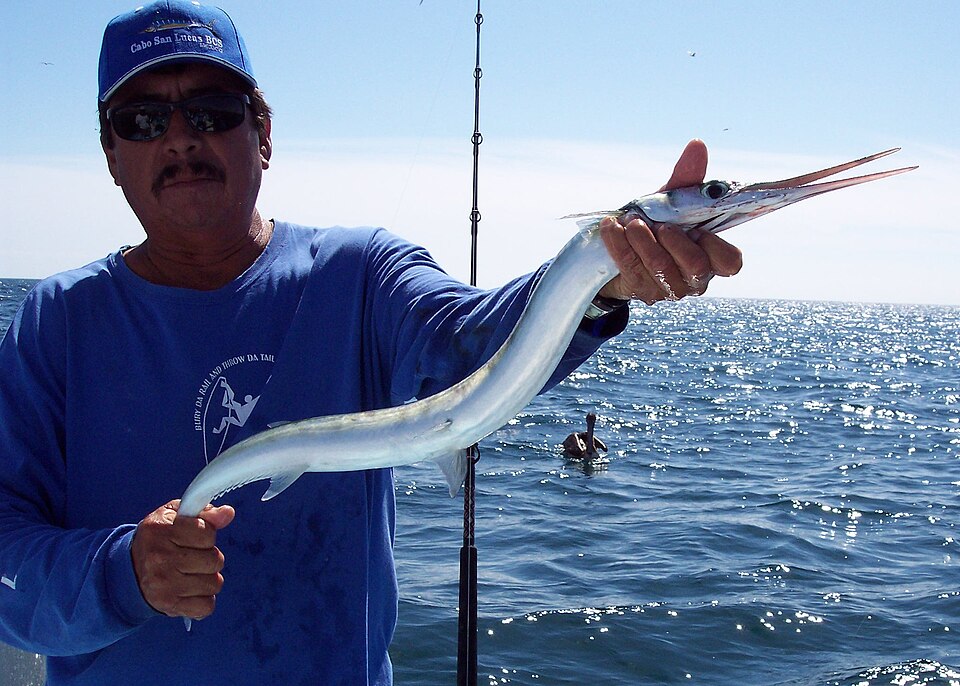
Strongylura exilis, described by Girard in 1854, is a needlefish with an elongate body and a beak-like snout that lives in coastal waters of the eastern Pacific, from San Francisco, in California, to Peru, including the Galápagos Islands [1],[2]. It can reach 91 cm in total length and lives in small schools near the surface [2],[3].
Globally the IUCN rates it Least Concern, according to the 2018 assessment [4]. Much of what is known about its early development comes from an aquarium rearing study published in 1988 [3].
Etymology
The genus name, Strongylura, comes from the Greek strongylos, meaning round, and oura, meaning tail, according to the etymology FishBase gives [2].
Identification and similar species
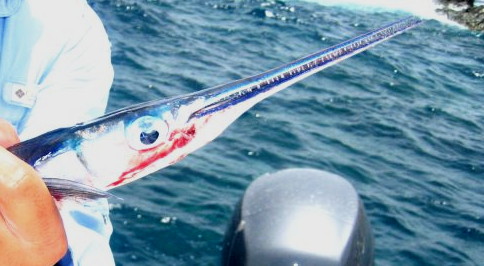
It is an elongate fish. The dorsal fin has 13 to 17 soft rays and the anal fin 16 to 19, with no spines in either; the tail fin is slightly notched and the skeleton has 67 to 74 vertebrae [2].
Young fish change shape a great deal as they grow. At hatching they measure between 6 and 9 mm and the mouth is slightly subterminal to nearly equal in both jaws; the lower jaw then lengthens faster than the upper one, producing a phase with a half-grown beak that peaks at about 24 mm of body length, when the difference between the two jaws equals 27 % of that length [3]. Colour changes too: the larva, covered at hatching in yellow and black pigment, comes to have a green back on a black ground and silvery flanks [3].
Distribution and habitat
The species occupies the eastern Pacific between San Francisco, in California, and Peru, and includes the Galápagos Islands [2],[3]. It has been recorded in sea, brackish and fresh water, from the surface down to 100 m depth [2].
It is usually seen in bays and harbours, near the surface and in small groups [3]; it is also common in coastal areas and mangrove lagoons [2]. The adults used for the rearing study were caught in 1979 with a beach seine over sandy bottom, north of the Scripps Institution pier, in California [3].
Biology
It is oviparous. The eggs are spherical, measure between 2.4 and 2.7 mm and carry 28 to 40 long filaments spread over the shell; the filaments of neighbouring eggs tangle into sticky masses that stay attached to vegetation or floating objects [3],[2]. The mature females in the study measured between 500 and 636 mm standard length, and the males 435 and 480 mm [3].
In water at 19 to 21 °C, hatching took place between 10 and 19 days after fertilisation. At hatching the larvae already had working eyes, jaws and digestive tract, absorbed the yolk sac by about day 3 and, fed brine shrimp nauplii (Artemia) in captivity, grew about 1 mm per day [3].
Teeth begin to form on day 2 of life, and by about day 10 there is a row of large, widely spaced teeth with small ones between them. The pelvic fins are the last to complete their 6 rays, between days 18 and 39, later than in any other known needlefish (belonid) [3].
Ecology
Adults form small schools and feed mainly on small fishes; their estimated trophic level is 4.5 [2].
The larvae are neustonic, that is, they live right at the water surface [2]. In the aquarium, newly hatched larvae took brine shrimp nauplii at once and larger ones took chopped squid, which does not show what they eat at sea [3].
Conservation
Health, toxicological and chemical relevance
Not medical advice. For a sting, a poisoning or an allergy, seek medical care.
FishBase describes it as harmless to people [2].
Human relevance
References (4)
- Froese, R., Pauly, D. (2026). Strongylura exilis (Girard, 1854). World Register of Marine Species. https://www.marinespecies.org/aphia.php?p=taxdetails&id=275978 (accessed 2026-10-25)
- Froese, R., Pauly, D. (2026). Strongylura exilis, Californian needlefish. FishBase. https://www.fishbase.se/summary/Strongylura-exilis (accessed 2026-10-25)
- Ambrose, D.A., Moser, H.G. (1988). Rearing, development, and early life history of the California Needlefish, Strongylura exilis. Revue française d'Aquariologie 15(2); NOAA National Marine Fisheries Service, Southwest Fisheries Center, 43-48. https://storage.googleapis.com/nmfs_odp_swfsc/Publications/Files/CR/1988/8803.pdf (accessed 2026-10-25)
- Collette, B.B., Acero, A. (2018). Strongylura exilis: Collette, B.B. & Acero, A. The IUCN Red List of Threatened Species. doi:10.2305/iucn.uk.2019-2.rlts.t183294a1735660.en (accessed 2026-10-25)
More pictures
Where it has been recorded
- Filled: scientific records, or confirmed by a curator
- Hatched: isolated record
- Dotted outline: no scientific records and no curator's confirmation (an ORKA sighting is not drawn here)
- Tropical northern sea
Scientific records (3 records)
- Tropical–cold transition zone
Scientific records (5 records)
- Cold central sea
Scientific records (3 records)
- Cold southern sea
Scientific records (2 records)
From openly licensed OBIS and GBIF records (CC0 or CC BY). How each list is built.
Related species
From the same genus (Strongylura) and from the same family (Belonidae).
Names and sources
In Spanish
- Aguja — Peru; fishbase · main name
- Aguja Brava — Wikidata
- Agujón Californiano — Wikidata; WoRMS
- Lápiz Aguja — Wikidata
- Marao de California — Peru; fishbase
- Pez aguja — Peru; fishbase
- Picuda — Peru; fishbase
In English
- California needlefish — WoRMS
- Californian Needlefish — Wikidata
Classification
Learn more
Conservation status: Least Concern (IUCN Red List, according to Wikidata). Taxonomy: PeRMS / WoRMS (CC BY 4.0).