
Marine life guide of Peru · Blenniidae
Giant blenny
Scartichthys gigas (Steindachner, 1876)
- Names in Peru
- Borracho · Borracho gigante
Species account
Summary
Identification and similar species
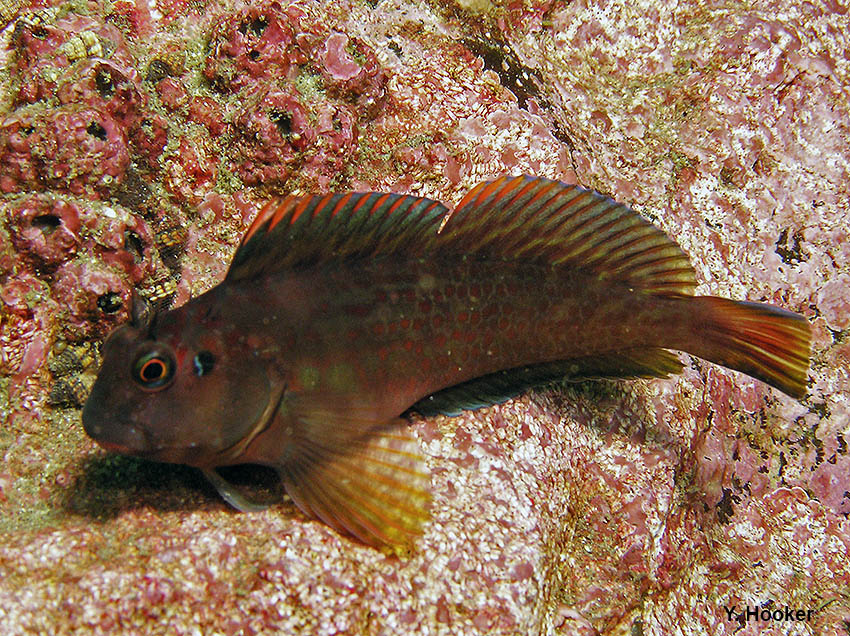
A 2021 genetic and morphological study sorts the members of the genus by two main traits: the number of incisor teeth and the colouration. Scartichthys gigas has fewer than 73 incisors and usually 17 rays in the dorsal fin [1]. Only two colour patterns matched that incisor count: a reticulated one and one with two bars and a covered head; reticulated specimens had a mean total length of 156 mm [1]. Across all fish in the study, of several species, total length ran from 50 to 246 mm, and adults of the genus can reach 300 mm [1]. Another source gives 251 mm as the species' maximum length and 13 cm as the size at maturity [4].
Uniform orange-brown juveniles, which used to be assigned to this species, are in fact juveniles of Scartichthys viridis [1]. The colour of a young fish therefore does not suffice to name it; the study's main criterion is counting the incisors and the dorsal-fin rays [1].
Similar species
Distribution and habitat
The species ranges from Panama (9° N) to Antofagasta in northern Chile (23° S) [1]. It overlaps with Scartichthys viridis only between about 14° S and 23° S [1]. From the Peruvian locality of San Juan de Marcona the study obtained colouration data only [1].
It is a shallow rocky-coast fish: the FishBase entry places it between 0 and 10 m depth [4]. The genetic study collected fish between 0 and 15 m [1].
Biology
It is oviparous and the eggs are laid in mollusc shells or on rocks; the larvae are planktonic and are often found in shallow coastal waters [4]. The same source gives plants, small molluscs and crustaceans as its food [4].
Fishes of the genus are known in English as drunk blennies [1]. In Lima, in a series of 72 fish from the Chorrillos fish terminal gathered between September 2008 and August 2009, fish size was correlated with the number of parasite species [2].
Ecology
Parasites are the best-documented part of its ecology in Peru. In the 72 fish from Chorrillos, 4 parasites were found: an isopod, a copepod, a digenean (Zoogonus rubellus) and a nematode; the copepod occurred in about 56 % of the fish and the digenean in about 26 % [2]. The sex of the fish was not related to parasite abundance or prevalence [2].
Another study examined 215 fish, 147 males and 68 females, from the Chorrillos fish terminal between June 2013 and March 2014 and found 6 species of helminths: 3 digeneans, 2 nematodes and the cystacanths of an acanthocephalan [5]. Three of them, 2 digeneans and 1 nematode, were new records for Peru [5].
Conservation
Health, toxicological and chemical relevance
Not medical advice. For a sting, a poisoning or an allergy, seek medical care.
FishBase states that a soup called borracho is made from the species, said to cause a mild intoxication and a short-lived tiredness [4]. The genetic study mentions a belief in effects from eating these fish and calls it unfounded [1].
Human relevance
Where to see it in Peru
The genetic study collected fish between 0 and 15 m depth and recorded the colouration of fish at San Juan de Marcona, in Peru [1].
References (5)
- Delrieu-Trottin, E., Hartmann-Salvo, H., Saenz-Agudelo, P. et al. (2021). DNA reconciles morphology and colouration in the drunk blenny genus Scartichthys (Teleostei: Blenniidae) and provides insights into their evolutionary history. bioRxiv. doi:10.1101/2021.02.22.432327 (accessed 2026-10-25)
- Iannacone, J., Sánchez, V., Olazábal, N. et al. (2012). INDICES ECOLÓGICOS DE LOS PARÁSITOS DE SCARTICHTHYS GIGAS (STEINDACHNER, 1876) (PERCIFORMES: BLENNIIDAE) DE LAS COSTAS DE LIMA, PERÚ. Neotropical Helminthology, 191-203. doi:10.24039/rnh2012621008 (accessed 2026-10-25)
- Bessudo, S., Dominici-Arosemena, A., Espinosa, H. et al. (2007). Scartichthys gigas: Bessudo, S., Dominici-Arosemena, A., Espinosa, H. & Hastings, P. The IUCN Red List of Threatened Species. doi:10.2305/iucn.uk.2010-3.rlts.t183275a8084978.en (accessed 2026-10-25)
- Froese, R., Pauly, D. (2026). Scartichthys gigas, Giant blenny. FishBase. https://fishbase.se/summary/Scartichthys-gigas.html (accessed 2026-10-25)
- Tarmeño, N., Severino, R., Sánchez, L. (2015). HELMINTOFAUNA DE SCARTICHTHYS GIGAS (STEINDACHNER, 1876) DE LA ZONA COSTERA DE CHORRILLOS, LIMA, PERÚ. Neotropical Helminthology, 285-300. doi:10.24039/rnh201592841 (accessed 2026-10-25)