
Bony fishes · Blenniidae
Giant blenny
Scartichthys gigas (Steindachner, 1876)
Spanish: Borracho
- Names in Peru
- Borracho · Borracho gigante
- Peruvian Register of Marine Species
- Listed in PeRMS (IMARPE)
Species account
Summary
Identification and similar species
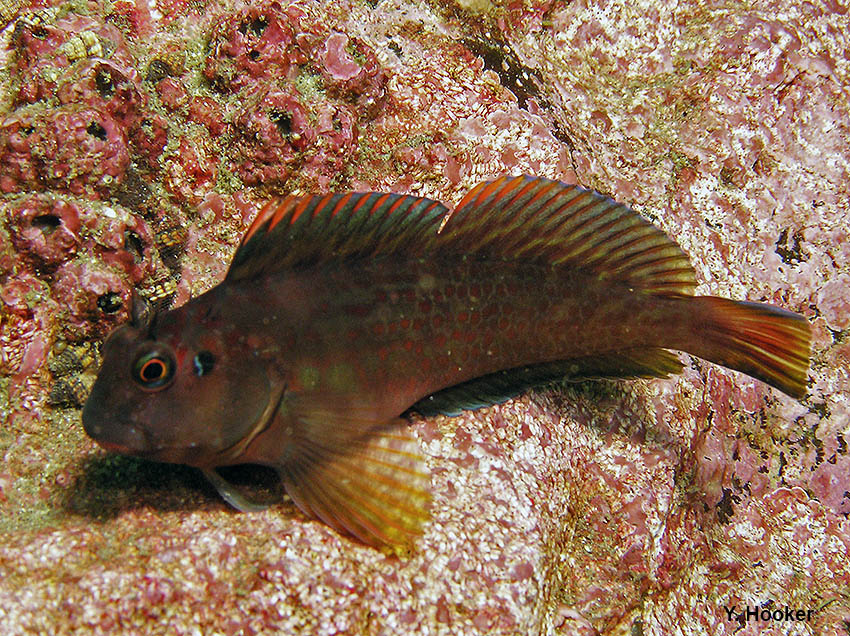
A 2021 genetic and morphological study sorts the members of the genus by two main traits: the number of incisor teeth and the colouration. Scartichthys gigas has fewer than 73 incisors and usually 17 rays in the dorsal fin [1]. Only two colour patterns matched that incisor count: a reticulated one and one with two bars and a covered head; reticulated specimens had a mean total length of 156 mm [1]. Across all fish in the study, of several species, total length ran from 50 to 246 mm, and adults of the genus can reach 300 mm [1]. Another source gives 251 mm as the species' maximum length and 13 cm as the size at maturity [4].
Uniform orange-brown juveniles, which used to be assigned to this species, are in fact juveniles of Scartichthys viridis [1]. The colour of a young fish therefore does not suffice to name it; the study's main criterion is counting the incisors and the dorsal-fin rays [1].
Similar species
Distribution and habitat
The species ranges from Panama (9° N) to Antofagasta in northern Chile (23° S) [1]. It overlaps with Scartichthys viridis only between about 14° S and 23° S [1]. From the Peruvian locality of San Juan de Marcona the study obtained colouration data only [1].
It is a shallow rocky-coast fish: the FishBase entry places it between 0 and 10 m depth [4]. The genetic study collected fish between 0 and 15 m [1].
Biology
It is oviparous and the eggs are laid in mollusc shells or on rocks; the larvae are planktonic and are often found in shallow coastal waters [4]. The same source gives plants, small molluscs and crustaceans as its food [4].
Fishes of the genus are known in English as drunk blennies [1]. In Lima, in a series of 72 fish from the Chorrillos fish terminal gathered between September 2008 and August 2009, fish size was correlated with the number of parasite species [2].
Ecology
Parasites are the best-documented part of its ecology in Peru. In the 72 fish from Chorrillos, 4 parasites were found: an isopod, a copepod, a digenean (Zoogonus rubellus) and a nematode; the copepod occurred in about 56 % of the fish and the digenean in about 26 % [2]. The sex of the fish was not related to parasite abundance or prevalence [2].
Another study examined 215 fish, 147 males and 68 females, from the Chorrillos fish terminal between June 2013 and March 2014 and found 6 species of helminths: 3 digeneans, 2 nematodes and the cystacanths of an acanthocephalan [5]. Three of them, 2 digeneans and 1 nematode, were new records for Peru [5].
Conservation
Health, toxicological and chemical relevance
Not medical advice. For a sting, a poisoning or an allergy, seek medical care.
FishBase states that a soup called borracho is made from the species, said to cause a mild intoxication and a short-lived tiredness [4]. The genetic study mentions a belief in effects from eating these fish and calls it unfounded [1].
Human relevance
Where to see it in Peru
The genetic study collected fish between 0 and 15 m depth and recorded the colouration of fish at San Juan de Marcona, in Peru [1].
References (5)
- Delrieu-Trottin, E., Hartmann-Salvo, H., Saenz-Agudelo, P. et al. (2021). DNA reconciles morphology and colouration in the drunk blenny genus Scartichthys (Teleostei: Blenniidae) and provides insights into their evolutionary history. bioRxiv. doi:10.1101/2021.02.22.432327 (accessed 2026-10-25)
- Iannacone, J., Sánchez, V., Olazábal, N. et al. (2012). INDICES ECOLÓGICOS DE LOS PARÁSITOS DE SCARTICHTHYS GIGAS (STEINDACHNER, 1876) (PERCIFORMES: BLENNIIDAE) DE LAS COSTAS DE LIMA, PERÚ. Neotropical Helminthology, 191-203. doi:10.24039/rnh2012621008 (accessed 2026-10-25)
- Bessudo, S., Dominici-Arosemena, A., Espinosa, H. et al. (2007). Scartichthys gigas: Bessudo, S., Dominici-Arosemena, A., Espinosa, H. & Hastings, P. The IUCN Red List of Threatened Species. doi:10.2305/iucn.uk.2010-3.rlts.t183275a8084978.en (accessed 2026-10-25)
- Froese, R., Pauly, D. (2026). Scartichthys gigas, Giant blenny. FishBase. https://fishbase.se/summary/Scartichthys-gigas.html (accessed 2026-10-25)
- Tarmeño, N., Severino, R., Sánchez, L. (2015). HELMINTOFAUNA DE SCARTICHTHYS GIGAS (STEINDACHNER, 1876) DE LA ZONA COSTERA DE CHORRILLOS, LIMA, PERÚ. Neotropical Helminthology, 285-300. doi:10.24039/rnh201592841 (accessed 2026-10-25)
More pictures
Where it has been recorded
- Filled: scientific records, or confirmed by a curator
- Hatched: isolated record
- Dotted outline: no scientific records and no curator's confirmation (an ORKA sighting is not drawn here)
- Tropical northern sea
Scientific records (3 records)
- Tropical–cold transition zone
Scientific records (3 records)
- Cold central sea
Scientific records (24 records)
- Cold southern sea
Scientific records (22 records)
From openly licensed OBIS and GBIF records (CC0 or CC BY). How each list is built.
Related species
From the same genus (Scartichthys) and from the same family (Blenniidae).
Scartichthys viridis
IUCN status: LC · Least ConcernBarnaclebill blenny
Hypsoblennius brevipinnis
IUCN status: LC · Least ConcernPeruvian Blenny
Hypsoblennius paytensis
IUCN status: LC · Least Concern
Slender Blenny
Parahypsos piersoni
IUCN status: LC · Least Concern
Tidepool Blenny
Hypsoblennius caulopus
IUCN status: DD · Data DeficientHypsoblennius robustus
IUCN status: LC · Least ConcernHypsoblennius sordidus
IUCN status: LC · Least Concern
Devilfish
Ophioblennius atlanticus
IUCN status: LC · Least Concern
Names and sources
In Spanish
- Borracho — Peru; fishbase; Wikidata · main name
- Borracho gigante — Peru; fishbase; Wikidata
In English
- Giant blenny — Wikidata
Classification
Learn more
Conservation status: Least Concern (IUCN Red List, according to Wikidata). Taxonomy: PeRMS / WoRMS (CC BY 4.0).