
Marine life guide of Peru · Porcellanidae
Petrolisthes violaceus
Petrolisthes violaceus (Guérin, 1829)
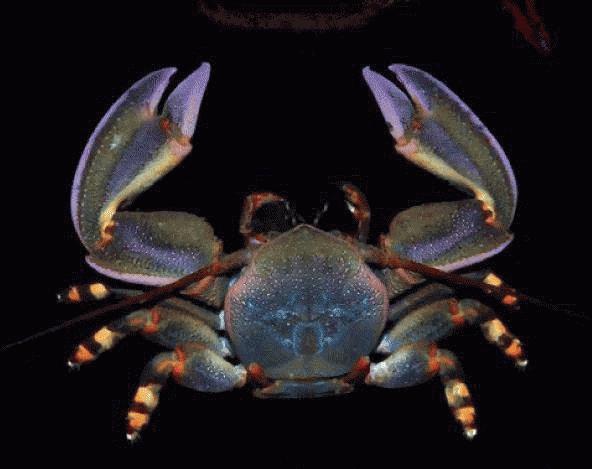
Species account
Summary
Petrolisthes violaceus is a porcelain crab of the family Porcellanidae [1]. It is an intertidal crustacean of the south-eastern Pacific: a 1997 paper gives its range from Bahía de Ancón, in Peru, to Taitao, in Aisén (Chile) [2]. It lives under rocks in the lower-middle part of the intertidal zone and in the shallow subtidal [3]. Its larval development has two zoeal stages and a megalopa [4]. Ovigerous females clean their brood with the fifth pair of legs [5].
Distribution and habitat
Pardo and colleagues, relying on a 1981 review, bound its range from Bahía de Ancón, in Peru, to Taitao, in Aisén, southern Chile [2]. Another paper describes it as a species of Chilean rocky shores that extends from northern Peru to Aisén [3]. The two texts do not agree on the exact northern limit, so in Peru that limit should be read as approximate. A population genomic analysis between 20.4° S and 41.8° S distinguished two genetic groups along that coast [6].
Its habitat is loose rock on the intertidal shore, under which it shelters, in the lower-middle zone and down to the shallow subtidal [3]. On a coast in southern Chile Petrolisthes violaceus peaked in numbers lower on the shore, while its congener Petrolisthes laevigatus peaked higher up [7].
Biology
Its larval development was described from larvae reared in the laboratory: the sequence runs prezoea, zoea I, zoea II, megalopa. At 19 °C and a salinity of 34, the megalopa was reached after 25.2 days on average [4].
The first zoea depends strongly on food. Larvae fed daily raised their dry weight by 94.7 %, whereas those kept unfed lost up to 18.9 %. With 1 to 3 days of food at the start they did not complete the moult, and those that did moult had grown by more than 55.4 % over their initial weight [2].
Ovigerous females actively tend their brood. The fifth pair of legs is small, bears a pincer and specialised bristles, and the female uses it to clean the embryos, mostly by day. Females whose fifth legs were experimentally removed had higher embryo mortality during incubation [5].
Ecology
Its position on the shore is linked to its physiology. Compared with Petrolisthes laevigatus, which occupies higher levels, Petrolisthes violaceus withstood drying in air and a lack of oxygen during long exposure better, but tolerated high temperatures less well [7]. The two species have a similar gill surface; Petrolisthes laevigatus, however, has a larger area of respiratory membranes on its legs, which, according to the authors, could give it an advantage in withstanding emersion [3].
The optimal performance temperature of seven populations, spread over about 3000 km of coast, declined toward higher latitudes, and high-latitude populations tolerated a wider thermal range. The authors conclude that low-latitude populations still have a margin against the warming projected for the end of this century [8].
Where to see it in Peru
The literature describes this species on rocky shores, under stones in the lower-middle intertidal zone and in the shallow subtidal, and places the northern end of its range in Peru, at Bahía de Ancón according to a 1981 review reported by a 1997 paper, or in northern Peru according to another. The texts consulted name no specific Peruvian observation sites and mention no access restrictions [2],[3].
References (8)
- WoRMS Editorial Board (2026). Petrolisthes violaceus (Guérin, 1829). World Register of Marine Species. https://www.marinespecies.org/aphia.php?p=taxdetails&id=431871 (accessed 2026-10-25)
- Pardo, L.M., Véliz, D., Wehrtmann, I.S. et al. (1997). Efecto de períodos de ayuno en el crecimiento de la zoea I de Petrolisthes violaceus (Guérin, 1831) (Decapoda: Anomura: Porcellanidae). Investigaciones Marinas. doi:10.4067/s0717-71781997002500018 (accessed 2026-10-25)
- Vargas, M.A., Lagos, M.E., Contreras, D.A. et al. (2010). Área de estructuras respiratorias y su efecto en la regulación del equilibrio ácido-base en dos especies de cangrejos porcelánidos intermareales, Petrolisthes laevigatus y Petrolisthes violaceus. Revista de Biología Marina y Oceanografía. doi:10.4067/s0718-19572010000200006 (accessed 2026-10-25)
- Véliz, D., Miguel Pardo, L., Wehrtmann, I.S. et al. (1997). The Larval Development of Petrolisthes Violaceus (Guérin, 1831) (Decapoda, Anomura, Porcellanidae) From Chilean Waters, Cultivated Under Laboratory Conditions. Crustaceana, 562-583. doi:10.1163/156854097x00681 (accessed 2026-10-25)
- Förster, C., Baeza, J.A. (2001). ACTIVE BROOD CARE IN THE ANOMURAN CRAB PETROLISTHES VIOLACEUS (DECAPODA: ANOMURA: PORCELLANIDAE): GROOMING OF BROODED EMBRYOS BY THE FIFTH PEREIOPODS. Journal of Crustacean Biology, 606-615. doi:10.1651/0278-0372(2001)021[0606:abcita]2.0.co;2 (accessed 2026-10-25)
- Soto, J., Rojas-Hernandez, N., Dewitte, B. et al. (2026). Population genomic analysis of Petrolisthes violaceus (Anomura:Porcellanidae) reveals two genetic groups along the Southeast Pacific coast (20.4°S–41.8°S). Regional Studies in Marine Science, 105146. doi:10.1016/j.rsma.2026.105146 (accessed 2026-10-25)
- Lagos, M.E., Muñoz, J.L., Contreras, D.A. et al. (2011). Microhabitat segregation and physiological differences in two species of intertidal porcellanid crabs (Genus Petrolisthes) on the southern coast of Chile. Scientia Marina, 273-278. doi:10.3989/scimar.2011.75n2273 (accessed 2026-10-25)
- Gaitán-Espitia, J.D., Bacigalupe, L.D., Opitz, T. et al. (2014). Geographic variation in thermal physiological performance of the intertidal crab Petrolisthes violaceus along a latitudinal gradient. Journal of Experimental Biology. doi:10.1242/jeb.108217 (accessed 2026-10-25)