
Crabs, lobsters and shrimps · Porcellanidae
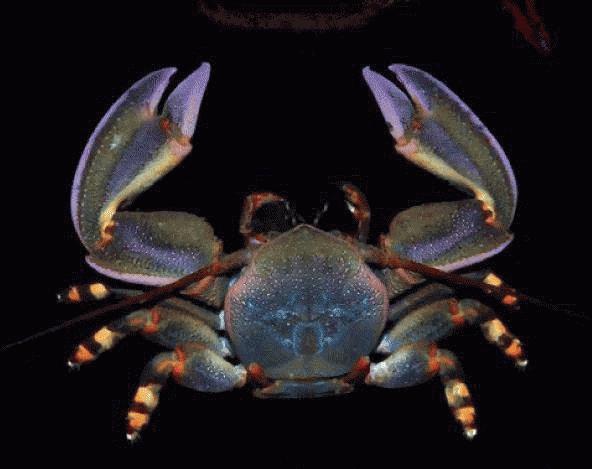
Petrolisthes violaceus
Petrolisthes violaceus (Guérin, 1829)
- Peruvian Register of Marine Species
- Listed in PeRMS (IMARPE)
Species account
Summary
Petrolisthes violaceus is a porcelain crab of the family Porcellanidae [1]. It is an intertidal crustacean of the south-eastern Pacific: a 1997 paper gives its range from Bahía de Ancón, in Peru, to Taitao, in Aisén (Chile) [2]. It lives under rocks in the lower-middle part of the intertidal zone and in the shallow subtidal [3]. Its larval development has two zoeal stages and a megalopa [4]. Ovigerous females clean their brood with the fifth pair of legs [5].
Distribution and habitat
Pardo and colleagues, relying on a 1981 review, bound its range from Bahía de Ancón, in Peru, to Taitao, in Aisén, southern Chile [2]. Another paper describes it as a species of Chilean rocky shores that extends from northern Peru to Aisén [3]. The two texts do not agree on the exact northern limit, so in Peru that limit should be read as approximate. A population genomic analysis between 20.4° S and 41.8° S distinguished two genetic groups along that coast [6].
Its habitat is loose rock on the intertidal shore, under which it shelters, in the lower-middle zone and down to the shallow subtidal [3]. On a coast in southern Chile Petrolisthes violaceus peaked in numbers lower on the shore, while its congener Petrolisthes laevigatus peaked higher up [7].
Biology
Its larval development was described from larvae reared in the laboratory: the sequence runs prezoea, zoea I, zoea II, megalopa. At 19 °C and a salinity of 34, the megalopa was reached after 25.2 days on average [4].
The first zoea depends strongly on food. Larvae fed daily raised their dry weight by 94.7 %, whereas those kept unfed lost up to 18.9 %. With 1 to 3 days of food at the start they did not complete the moult, and those that did moult had grown by more than 55.4 % over their initial weight [2].
Ovigerous females actively tend their brood. The fifth pair of legs is small, bears a pincer and specialised bristles, and the female uses it to clean the embryos, mostly by day. Females whose fifth legs were experimentally removed had higher embryo mortality during incubation [5].
Ecology
Its position on the shore is linked to its physiology. Compared with Petrolisthes laevigatus, which occupies higher levels, Petrolisthes violaceus withstood drying in air and a lack of oxygen during long exposure better, but tolerated high temperatures less well [7]. The two species have a similar gill surface; Petrolisthes laevigatus, however, has a larger area of respiratory membranes on its legs, which, according to the authors, could give it an advantage in withstanding emersion [3].
The optimal performance temperature of seven populations, spread over about 3000 km of coast, declined toward higher latitudes, and high-latitude populations tolerated a wider thermal range. The authors conclude that low-latitude populations still have a margin against the warming projected for the end of this century [8].
Where to see it in Peru
The literature describes this species on rocky shores, under stones in the lower-middle intertidal zone and in the shallow subtidal, and places the northern end of its range in Peru, at Bahía de Ancón according to a 1981 review reported by a 1997 paper, or in northern Peru according to another. The texts consulted name no specific Peruvian observation sites and mention no access restrictions [2],[3].
References (8)
- WoRMS Editorial Board (2026). Petrolisthes violaceus (Guérin, 1829). World Register of Marine Species. https://www.marinespecies.org/aphia.php?p=taxdetails&id=431871 (accessed 2026-10-25)
- Pardo, L.M., Véliz, D., Wehrtmann, I.S. et al. (1997). Efecto de períodos de ayuno en el crecimiento de la zoea I de Petrolisthes violaceus (Guérin, 1831) (Decapoda: Anomura: Porcellanidae). Investigaciones Marinas. doi:10.4067/s0717-71781997002500018 (accessed 2026-10-25)
- Vargas, M.A., Lagos, M.E., Contreras, D.A. et al. (2010). Área de estructuras respiratorias y su efecto en la regulación del equilibrio ácido-base en dos especies de cangrejos porcelánidos intermareales, Petrolisthes laevigatus y Petrolisthes violaceus. Revista de Biología Marina y Oceanografía. doi:10.4067/s0718-19572010000200006 (accessed 2026-10-25)
- Véliz, D., Miguel Pardo, L., Wehrtmann, I.S. et al. (1997). The Larval Development of Petrolisthes Violaceus (Guérin, 1831) (Decapoda, Anomura, Porcellanidae) From Chilean Waters, Cultivated Under Laboratory Conditions. Crustaceana, 562-583. doi:10.1163/156854097x00681 (accessed 2026-10-25)
- Förster, C., Baeza, J.A. (2001). ACTIVE BROOD CARE IN THE ANOMURAN CRAB PETROLISTHES VIOLACEUS (DECAPODA: ANOMURA: PORCELLANIDAE): GROOMING OF BROODED EMBRYOS BY THE FIFTH PEREIOPODS. Journal of Crustacean Biology, 606-615. doi:10.1651/0278-0372(2001)021[0606:abcita]2.0.co;2 (accessed 2026-10-25)
- Soto, J., Rojas-Hernandez, N., Dewitte, B. et al. (2026). Population genomic analysis of Petrolisthes violaceus (Anomura:Porcellanidae) reveals two genetic groups along the Southeast Pacific coast (20.4°S–41.8°S). Regional Studies in Marine Science, 105146. doi:10.1016/j.rsma.2026.105146 (accessed 2026-10-25)
- Lagos, M.E., Muñoz, J.L., Contreras, D.A. et al. (2011). Microhabitat segregation and physiological differences in two species of intertidal porcellanid crabs (Genus Petrolisthes) on the southern coast of Chile. Scientia Marina, 273-278. doi:10.3989/scimar.2011.75n2273 (accessed 2026-10-25)
- Gaitán-Espitia, J.D., Bacigalupe, L.D., Opitz, T. et al. (2014). Geographic variation in thermal physiological performance of the intertidal crab Petrolisthes violaceus along a latitudinal gradient. Journal of Experimental Biology. doi:10.1242/jeb.108217 (accessed 2026-10-25)
More pictures
Where it has been recorded
- Filled: scientific records, or confirmed by a curator
- Hatched: isolated record
- Dotted outline: no scientific records and no curator's confirmation (an ORKA sighting is not drawn here)
- Cold southern sea
Scientific records (4 records)
From openly licensed OBIS and GBIF records (CC0 or CC BY). How each list is built.
Related species
From the same genus (Petrolisthes).
Green porcelain crab
Petrolisthes armatus
IUCN status: Not evaluated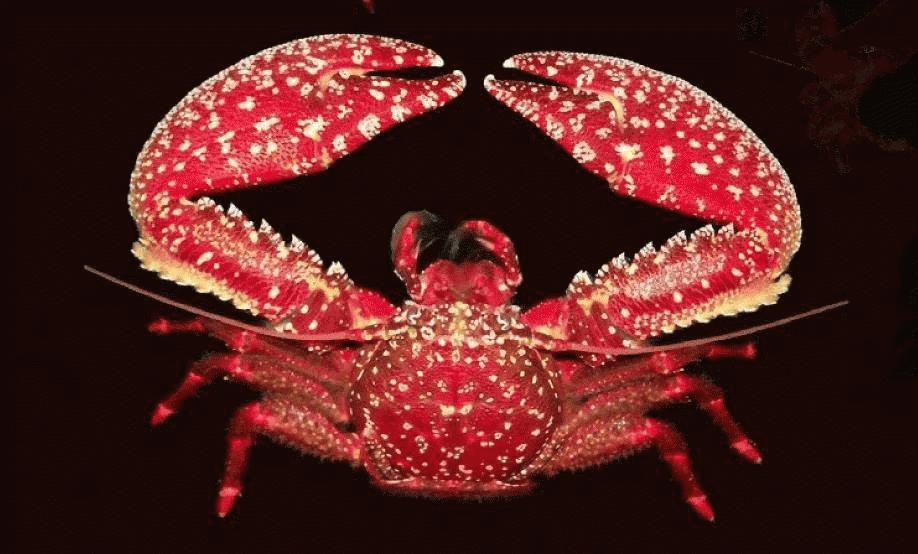
Petrolisthes desmarestii
IUCN status: Not evaluated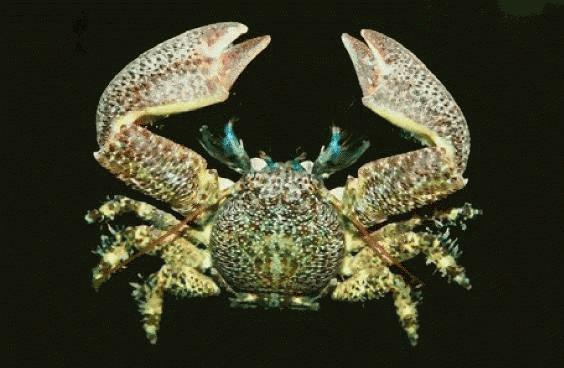
Petrolisthes granulosus
IUCN status: Not evaluatedPetrolisthes edwardsii
IUCN status: Not evaluated- No openly licensed image yet
Petrolisthes haigae
IUCN status: Not evaluated 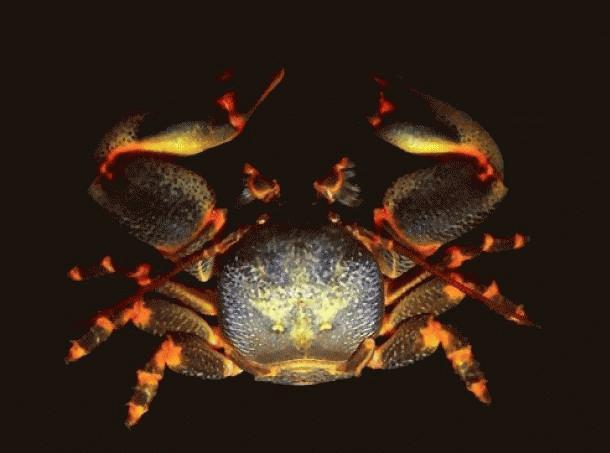
Petrolisthes laevigatus
IUCN status: Not evaluated- No openly licensed image yet
Petrolisthes lewisi
IUCN status: Not evaluated - No openly licensed image yet
Petrolisthes ortmanni
IUCN status: Not evaluated
Names and sources
Classification
Learn more
Conservation status: no data (IUCN). Taxonomy: PeRMS / WoRMS (CC BY 4.0).