
Marine life guide of Peru · Mobulidae
Sicklefin devil ray
Mobula tarapacana (Philippi, 1892)
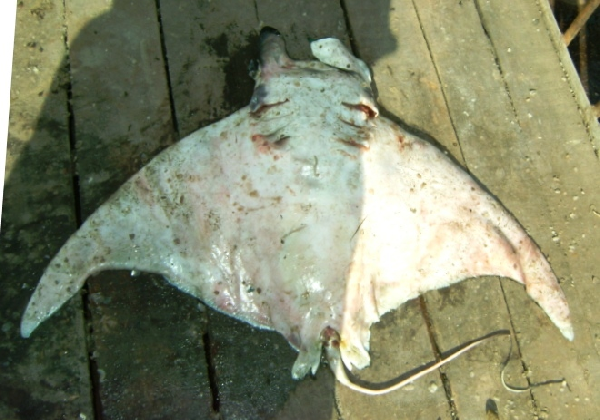
Species account
Summary
Mobula tarapacana is a devil ray of the family Mobulidae, in the order Myliobatiformes [1]. It is one of the five mobulid species recorded off Peru [2], and it appears in the checklist of Peruvian chondrichthyans under the English name Chilean devil ray [3]. It is an oceanic animal: individuals fitted with satellite transmitters in the central North Atlantic dived to almost 2000 m [4]. Its global category on the IUCN Red List is Critically Endangered [5].
Etymology
Philippi described it in 1892 as Cephaloptera tarapacana, and it is now accepted within the genus Mobula; WoRMS lists Mobula coilloti, from 1960, and Mobula formosana, from 1962, as later synonyms [1]. The checklist of Peruvian chondrichthyans gives its English name as Chilean devil ray, and a study at Isla del Coco, in Costa Rica, uses the same name [3],[6].
Identification and similar species
It is a large mobulid. In Sri Lankan landings, the rays measured had a disc width of 98 to 326 cm, with females between 132 and 326 cm and mature males between 212 and 314 cm, although those figures include pups [7]. In catches from the Bohol Sea, in the Philippines, the rays measured ranged from 179 to 279 cm [8].
It belongs to the group of large mobulids, which is recognised by a slit-shaped spiracle on the upper surface of the pectoral fins [9]. The filter plates of its gills have heart-shaped lobes covered in conical denticles, and the lobes of neighbouring plates can be joined by connective tissue [9].
Telling mobulids apart at a landing site is difficult: in Peru, the official IMARPE records attributed all catches to Mobula thurstoni until 2012, and misidentifications still bias the catch data [2].
Similar species
- Mobula mobular: Mobula mobular has smooth, rectangular lobes on its gill filter, whereas Mobula tarapacana has heart-shaped lobes covered in denticles; this is an internal feature that requires examining the gill arch [9].
- Mobula birostris: Mobula birostris is much larger, with females of 180 to 478 cm disc width in Sri Lanka, and its filter lobes are rectangular rather than heart-shaped [7],[9].
- Mobula thurstoni: Mobula thurstoni has the same kind of filter, with heart-shaped lobes and denticles, so that feature does not separate them; size helps, though with overlap: in Sri Lanka the females of Mobula thurstoni measured 72 to 168 cm disc width and those of Mobula tarapacana 132 to 326 cm [9],[7].
Distribution and habitat
The studies available on the species come from the central North Atlantic [4], the Indian Ocean [7], the Bohol Sea in the western Pacific [10] and the eastern tropical Pacific [6].
Off Peru it appears in the checklist of chondrichthyans, which relies on the catalogue of marine fishes by Chirichigno and Cornejo [3]. It is one of the five mobulid species recorded in the country, together with Mobula birostris, Mobula mobular, Mobula munkiana and Mobula thurstoni [2].
It is an open-sea species: the 15 individuals tagged in the Azores stayed in oceanic waters throughout the tracking, which lasted up to 9 months [4]. At Isla del Coco, between 2010 and 2019, this species and Mobula birostris, counted as a single group, were recorded in about 57 % of the dives of a submersible [6].
Biology
In Sri Lankan landings, 3 pups of this species were recorded, of 117, 132 and 149 cm disc width, and the smallest pregnant females measured 304 and 326 cm [7]. In the Bohol Sea, the females measured were between 195 and 242 cm and the males between 200 and 279 cm [10].
It is one of the deepest-diving marine animals: among the 15 individuals fitted with satellite transmitters in the Azores, those tagged in 2011 reached daily maximum depths of 1736 to 1896 m, in water of 3.6 to 4.4 °C, and descended at speeds of up to 6 m per second [4]. Earlier studies had concluded that the heat exchangers in the skull probably warm the species' brain [4].
Ecology
It is a filter feeder that also takes larger prey. In the Bohol Sea, the krill Euphausia diomedeae occurred in 18 of the 22 stomachs examined, and others held copepods, a squid and fish remains [10]. DNA analysis of the stomachs of 24 rays from the same sea detected 3 fish taxonomic units (OTUs) in this species, against 14 in Mobula birostris [8].
There were more deep dives by day (28) than at night (21), and the stepwise ascents are consistent with a search for fish or squid in dense layers at that depth; the authors caution that direct confirmation is needed [4].
Conservation
Its global category on the IUCN Red List is Critically Endangered [5].
All mobulids have been listed in Appendices I and II of the Convention on Migratory Species since 2014 and in Appendix II of CITES since 2016 [2]. In Peru, Mobula birostris has had special protection since 2016, which prohibits catching, retaining and selling it; in 2024 the Ministry of Production extended protection to all mobulids with a rule scheduled for January 2025, although fishing communities have voiced concern about their livelihoods and enforcement is uncertain [2].
Official statistics do not separate it: between 2000 and 2023 IMARPE reported about 7445 t of mobulids, and the species-level data name only Mobula mobular, Mobula munkiana and Mobula thurstoni, plus an unspecified group [2].
Outside Peru there are better figures. In Sri Lankan markets, annual landings of this species were estimated, with a model, at between 4867 individuals in 2019 and 13966 in 2013, and the mean width of landed rays fell by about 2.4 cm per year [7].
Human relevance
In Peru mobulids are retained mainly for their meat, fresh or dried, with no sign of a gill-plate trade, and in the Lambayeque region the meat is used in traditional cooking [2].
In Sri Lanka, where this species is the second most landed after Mobula mobular, its fresh meat was the most valued in the markets of Negombo and Chilaw [7].
Where to see it in Peru
In the Peruvian literature consulted the species appears only in the checklist of the Peruvian sea's chondrichthyans [3], and at the 6 ports of Tumbes and Piura where 257 mobulids were measured between April 2017 and February 2019 the species identified were Mobula mobular, Mobula thurstoni, Mobula munkiana and Mobula birostris [2].
References (10)
- Froese, R., Pauly, D. (2026). Mobula tarapacana (Philippi, 1892). World Register of Marine Species. https://www.marinespecies.org/aphia.php?p=taxdetails&id=105859 (accessed 2026-10-21)
- Rojas-Perea, S., D’Costa, N.G., Kanagusuku, K. et al. (2024). Fisheries, trade, and conservation of manta and devil rays in Peru. Environmental Biology of Fishes, 725-748. doi:10.1007/s10641-024-01647-7 (accessed 2026-10-21)
- Cornejo, R., Vélez-Zuazo, X., González-Pestana, A. et al. (2015). An updated checklist of Chondrichthyes from the southeast Pacific off Peru. Check List, 1809. doi:10.15560/11.6.1809 (accessed 2026-10-21)
- Thorrold, S.R., Afonso, P., Fontes, J. et al. (2014). Extreme diving behaviour in devil rays links surface waters and the deep ocean. Nature Communications, 4274. doi:10.1038/ncomms5274 (accessed 2026-10-21)
- Jabado, R.W., Marshall, A., Stevens, G. et al. (2025). Mobula tarapacana: Jabado, R.W., Marshall, A., Stevens, G., Laglbauer, B., Barros, N., D’Costa, N., Carter, R., De Bruyne, G., Doherty, P., Fernando, D., Metcalfe, K., Mvomo Minko, Y. & Rohner, C.A. The IUCN Red List of Threatened Species 2025: e.T60199A279077133. doi:10.2305/iucn.uk.2025-2.rlts.t60199a279077133.en (accessed 2026-10-21)
- Espinoza, M., Quesada-Perez, F., Madrigal-Mora, S. et al. (2024). A decade of submersible observations revealed temporal trends in elasmobranchs in a remote island of the Eastern Tropical Pacific Ocean. Scientific Reports, 13786. doi:10.1038/s41598-024-64157-7 (accessed 2026-10-21)
- Fernando, D., Stewart, J.D. (2021). High bycatch rates of manta and devil rays in the “small-scale” artisanal fisheries of Sri Lanka. PeerJ, e11994. doi:10.7717/peerj.11994 (accessed 2026-10-21)
- Bessey, C., Jarman, S.N., Stat, M. et al. (2019). DNA metabarcoding assays reveal a diverse prey assemblage for Mobula rays in the Bohol Sea, Philippines. Ecology and Evolution, 2459-2474. doi:10.1002/ece3.4858 (accessed 2026-10-21)
- Teeple, J.B., Kahane-Rapport, S.R., Cohen, K.E. et al. (2025). Form and Function in Mobulids: A Comparative Analysis of Filter Morphology With Bioinspiration Applications. Integrative And Comparative Biology, 1576-1600. doi:10.1093/icb/icaf142 (accessed 2026-10-21)
- Rohner, C.A., Burgess, K.B., Rambahiniarison, J.M. et al. (2017). Mobulid rays feed on euphausiids in the Bohol Sea. Royal Society Open Science, 161060. doi:10.1098/rsos.161060 (accessed 2026-10-21)