
Sharks, rays and chimaeras · Mobulidae
Sicklefin devil ray
Mobula tarapacana (Philippi, 1892)
Spanish: Manta cornuda
- Peruvian Register of Marine Species
- Listed in PeRMS (IMARPE)
Species account
Summary
Mobula tarapacana is a devil ray of the family Mobulidae, in the order Myliobatiformes [1]. It is one of the five mobulid species recorded off Peru [2], and it appears in the checklist of Peruvian chondrichthyans under the English name Chilean devil ray [3]. It is an oceanic animal: individuals fitted with satellite transmitters in the central North Atlantic dived to almost 2000 m [4]. Its global category on the IUCN Red List is Critically Endangered [5].
Etymology
Philippi described it in 1892 as Cephaloptera tarapacana, and it is now accepted within the genus Mobula; WoRMS lists Mobula coilloti, from 1960, and Mobula formosana, from 1962, as later synonyms [1]. The checklist of Peruvian chondrichthyans gives its English name as Chilean devil ray, and a study at Isla del Coco, in Costa Rica, uses the same name [3],[6].
Identification and similar species
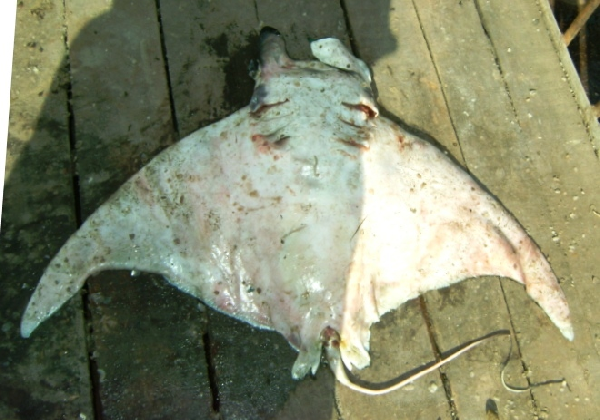
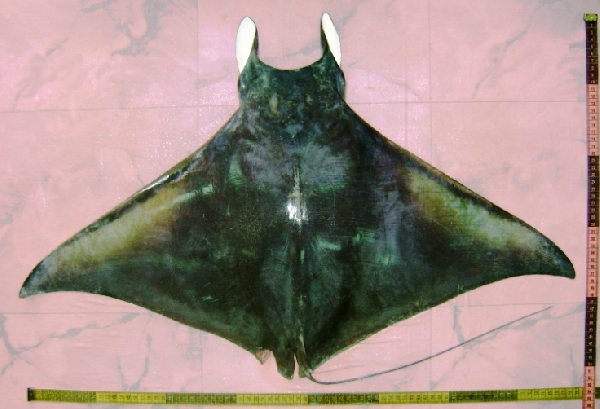
It is a large mobulid. In Sri Lankan landings, the rays measured had a disc width of 98 to 326 cm, with females between 132 and 326 cm and mature males between 212 and 314 cm, although those figures include pups [7]. In catches from the Bohol Sea, in the Philippines, the rays measured ranged from 179 to 279 cm [8].
It belongs to the group of large mobulids, which is recognised by a slit-shaped spiracle on the upper surface of the pectoral fins [9]. The filter plates of its gills have heart-shaped lobes covered in conical denticles, and the lobes of neighbouring plates can be joined by connective tissue [9].
Telling mobulids apart at a landing site is difficult: in Peru, the official IMARPE records attributed all catches to Mobula thurstoni until 2012, and misidentifications still bias the catch data [2].
Similar species
- Mobula mobular: Mobula mobular has smooth, rectangular lobes on its gill filter, whereas Mobula tarapacana has heart-shaped lobes covered in denticles; this is an internal feature that requires examining the gill arch [9].
- Mobula birostris: Mobula birostris is much larger, with females of 180 to 478 cm disc width in Sri Lanka, and its filter lobes are rectangular rather than heart-shaped [7],[9].
- Mobula thurstoni: Mobula thurstoni has the same kind of filter, with heart-shaped lobes and denticles, so that feature does not separate them; size helps, though with overlap: in Sri Lanka the females of Mobula thurstoni measured 72 to 168 cm disc width and those of Mobula tarapacana 132 to 326 cm [9],[7].
Distribution and habitat
The studies available on the species come from the central North Atlantic [4], the Indian Ocean [7], the Bohol Sea in the western Pacific [10] and the eastern tropical Pacific [6].
Off Peru it appears in the checklist of chondrichthyans, which relies on the catalogue of marine fishes by Chirichigno and Cornejo [3]. It is one of the five mobulid species recorded in the country, together with Mobula birostris, Mobula mobular, Mobula munkiana and Mobula thurstoni [2].
It is an open-sea species: the 15 individuals tagged in the Azores stayed in oceanic waters throughout the tracking, which lasted up to 9 months [4]. At Isla del Coco, between 2010 and 2019, this species and Mobula birostris, counted as a single group, were recorded in about 57 % of the dives of a submersible [6].
Biology
In Sri Lankan landings, 3 pups of this species were recorded, of 117, 132 and 149 cm disc width, and the smallest pregnant females measured 304 and 326 cm [7]. In the Bohol Sea, the females measured were between 195 and 242 cm and the males between 200 and 279 cm [10].
It is one of the deepest-diving marine animals: among the 15 individuals fitted with satellite transmitters in the Azores, those tagged in 2011 reached daily maximum depths of 1736 to 1896 m, in water of 3.6 to 4.4 °C, and descended at speeds of up to 6 m per second [4]. Earlier studies had concluded that the heat exchangers in the skull probably warm the species' brain [4].
Ecology
It is a filter feeder that also takes larger prey. In the Bohol Sea, the krill Euphausia diomedeae occurred in 18 of the 22 stomachs examined, and others held copepods, a squid and fish remains [10]. DNA analysis of the stomachs of 24 rays from the same sea detected 3 fish taxonomic units (OTUs) in this species, against 14 in Mobula birostris [8].
There were more deep dives by day (28) than at night (21), and the stepwise ascents are consistent with a search for fish or squid in dense layers at that depth; the authors caution that direct confirmation is needed [4].
Conservation
Its global category on the IUCN Red List is Critically Endangered [5].
All mobulids have been listed in Appendices I and II of the Convention on Migratory Species since 2014 and in Appendix II of CITES since 2016 [2]. In Peru, Mobula birostris has had special protection since 2016, which prohibits catching, retaining and selling it; in 2024 the Ministry of Production extended protection to all mobulids with a rule scheduled for January 2025, although fishing communities have voiced concern about their livelihoods and enforcement is uncertain [2].
Official statistics do not separate it: between 2000 and 2023 IMARPE reported about 7445 t of mobulids, and the species-level data name only Mobula mobular, Mobula munkiana and Mobula thurstoni, plus an unspecified group [2].
Outside Peru there are better figures. In Sri Lankan markets, annual landings of this species were estimated, with a model, at between 4867 individuals in 2019 and 13966 in 2013, and the mean width of landed rays fell by about 2.4 cm per year [7].
Human relevance
In Peru mobulids are retained mainly for their meat, fresh or dried, with no sign of a gill-plate trade, and in the Lambayeque region the meat is used in traditional cooking [2].
In Sri Lanka, where this species is the second most landed after Mobula mobular, its fresh meat was the most valued in the markets of Negombo and Chilaw [7].
Where to see it in Peru
In the Peruvian literature consulted the species appears only in the checklist of the Peruvian sea's chondrichthyans [3], and at the 6 ports of Tumbes and Piura where 257 mobulids were measured between April 2017 and February 2019 the species identified were Mobula mobular, Mobula thurstoni, Mobula munkiana and Mobula birostris [2].
References (10)
- Froese, R., Pauly, D. (2026). Mobula tarapacana (Philippi, 1892). World Register of Marine Species. https://www.marinespecies.org/aphia.php?p=taxdetails&id=105859 (accessed 2026-10-21)
- Rojas-Perea, S., D’Costa, N.G., Kanagusuku, K. et al. (2024). Fisheries, trade, and conservation of manta and devil rays in Peru. Environmental Biology of Fishes, 725-748. doi:10.1007/s10641-024-01647-7 (accessed 2026-10-21)
- Cornejo, R., Vélez-Zuazo, X., González-Pestana, A. et al. (2015). An updated checklist of Chondrichthyes from the southeast Pacific off Peru. Check List, 1809. doi:10.15560/11.6.1809 (accessed 2026-10-21)
- Thorrold, S.R., Afonso, P., Fontes, J. et al. (2014). Extreme diving behaviour in devil rays links surface waters and the deep ocean. Nature Communications, 4274. doi:10.1038/ncomms5274 (accessed 2026-10-21)
- Jabado, R.W., Marshall, A., Stevens, G. et al. (2025). Mobula tarapacana: Jabado, R.W., Marshall, A., Stevens, G., Laglbauer, B., Barros, N., D’Costa, N., Carter, R., De Bruyne, G., Doherty, P., Fernando, D., Metcalfe, K., Mvomo Minko, Y. & Rohner, C.A. The IUCN Red List of Threatened Species 2025: e.T60199A279077133. doi:10.2305/iucn.uk.2025-2.rlts.t60199a279077133.en (accessed 2026-10-21)
- Espinoza, M., Quesada-Perez, F., Madrigal-Mora, S. et al. (2024). A decade of submersible observations revealed temporal trends in elasmobranchs in a remote island of the Eastern Tropical Pacific Ocean. Scientific Reports, 13786. doi:10.1038/s41598-024-64157-7 (accessed 2026-10-21)
- Fernando, D., Stewart, J.D. (2021). High bycatch rates of manta and devil rays in the “small-scale” artisanal fisheries of Sri Lanka. PeerJ, e11994. doi:10.7717/peerj.11994 (accessed 2026-10-21)
- Bessey, C., Jarman, S.N., Stat, M. et al. (2019). DNA metabarcoding assays reveal a diverse prey assemblage for Mobula rays in the Bohol Sea, Philippines. Ecology and Evolution, 2459-2474. doi:10.1002/ece3.4858 (accessed 2026-10-21)
- Teeple, J.B., Kahane-Rapport, S.R., Cohen, K.E. et al. (2025). Form and Function in Mobulids: A Comparative Analysis of Filter Morphology With Bioinspiration Applications. Integrative And Comparative Biology, 1576-1600. doi:10.1093/icb/icaf142 (accessed 2026-10-21)
- Rohner, C.A., Burgess, K.B., Rambahiniarison, J.M. et al. (2017). Mobulid rays feed on euphausiids in the Bohol Sea. Royal Society Open Science, 161060. doi:10.1098/rsos.161060 (accessed 2026-10-21)
More pictures
If you come across it
Protected or threatened species. Watch it without touching, feeding, chasing or taking it, and keep the recommended viewing distances.
Related species
From the same genus (Mobula).

Names and sources
In Spanish
- Manta cornuda — WoRMS; Wikidata · main name
- Diabolo Gigante De Guinea — Wikidata
- Manta Cornuada — Wikidata
- Manta Raya — Wikidata
- Raya Cornuda — Wikidata
- Vaquetilla — Wikidata
In English
- Sicklefin devil ray — WoRMS; Wikidata
- Box Ray — Wikidata
- Chilean Devil Ray — Wikidata
- Devil Ray — Wikidata
- Greater Guinean Mobula — Wikidata
- Spiny Mobula — Wikidata
Classification
Learn more
Conservation status: Critically Endangered (IUCN Red List, according to Wikidata). Taxonomy: PeRMS / WoRMS (CC BY 4.0).