
Marine life guide of Peru · Stichopodidae
Brown Sea Cucumber
Isostichopus fuscus (Ludwig, 1875)
- Names in Peru
- Pepino de mar de Galápagos · Pepino de Galápagos
Species account
Summary
Isostichopus fuscus is a sea cucumber of the family Stichopodidae, described by Ludwig in 1875 under the name Stichopus fuscus [1]. In Peru it is called «pepino de mar de Galápagos» [2] or «pepino de Galápagos» [2], and it is the most commercially valuable holothurian of the tropical eastern Pacific [2]. Overfishing to supply Asian markets made its populations collapse, and in Peru it has almost disappeared [2].
Identification and similar species
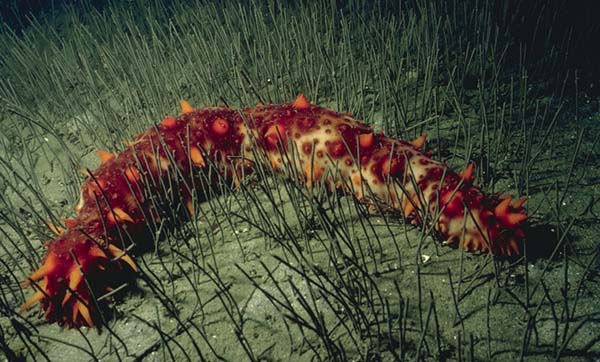
Its body is almost cylindrical, arched on the back and flat underneath [3]. The back is dark brown and carries many sturdy, pointed yellow papillae scattered without forming rows; the underside is a lighter brown, with the tube feet grouped in dense bands [3]. The mouth sits on the underside, ringed by 20 yellow tentacles, and the anus, at the rear end, lacks teeth [3]. Under the microscope, the body wall holds table-shaped ossicles and C-shaped curved rods, but no rosettes [3].
Fresh, it weighs on average between 294 g in Ecuador and 497 g in Mexico, and its mean length runs from 20 cm in Ecuador to 24 cm in Mexico; once dried it turns greyish black and is usually 6 to 10 cm long [3]. In the northern Gulf of California, 2808 specimens averaged 21.4 cm, with a maximum of 41 cm and up to 1200 g in weight [4].
Distribution and habitat
FAO's regional review places it from Baja California to mainland Ecuador, with the Galápagos, Socorro, Cocos and Revillagigedo islands, and notes that a 2005 study included Peru in its range, at the Lobos de Afuera Islands [5]. It occupies the coastal belt, from the shallow subtidal down to 39 m depth [5], although a 2017 article states that it reaches 61 m [4].
In the Galápagos it prefers rocky bottoms where the seaweed Ulva predominates [6], and in Baja California it usually lives on coral and rocky bottoms [5]. Occasionally it also turns up on sand or soft bottoms [4].
Biology
The sexes are separate, and males and females cannot be told apart by their appearance [6]. In the Galápagos it breeds all year round, regardless of water temperature, and in captivity it follows a lunar rhythm: it spawns between 1 and 4 days after the new moon, usually at night [6]. There it matures at 161 to 170.9 g drained wet weight; its larva feeds on plankton and, reared in the laboratory, settled between 22 and 27 days and reached 35 mm at 72 days [6].
In the northern Gulf of California, the northern edge of its range, the cycle is seasonal: gonads develop mainly from April to July, as the water warms, and spawning runs from June to November, peaking in August and September [4]. Of 553 gonads examined, 224 were female, 162 male, 157 undifferentiated and 10 hermaphrodite; the smallest reproductively active specimen measured 16 cm, and half of the population was sexually active at around 25 cm [4].
There are no growth estimates for the Galápagos; a preliminary calculation gave an asymptotic length of 36.118 cm and a growth coefficient K of 0.180 per year, and a later one obtained similar values, 29.108 cm and 0.243 [6]. At Bahías de Huatulco, in Mexico's southern Pacific, the von Bertalanffy equation gave an asymptotic length of 38.7 cm and a K of 0.4 [7]. The assembly of its genome, built from one specimen from Wolf Island, in the Galápagos, spans 898.4 megabases and has 23 chromosomes [8].
Ecology
It is more active at night [5]. At Coronado Island, in Loreto Bay (Gulf of California), 70 transects of 100 m² surveyed by day and again by night in October 2008 gave an average of 1.943 animals per transect by day and 3.714 by night: by day it hides in crevices such as holes in the rock or coral bases, and at night it comes out to feed in open areas [9].
Its recruitment is irregular: in the Bolívar Channel, in the Galápagos, the indices stayed low between 1994 and mid-1999, the point at which a massive wave of juveniles arrived whose density reached its maximum in 2001 [10]. FAO's review links that pulse, probably, to the 1997-1998 El Niño, which favoured breeding, and to the productive La Niña that followed, which helped the juveniles grow [6].
At 3 sites in Bahías de Huatulco the mean density was 0.018 individuals per square metre, too low to sustain a fishery at any of them [7].
Conservation
In October 2003 it was added to CITES Appendix III [6], at Ecuador's request [3], making it the first sea cucumber to appear in an appendix of that convention [6]. In mainland Ecuador fishing for it is banned outright; in the Galápagos it is managed with a total allowable catch, a minimum size of 20 cm fresh, no-take zones and a 2-month season [3].
In the Galápagos the fishery began in 1991, once it had been exhausted on the mainland; it was closed in 1992 and, when it reopened in 1994, the quota of 500000 individuals was overrun with catches of between 8 and 12 million [6]. A 1993 survey in eastern Fernandina gave 6.24 individuals per square metre, whereas in the Bolívar Channel densities from 1999 to 2007 ranged from 0.03 to 1.03 [6].
In Mexico it was fished heavily from 1988 to 1993; in 1994 fishing for it was banned outright, in 2002 it was allowed again subject to stock assessments, and in 2017 the species was listed under special protection [4].
In Peru the fishery began in the late 1980s and, once the species was depleted, the effort moved to other holothurians [5]; according to the 2008 FAO review, the country had no management measures for that fishery [5]. The management plan of the Mar Tropical de Grau National Reserve lists it among the highly threatened rocky-reef species [2] and prohibits taking it in the Arrecifes de Punta Sal [2], Cabo Blanco – El Ñuro [2] and Isla Foca sectors [2].
Health, toxicological and chemical relevance
Not medical advice. For a sting, a poisoning or an allergy, seek medical care.
Protein-degrading enzymes extracted from its tentacles and partly purified were used to digest proteins from its own body wall; of the peptide fractions obtained, the most antioxidant came from the crude protein hydrolysate, at 0.92 µmol Trolox equivalents per mg of protein [11]. The authors see those peptides as possible ingredients for functional foods [11].
Human relevance
It is caught by hookah diving in semi-industrial fisheries; its rehydrated body wall is eaten in Asia, and its main markets are Hong Kong and the United States [3]. In China it is prized because its texture and flavour resemble those of Apostichopus japonicus, the favourite species there [6].
According to the CITES permits for the Galápagos catch, China received 98.5 % of exports in 2004 and 95.9 % in 2005, and Peru, through Lima, imported 36227 and 49494 animals in those years [6]. Part of the illegal catch from the Galápagos may be landed in mainland Ecuador, travel overland to Peru and be exported as a Peruvian product [6].
Its reproductive cycle has been completed in captivity and it has been reared in abandoned shrimp ponds in mainland Ecuador, which has stirred interest in restocking the Galápagos [6].
Where to see it in Peru
The 2026 management plan of the Mar Tropical de Grau National Reserve, drawing on a 2011 study, states that the species has almost disappeared in Peru and is recorded only rarely [2]. A FAO review notes that a 2005 study included the Lobos de Afuera Islands in its range [5]. In the reserve's Isla Foca sector, as in two other sectors, taking it is prohibited [2].
References (11)
- WoRMS Editorial Board (2026). Isostichopus fuscus (Ludwig, 1875). World Register of Marine Species. https://www.marinespecies.org/aphia.php?p=taxdetails&id=529516 (accessed 2026-10-20)
- Servicio Nacional de Áreas Naturales Protegidas por el Estado (2026). Plan Maestro de la Reserva Nacional Mar Tropical de Grau 2026–2031. Anexo de la Resolución de Presidencia Ejecutiva N.° 000052-2026-SERNANP/PE. https://cdn.www.gob.pe/uploads/document/file/9468842/7752998-5-pm_2026-2031_rnmtg-f-f-f-f.pdf (accessed 2026-10-20)
- Purcell, S.W., Samyn, Y., Conand, C. (2012). Commercially important sea cucumbers of the world. FAO Species Catalogue for Fishery Purposes No. 6. FAO, Rome, 96-97. https://www.fao.org/4/i1918e/i1918e00.htm (accessed 2026-10-20)
- Pañola-Madrigal, A., Calderon-Aguilera, L.E., Aguilar-Cruz, C.A. et al. (2017). Reproductive cycle of the sea cucumber (Isostichopus fuscus) and its relationship with oceanographic variables at its northernmost distribution site. Revista de Biología Tropical, S180-S196. doi:10.15517/rbt.v65i1-1.31687 (accessed 2026-10-20)
- Toral-Granda, V. (2008). Population status, fisheries and trade of sea cucumbers in Latin America and the Caribbean. In: Toral-Granda, V., Lovatelli, A. and Vasconcellos, M. (eds.), Sea cucumbers. A global review of fisheries and trade. FAO Fisheries and Aquaculture Technical Paper No. 516. FAO, Rome, 213-229. https://www.fao.org/4/i0375e/i0375e00.htm (accessed 2026-10-20)
- Toral-Granda, V. (2008). Galapagos Islands: a hotspot of sea cucumber fisheries in Latin America and the Caribbean. In: Toral-Granda, V., Lovatelli, A. and Vasconcellos, M. (eds.), Sea cucumbers. A global review of fisheries and trade. FAO Fisheries and Aquaculture Technical Paper No. 516. FAO, Rome, 231-253. https://www.fao.org/4/i0375e/i0375e00.htm (accessed 2026-10-20)
- Glockner-Fagetti, A., Benítez-Villalobos, F. (2016). Spatio-temporal variation in density and size structure of the endangered sea cucumber Isostichopus fuscus in Huatulco National Park, Mexico. Marine Ecology. doi:10.1111/maec.12386 (accessed 2026-10-20)
- Ortiz-Pachar, J.D., Ramírez-González, J., Moity, N. et al. (2025). A chromosome-level genome assembly for the brown sea cucumber from the Galápagos Islands, Isostichopus fuscus. Scientific Data. doi:10.1038/s41597-025-06422-6 (accessed 2026-10-20)
- Reyes-Bonilla, H., Ramírez-Ortiz, G., Herrero-Pérezrul, M.D. et al. (2016). Subestimación de la abundancia del pepino café Isostichopus fuscus (Holothuroidea: Echinodermata) en muestreos diurnos con respecto a nocturnos en el golfo de California. Revista Mexicana de Biodiversidad, 519-522. doi:10.1016/j.rmb.2016.05.004 (accessed 2026-10-20)
- Hearn, A., Martínez, P., Toral-Granda, M.V. et al. (2005). Population dynamics of the exploited sea cucumber Isostichopus fuscus in the western Galápagos Islands, Ecuador. Fisheries Oceanography, 377-385. doi:10.1111/j.1365-2419.2005.00342.x (accessed 2026-10-20)
- Hernández-Sámano, A.C., Hernández-Ledesma, B. (2015). Release of Antioxidant Peptides from the Body Wall Proteins of the Sea Cucumber Isostichopus fuscus. Natural Product Communications, 1427-1430. doi:10.1177/1934578x1501000829 (accessed 2026-10-20)