
Sea stars, urchins and sea cucumbers · Stichopodidae
Brown Sea Cucumber
Isostichopus fuscus (Ludwig, 1875)
Spanish: Pepino de mar de Galápagos
- Names in Peru
- Pepino de mar de Galápagos · Pepino de Galápagos
- Peruvian Register of Marine Species
- Listed in PeRMS (IMARPE)
Species account
Summary
Isostichopus fuscus is a sea cucumber of the family Stichopodidae, described by Ludwig in 1875 under the name Stichopus fuscus [1]. In Peru it is called «pepino de mar de Galápagos» [2] or «pepino de Galápagos» [2], and it is the most commercially valuable holothurian of the tropical eastern Pacific [2]. Overfishing to supply Asian markets made its populations collapse, and in Peru it has almost disappeared [2].
Identification and similar species
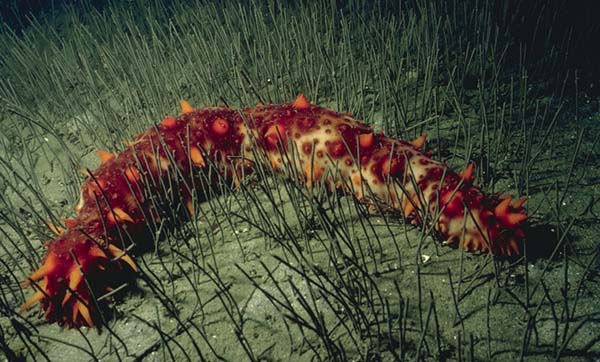
Its body is almost cylindrical, arched on the back and flat underneath [3]. The back is dark brown and carries many sturdy, pointed yellow papillae scattered without forming rows; the underside is a lighter brown, with the tube feet grouped in dense bands [3]. The mouth sits on the underside, ringed by 20 yellow tentacles, and the anus, at the rear end, lacks teeth [3]. Under the microscope, the body wall holds table-shaped ossicles and C-shaped curved rods, but no rosettes [3].
Fresh, it weighs on average between 294 g in Ecuador and 497 g in Mexico, and its mean length runs from 20 cm in Ecuador to 24 cm in Mexico; once dried it turns greyish black and is usually 6 to 10 cm long [3]. In the northern Gulf of California, 2808 specimens averaged 21.4 cm, with a maximum of 41 cm and up to 1200 g in weight [4].
Distribution and habitat
FAO's regional review places it from Baja California to mainland Ecuador, with the Galápagos, Socorro, Cocos and Revillagigedo islands, and notes that a 2005 study included Peru in its range, at the Lobos de Afuera Islands [5]. It occupies the coastal belt, from the shallow subtidal down to 39 m depth [5], although a 2017 article states that it reaches 61 m [4].
In the Galápagos it prefers rocky bottoms where the seaweed Ulva predominates [6], and in Baja California it usually lives on coral and rocky bottoms [5]. Occasionally it also turns up on sand or soft bottoms [4].
Biology
The sexes are separate, and males and females cannot be told apart by their appearance [6]. In the Galápagos it breeds all year round, regardless of water temperature, and in captivity it follows a lunar rhythm: it spawns between 1 and 4 days after the new moon, usually at night [6]. There it matures at 161 to 170.9 g drained wet weight; its larva feeds on plankton and, reared in the laboratory, settled between 22 and 27 days and reached 35 mm at 72 days [6].
In the northern Gulf of California, the northern edge of its range, the cycle is seasonal: gonads develop mainly from April to July, as the water warms, and spawning runs from June to November, peaking in August and September [4]. Of 553 gonads examined, 224 were female, 162 male, 157 undifferentiated and 10 hermaphrodite; the smallest reproductively active specimen measured 16 cm, and half of the population was sexually active at around 25 cm [4].
There are no growth estimates for the Galápagos; a preliminary calculation gave an asymptotic length of 36.118 cm and a growth coefficient K of 0.180 per year, and a later one obtained similar values, 29.108 cm and 0.243 [6]. At Bahías de Huatulco, in Mexico's southern Pacific, the von Bertalanffy equation gave an asymptotic length of 38.7 cm and a K of 0.4 [7]. The assembly of its genome, built from one specimen from Wolf Island, in the Galápagos, spans 898.4 megabases and has 23 chromosomes [8].
Ecology
It is more active at night [5]. At Coronado Island, in Loreto Bay (Gulf of California), 70 transects of 100 m² surveyed by day and again by night in October 2008 gave an average of 1.943 animals per transect by day and 3.714 by night: by day it hides in crevices such as holes in the rock or coral bases, and at night it comes out to feed in open areas [9].
Its recruitment is irregular: in the Bolívar Channel, in the Galápagos, the indices stayed low between 1994 and mid-1999, the point at which a massive wave of juveniles arrived whose density reached its maximum in 2001 [10]. FAO's review links that pulse, probably, to the 1997-1998 El Niño, which favoured breeding, and to the productive La Niña that followed, which helped the juveniles grow [6].
At 3 sites in Bahías de Huatulco the mean density was 0.018 individuals per square metre, too low to sustain a fishery at any of them [7].
Conservation
In October 2003 it was added to CITES Appendix III [6], at Ecuador's request [3], making it the first sea cucumber to appear in an appendix of that convention [6]. In mainland Ecuador fishing for it is banned outright; in the Galápagos it is managed with a total allowable catch, a minimum size of 20 cm fresh, no-take zones and a 2-month season [3].
In the Galápagos the fishery began in 1991, once it had been exhausted on the mainland; it was closed in 1992 and, when it reopened in 1994, the quota of 500000 individuals was overrun with catches of between 8 and 12 million [6]. A 1993 survey in eastern Fernandina gave 6.24 individuals per square metre, whereas in the Bolívar Channel densities from 1999 to 2007 ranged from 0.03 to 1.03 [6].
In Mexico it was fished heavily from 1988 to 1993; in 1994 fishing for it was banned outright, in 2002 it was allowed again subject to stock assessments, and in 2017 the species was listed under special protection [4].
In Peru the fishery began in the late 1980s and, once the species was depleted, the effort moved to other holothurians [5]; according to the 2008 FAO review, the country had no management measures for that fishery [5]. The management plan of the Mar Tropical de Grau National Reserve lists it among the highly threatened rocky-reef species [2] and prohibits taking it in the Arrecifes de Punta Sal [2], Cabo Blanco – El Ñuro [2] and Isla Foca sectors [2].
Health, toxicological and chemical relevance
Not medical advice. For a sting, a poisoning or an allergy, seek medical care.
Protein-degrading enzymes extracted from its tentacles and partly purified were used to digest proteins from its own body wall; of the peptide fractions obtained, the most antioxidant came from the crude protein hydrolysate, at 0.92 µmol Trolox equivalents per mg of protein [11]. The authors see those peptides as possible ingredients for functional foods [11].
Human relevance
It is caught by hookah diving in semi-industrial fisheries; its rehydrated body wall is eaten in Asia, and its main markets are Hong Kong and the United States [3]. In China it is prized because its texture and flavour resemble those of Apostichopus japonicus, the favourite species there [6].
According to the CITES permits for the Galápagos catch, China received 98.5 % of exports in 2004 and 95.9 % in 2005, and Peru, through Lima, imported 36227 and 49494 animals in those years [6]. Part of the illegal catch from the Galápagos may be landed in mainland Ecuador, travel overland to Peru and be exported as a Peruvian product [6].
Its reproductive cycle has been completed in captivity and it has been reared in abandoned shrimp ponds in mainland Ecuador, which has stirred interest in restocking the Galápagos [6].
Where to see it in Peru
The 2026 management plan of the Mar Tropical de Grau National Reserve, drawing on a 2011 study, states that the species has almost disappeared in Peru and is recorded only rarely [2]. A FAO review notes that a 2005 study included the Lobos de Afuera Islands in its range [5]. In the reserve's Isla Foca sector, as in two other sectors, taking it is prohibited [2].
References (11)
- WoRMS Editorial Board (2026). Isostichopus fuscus (Ludwig, 1875). World Register of Marine Species. https://www.marinespecies.org/aphia.php?p=taxdetails&id=529516 (accessed 2026-10-20)
- Servicio Nacional de Áreas Naturales Protegidas por el Estado (2026). Plan Maestro de la Reserva Nacional Mar Tropical de Grau 2026–2031. Anexo de la Resolución de Presidencia Ejecutiva N.° 000052-2026-SERNANP/PE. https://cdn.www.gob.pe/uploads/document/file/9468842/7752998-5-pm_2026-2031_rnmtg-f-f-f-f.pdf (accessed 2026-10-20)
- Purcell, S.W., Samyn, Y., Conand, C. (2012). Commercially important sea cucumbers of the world. FAO Species Catalogue for Fishery Purposes No. 6. FAO, Rome, 96-97. https://www.fao.org/4/i1918e/i1918e00.htm (accessed 2026-10-20)
- Pañola-Madrigal, A., Calderon-Aguilera, L.E., Aguilar-Cruz, C.A. et al. (2017). Reproductive cycle of the sea cucumber (Isostichopus fuscus) and its relationship with oceanographic variables at its northernmost distribution site. Revista de Biología Tropical, S180-S196. doi:10.15517/rbt.v65i1-1.31687 (accessed 2026-10-20)
- Toral-Granda, V. (2008). Population status, fisheries and trade of sea cucumbers in Latin America and the Caribbean. In: Toral-Granda, V., Lovatelli, A. and Vasconcellos, M. (eds.), Sea cucumbers. A global review of fisheries and trade. FAO Fisheries and Aquaculture Technical Paper No. 516. FAO, Rome, 213-229. https://www.fao.org/4/i0375e/i0375e00.htm (accessed 2026-10-20)
- Toral-Granda, V. (2008). Galapagos Islands: a hotspot of sea cucumber fisheries in Latin America and the Caribbean. In: Toral-Granda, V., Lovatelli, A. and Vasconcellos, M. (eds.), Sea cucumbers. A global review of fisheries and trade. FAO Fisheries and Aquaculture Technical Paper No. 516. FAO, Rome, 231-253. https://www.fao.org/4/i0375e/i0375e00.htm (accessed 2026-10-20)
- Glockner-Fagetti, A., Benítez-Villalobos, F. (2016). Spatio-temporal variation in density and size structure of the endangered sea cucumber Isostichopus fuscus in Huatulco National Park, Mexico. Marine Ecology. doi:10.1111/maec.12386 (accessed 2026-10-20)
- Ortiz-Pachar, J.D., Ramírez-González, J., Moity, N. et al. (2025). A chromosome-level genome assembly for the brown sea cucumber from the Galápagos Islands, Isostichopus fuscus. Scientific Data. doi:10.1038/s41597-025-06422-6 (accessed 2026-10-20)
- Reyes-Bonilla, H., Ramírez-Ortiz, G., Herrero-Pérezrul, M.D. et al. (2016). Subestimación de la abundancia del pepino café Isostichopus fuscus (Holothuroidea: Echinodermata) en muestreos diurnos con respecto a nocturnos en el golfo de California. Revista Mexicana de Biodiversidad, 519-522. doi:10.1016/j.rmb.2016.05.004 (accessed 2026-10-20)
- Hearn, A., Martínez, P., Toral-Granda, M.V. et al. (2005). Population dynamics of the exploited sea cucumber Isostichopus fuscus in the western Galápagos Islands, Ecuador. Fisheries Oceanography, 377-385. doi:10.1111/j.1365-2419.2005.00342.x (accessed 2026-10-20)
- Hernández-Sámano, A.C., Hernández-Ledesma, B. (2015). Release of Antioxidant Peptides from the Body Wall Proteins of the Sea Cucumber Isostichopus fuscus. Natural Product Communications, 1427-1430. doi:10.1177/1934578x1501000829 (accessed 2026-10-20)
More pictures
If you come across it
Protected or threatened species. Watch it without touching, feeding, chasing or taking it, and keep the recommended viewing distances.extraction prohibited in the sector — SERNANP (2026). Plan Maestro de la Reserva Nacional Mar Tropical de Grau 2026–2031. RPE N.° 000052-2026-SERNANP, p. 128 of the PDF
Where it has been recorded
- Filled: scientific records, or confirmed by a curator
- Hatched: isolated record
- Dotted outline: no scientific records and no curator's confirmation (an ORKA sighting is not drawn here)
- Cold central sea
Isolated record (1 record)
From openly licensed OBIS and GBIF records (CC0 or CC BY). How each list is built.
Related species
From the same family.
Names and sources
In Spanish
- Pepino de mar de Galápagos — Peru; SERNANP (2026). Plan Maestro de la Reserva Nacional Mar Tropical de Grau 2026–2031. RPE N.° 000052-2026-SERNANP, p. 45 of the PDF · main name
- Pepino café gigante — Wikidata
- Pepino de Galápagos — Peru; SERNANP (2026). Plan Maestro de la Reserva Nacional Mar Tropical de Grau 2026–2031. RPE N.° 000052-2026-SERNANP, p. 45 of the PDF
In English
- Brown Sea Cucumber — Wikidata
Classification
Learn more
Conservation status: no data (IUCN). Taxonomy: PeRMS / WoRMS (CC BY 4.0).