
Marine life guide of Peru · Sternoptychidae
Argyropelecus olfersii
Argyropelecus olfersii (Cuvier, 1829)
Species account
Summary
Argyropelecus olfersii is a deep-sea hatchetfish of the family Sternoptychidae and the order Stomiiformes; the accepted name is Cuvier's, from 1829 [1]. It is small: in a sample from the Bay of Biscay it measured between 3.3 and 10.0 cm in standard length [2]. In that study it was caught in night-time trawls between 370 and 1335 m depth, and the authors class it among the short vertical migrants [2]. The IUCN assesses it as Least Concern [3].
Identification and similar species
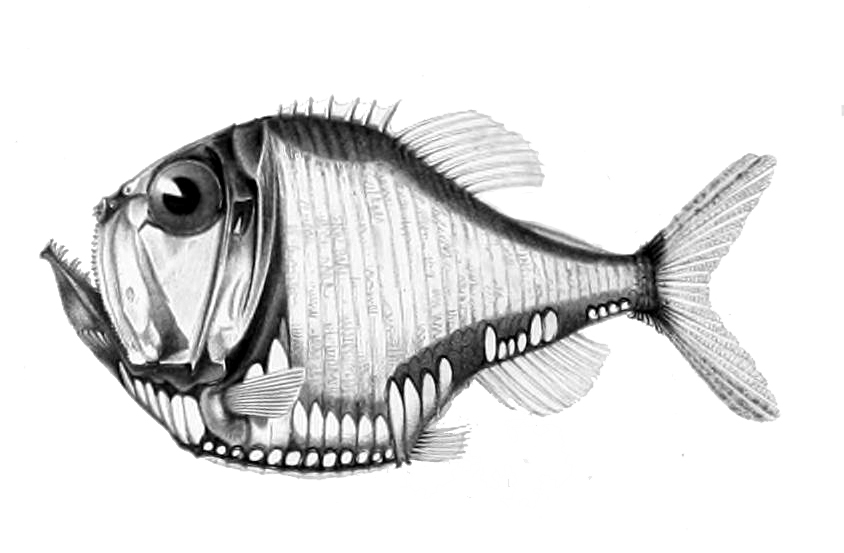
The genus Argyropelecus is recognised by a blade-like fin in front of the soft dorsal fin, 12 abdominal, 6 supra-abdominal and 2 suprapectoral photophores, no lateral photophore, and a divided anal fin [4]. In Schultz's key, Argyropelecus olfersii falls among the species whose photophores do not form a nearly continuous series but groups with gaps between them (which separates it from Argyropelecus gigas and Argyropelecus affinis, but not from other species of the genus) [4].
By that same key it has a pair of smooth spines at the rear angle of the abdomen, both about equal in length and diverging at an angle of roughly 45° to 50°; the dorsal and abdominal ridges are smooth and the lower edge of the caudal peduncle carries no spines [4]. The lower preopercular spine points downward and slightly forward and outward, and the upper one is very small or absent; the body depth goes about 1.5 times into standard length and the height of the dorsal blade goes 1 to 1.4 times into the length of its base [4]. The gill rakers number 7 to 9 plus 8 to 10 [4].
That key dates from 1938 and does not reflect later work: Schultz tentatively placed Garman's Argyropelecus lynchus in the synonymy of Argyropelecus olfersii, although a 1937 study by Parr had suggested they might be separate species, and he attributed much of the difference to variation in body proportions [4].
Similar species
- Argyropelecus aculeatus: The rear abdominal spine is longer than the front one and points backward, with an angle of about 90° between them; adults have serrated dorsal and abdominal ridges and a double row of spines on the lower edge of the caudal peduncle [4].
- Argyropelecus sladeni: The lower preopercular spine is straight and the upper one is of moderate size, its tip passing the rear margin of the bone; the dorsal blade is taller, going 1.7 to 2.3 times into the length of its base [4].
Distribution and habitat
Schultz's review gives the species' range as the Pacific (Baja California and Panama), the Atlantic (off New Jersey and South Carolina) and the Indian Ocean [4]. That list does not mention Peru, which says nothing about whether it is present or absent there [4].
The most detailed modern data come from the northeastern Atlantic. In night-time trawls in slope canyons of the Bay of Biscay, between 25 and 2000 m, 64 fish (70 individuals pooled) of this species were analysed, taken from 370 to 1335 m depth [2]. Another study of the same community lists the species with a sampling depth range of 150 to 2000 m [5].
Biology
In the Bay of Biscay, the individuals used for isotope analysis measured 3.3 to 10.0 cm in standard length, with a mean of 6.3 ± 1.7 cm [2]. In another sample, of 37 individuals, the mean standard length was 5.7 ± 1.1 cm [5]. With 205 individuals, no significant relationship was found between size and capture depth (p = 0.706) [2].
In the authors' table it is listed as a short vertical migrant, although in the discussion they group it with the non-migratory species [2].
On the genetic side, the mitochondrial genome of Argyropelecus olfersii, sequenced from a North Atlantic specimen, has long repeats between genes that kept it from being assembled in a single piece (it ended up in 2 fragments), and according to the authors it seems to carry a tandem duplication of 2 transfer RNAs, C and A, shorter than the one in Argyropelecus aculeatus [6].
Ecology
According to the Bay of Biscay study, this species eats crustaceans and small fish, a point the authors take from a reference work (Muus and colleagues, 1999) and not from their own analysis of stomach contents [2].
They measured nitrogen 15 in the muscle of 64 fish and obtained a mean value of 10.18 ± 0.47 ‰ [2]. That value rose with capture depth but not significantly with the size of the fish, so there was no sign of a diet change with growth; the authors explain it by animals living deeper depending on a food web based on organic particles degraded by bacteria [2]. Argyropelecus olfersii was, among the species the authors consider non-migratory, the one with the widest sampled depth range, about 1000 m [2].
Conservation
The IUCN classifies Argyropelecus olfersii as Least Concern (LC) globally, according to the assessment by Harold and Milligan published in 2018 [3].
References (6)
- WoRMS Editorial Board (2026). Argyropelecus olfersii (Cuvier, 1829). World Register of Marine Species. https://www.marinespecies.org/aphia.php?p=taxdetails&id=274967 (accessed 2026-10-25)
- Loutrage, L. (2024). Ontogenetic shift or not? Different foraging trade-offs within the meso- to bathypelagic fish community. Ecology and Evolution. doi:10.1002/ece3.11129 (accessed 2026-10-25)
- Harold, A., Milligan, R. (2018). Argyropelecus olfersii: Harold, A. & Milligan, R. The IUCN Red List of Threatened Species 2019: e.T18253287A21913744. doi:10.2305/IUCN.UK.2019-2.RLTS.T18253287A21913744.en (accessed 2026-10-25)
- Schultz, L.P. (1938). Review of the fishes of the genera Polyipnus and Argyropelecus (family Sternoptichidae), with descriptions of three new species. Proceedings of the United States National Museum, 135-155. doi:10.5479/si.00963801.86-3047.135 (accessed 2026-10-25)
- Loutrage, L. (2025). Unlocking the Depths: Use of a Trait-Based Approach to Reveal the Diversity of Foraging Strategies in a Deep-Pelagic Fish Community. Ecology and Evolution. doi:10.1002/ece3.71891 (accessed 2026-10-25)
- Gomes-dos-Santos, A. (2023). Mitochondrial replication's role in vertebrate mtDNA strand asymmetry. Open Biology. doi:10.1098/rsob.230181 (accessed 2026-10-25)