
Bony fishes · Sternoptychidae
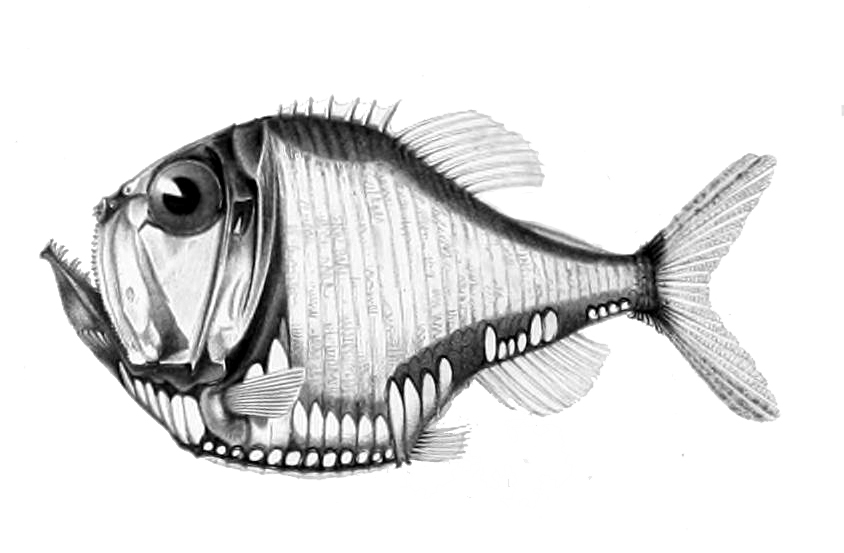
Argyropelecus olfersii
Argyropelecus olfersii (Cuvier, 1829)
- Peruvian Register of Marine Species
- Listed in PeRMS (IMARPE)
Species account
Summary
Argyropelecus olfersii is a deep-sea hatchetfish of the family Sternoptychidae and the order Stomiiformes; the accepted name is Cuvier's, from 1829 [1]. It is small: in a sample from the Bay of Biscay it measured between 3.3 and 10.0 cm in standard length [2]. In that study it was caught in night-time trawls between 370 and 1335 m depth, and the authors class it among the short vertical migrants [2]. The IUCN assesses it as Least Concern [3].
Identification and similar species
The genus Argyropelecus is recognised by a blade-like fin in front of the soft dorsal fin, 12 abdominal, 6 supra-abdominal and 2 suprapectoral photophores, no lateral photophore, and a divided anal fin [4]. In Schultz's key, Argyropelecus olfersii falls among the species whose photophores do not form a nearly continuous series but groups with gaps between them (which separates it from Argyropelecus gigas and Argyropelecus affinis, but not from other species of the genus) [4].
By that same key it has a pair of smooth spines at the rear angle of the abdomen, both about equal in length and diverging at an angle of roughly 45° to 50°; the dorsal and abdominal ridges are smooth and the lower edge of the caudal peduncle carries no spines [4]. The lower preopercular spine points downward and slightly forward and outward, and the upper one is very small or absent; the body depth goes about 1.5 times into standard length and the height of the dorsal blade goes 1 to 1.4 times into the length of its base [4]. The gill rakers number 7 to 9 plus 8 to 10 [4].
That key dates from 1938 and does not reflect later work: Schultz tentatively placed Garman's Argyropelecus lynchus in the synonymy of Argyropelecus olfersii, although a 1937 study by Parr had suggested they might be separate species, and he attributed much of the difference to variation in body proportions [4].
Similar species
- Argyropelecus aculeatus: The rear abdominal spine is longer than the front one and points backward, with an angle of about 90° between them; adults have serrated dorsal and abdominal ridges and a double row of spines on the lower edge of the caudal peduncle [4].
- Argyropelecus sladeni: The lower preopercular spine is straight and the upper one is of moderate size, its tip passing the rear margin of the bone; the dorsal blade is taller, going 1.7 to 2.3 times into the length of its base [4].
Distribution and habitat
Schultz's review gives the species' range as the Pacific (Baja California and Panama), the Atlantic (off New Jersey and South Carolina) and the Indian Ocean [4]. That list does not mention Peru, which says nothing about whether it is present or absent there [4].
The most detailed modern data come from the northeastern Atlantic. In night-time trawls in slope canyons of the Bay of Biscay, between 25 and 2000 m, 64 fish (70 individuals pooled) of this species were analysed, taken from 370 to 1335 m depth [2]. Another study of the same community lists the species with a sampling depth range of 150 to 2000 m [5].
Biology
In the Bay of Biscay, the individuals used for isotope analysis measured 3.3 to 10.0 cm in standard length, with a mean of 6.3 ± 1.7 cm [2]. In another sample, of 37 individuals, the mean standard length was 5.7 ± 1.1 cm [5]. With 205 individuals, no significant relationship was found between size and capture depth (p = 0.706) [2].
In the authors' table it is listed as a short vertical migrant, although in the discussion they group it with the non-migratory species [2].
On the genetic side, the mitochondrial genome of Argyropelecus olfersii, sequenced from a North Atlantic specimen, has long repeats between genes that kept it from being assembled in a single piece (it ended up in 2 fragments), and according to the authors it seems to carry a tandem duplication of 2 transfer RNAs, C and A, shorter than the one in Argyropelecus aculeatus [6].
Ecology
According to the Bay of Biscay study, this species eats crustaceans and small fish, a point the authors take from a reference work (Muus and colleagues, 1999) and not from their own analysis of stomach contents [2].
They measured nitrogen 15 in the muscle of 64 fish and obtained a mean value of 10.18 ± 0.47 ‰ [2]. That value rose with capture depth but not significantly with the size of the fish, so there was no sign of a diet change with growth; the authors explain it by animals living deeper depending on a food web based on organic particles degraded by bacteria [2]. Argyropelecus olfersii was, among the species the authors consider non-migratory, the one with the widest sampled depth range, about 1000 m [2].
Conservation
The IUCN classifies Argyropelecus olfersii as Least Concern (LC) globally, according to the assessment by Harold and Milligan published in 2018 [3].
References (6)
- WoRMS Editorial Board (2026). Argyropelecus olfersii (Cuvier, 1829). World Register of Marine Species. https://www.marinespecies.org/aphia.php?p=taxdetails&id=274967 (accessed 2026-10-25)
- Loutrage, L. (2024). Ontogenetic shift or not? Different foraging trade-offs within the meso- to bathypelagic fish community. Ecology and Evolution. doi:10.1002/ece3.11129 (accessed 2026-10-25)
- Harold, A., Milligan, R. (2018). Argyropelecus olfersii: Harold, A. & Milligan, R. The IUCN Red List of Threatened Species 2019: e.T18253287A21913744. doi:10.2305/IUCN.UK.2019-2.RLTS.T18253287A21913744.en (accessed 2026-10-25)
- Schultz, L.P. (1938). Review of the fishes of the genera Polyipnus and Argyropelecus (family Sternoptichidae), with descriptions of three new species. Proceedings of the United States National Museum, 135-155. doi:10.5479/si.00963801.86-3047.135 (accessed 2026-10-25)
- Loutrage, L. (2025). Unlocking the Depths: Use of a Trait-Based Approach to Reveal the Diversity of Foraging Strategies in a Deep-Pelagic Fish Community. Ecology and Evolution. doi:10.1002/ece3.71891 (accessed 2026-10-25)
- Gomes-dos-Santos, A. (2023). Mitochondrial replication's role in vertebrate mtDNA strand asymmetry. Open Biology. doi:10.1098/rsob.230181 (accessed 2026-10-25)
More pictures
Where it has been recorded
- Filled: scientific records, or confirmed by a curator
- Hatched: isolated record
- Dotted outline: no scientific records and no curator's confirmation (an ORKA sighting is not drawn here)
- Cold central sea
Scientific records (7 records)
- Cold southern sea
Scientific records (1 record)
From openly licensed OBIS and GBIF records (CC0 or CC BY). How each list is built.
Related species
From the same genus (Argyropelecus) and from the same family (Sternoptychidae).

Pacific hatchet fish
Argyropelecus affinis
IUCN status: LC · Least Concern
Silvery hatchetfish
Argyropelecus lychnus
IUCN status: LC · Least Concern
Diaphanous hatchet fish
Sternoptyx diaphana
IUCN status: LC · Least Concern- No openly licensed image yet
Araiophos eastropas
IUCN status: DD · Data Deficient - No openly licensed image yet
Maurolicus breviculus
IUCN status: LC · Least Concern 
Pearl-side
Maurolicus muelleri
IUCN status: LC · Least Concern- No openly licensed image yet
Dark hatchetfish
Sternoptyx obscura
IUCN status: LC · Least Concern
Names and sources
Classification
Learn more
Conservation status: Least Concern (IUCN Red List, according to Wikidata). Taxonomy: PeRMS / WoRMS (CC BY 4.0).