
Bony fishes · Congridae
Twinpored eel
Xenomystax atrarius Gilbert, 1891
- Peruvian Register of Marine Species
- Listed in PeRMS (IMARPE)

Species account
Summary
Xenomystax atrarius is a deep-water eel of the eastern Pacific, known in English as the twinpored eel, that has been caught over the continental slope [1],[2]. It is rare in collections: in 1972 only 19 specimens were known, and its placement in any one eel family was still considered uncertain [2]. The IUCN assesses it as Least Concern [3].
Identification and similar species
It is an elongate eel with a long, broad snout and many conical teeth in each jaw; the vomerine teeth form a single row [4]. The four Chilean specimens measured by Cervigón and colleagues had a head of 20 % to 22 % of standard length, a maxilla of 47 % to 51 % of head length, and 37 to 40 lateral-line pores in front of the anus [5].
The general colour is brownish and paler towards the rear; the gill region, the base of the dorsal fin, the lateral line and the nape are blackish, and the fins are pale [5]. The species reaches about 100 cm in total length [1]. Peden concluded that Xenomystax rictus is a junior synonym of this species [2].
Distribution and habitat
It has been recorded in the eastern Pacific, from southern Canada to Chile, mostly near the continental slope [2],[1]. In Chile, Cervigón and colleagues cited it from about the latitude of Valparaíso, and one of their specimens, from the Coquimbo region, was taken by trawl at 350 to 400 m depth [5]; the Punta Toro sample, somewhat further south, shows it also occurs in central Chile [4]. It is a deep-water bathydemersal fish recorded between 152 and 1050 m [1].
A sample of 114 individuals was obtained by trawl off Punta Toro, in central Chile, at 610 m depth [4].
Biology
In the Punta Toro sample, individuals measured 36 to 66 cm in total length and weighed 19 to 214 g, with the mode at 50 to 52 cm [4]. Of 114 stomachs, only 33 held recognisable prey; the rest contained heavily digested organic matter [4].
Because the catch was made at about 21 h and most stomachs held only heavily digested organic matter, the author proposed that the species feeds mainly by day [4]. A male of 520 mm total length had visible but poorly developed gonads [5].
Ecology
It is a predator that feeds on animals living on the bottom. Among prey that could be identified, crustaceans made up 61 %, elasmobranchs 21 % and bony fishes 18 % [4]. The most frequent prey was the shrimp Haliporoides diomedeae, found in 19 of 33 stomach contents (58 %) [4].
The shrimp Heterocarpus reedi, the shark Centroscyllium granulosum and the fish Coelorhynchus chilensis also appeared, these three as juveniles [4]. The author describes it as a broad-diet carnivorous predator of the second or third order, and notes that in that area it appears to press on commercially important crustaceans [4].
Conservation
References (5)
- Froese, R., Pauly, D. (2026). Xenomystax atrarius, Twinpored eel. FishBase. https://www.fishbase.se/summary/Xenomystax-atrarius.html (accessed 2026-10-25)
- Peden, A.E. (1972). Redescription and Distribution of the Rare Deep-Sea Eel Xenomystax atrarius in the Eastern Pacific Ocean. Journal of the Fisheries Research Board of Canada, 1-12. doi:10.1139/f72-001 (accessed 2026-10-25)
- McCosker, J., Smith, D.G., Tighe, K. (2011). Xenomystax atrarius: McCosker, J., Smith, D.G. & Tighe, K. The IUCN Red List of Threatened Species. doi:10.2305/iucn.uk.2019-1.rlts.t199408a2592235.en (accessed 2026-10-25)
- Meléndez C., R. (1982). Estudio preliminar de la alimentación de Xenomystax atrarius Gilbert, 1891 (Pisces, Congridae). Boletín del Museo Nacional de Historia Natural, 45-48. doi:10.54830/bmnhn.v39.1982.445 (accessed 2026-10-25)
- Cervigón, F., Pequeño R., G., Kong, I. (1980). Presencia de Pseudoxenomystax albescens (Barnard, 1923) y Xenomystax atrarius Gilbert, 1891, en las costas de Chile (Teleostomi, Congridae). Boletín del Museo Nacional de Historia Natural, 317-321. doi:10.54830/bmnhn.v37.1980.497 (accessed 2026-10-25)
More pictures
Where it has been recorded
- Filled: scientific records, or confirmed by a curator
- Hatched: isolated record
- Dotted outline: no scientific records and no curator's confirmation (an ORKA sighting is not drawn here)
- Tropical northern sea
Scientific records (1 record)
- Tropical–cold transition zone
Scientific records (1 record)
- Cold central sea
Scientific records (6 records)
- Cold southern sea
Scientific records (1 record)
From openly licensed OBIS and GBIF records (CC0 or CC BY). How each list is built.
Related species
From the same family.
Slope conger
Ariosoma prorigerum
IUCN status: LC · Least ConcernShorthead conger
Bathycongrus macrurus
IUCN status: LC · Least ConcernNeedletail conger
Rhynchoconger nitens
IUCN status: LC · Least Concern- No openly licensed image yet
Largehead conger
Bathycongrus varidens
IUCN status: LC · Least Concern 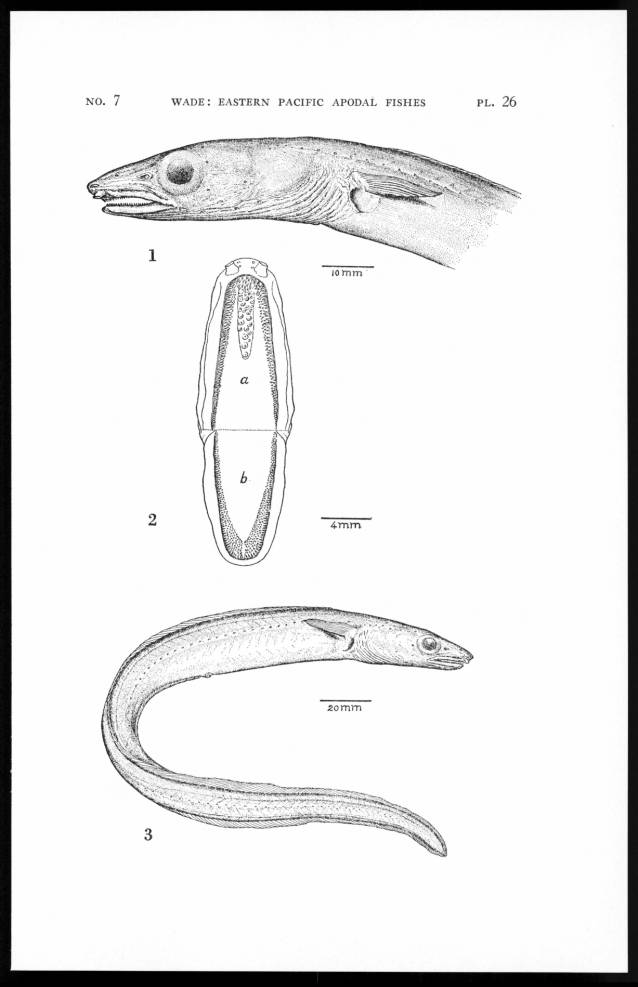
Hardtail conger
Gnathophis cinctus
IUCN status: LC · Least Concern- No openly licensed image yet
Ringeye conger
Paraconger californiensis
IUCN status: LC · Least Concern
Names and sources
In English
- Twinpored eel — WoRMS
Classification
Learn more
Conservation status: Least Concern (IUCN Red List, according to Wikidata). Taxonomy: PeRMS / WoRMS (CC BY 4.0).