
Sea snails · Muricidae
Xanthochorus cassidiformis
Xanthochorus cassidiformis (Blainville, 1832)
- Peruvian Register of Marine Species
- Listed in PeRMS (IMARPE)

Species account
Summary
Xanthochorus cassidiformis (Blainville, 1832) is the accepted name of a marine snail in the family Muricidae, genus Xanthochorus [1]. It appears in the checklist of the marine molluscs of Peru, which gathers 1018 marine species, 47 of them in the family Muricidae [2].
The best-documented part of its biology comes from a study in southern Chile on sandy-bottom animals: adults kept in aquaria averaged 58.1 mm, laid egg capsules attached to the substrate, and their larvae left the capsule after 30 to 34 days as swimming larvae that feed in the plankton [3].
Identification and similar species
The adults whose egg-laying was measured, collected in southern Chile, averaged 58.1 mm in size [3]. The egg mass described holds between 38 and 112 capsules, usually in a single layer, and each capsule is opalescent cream, with a flattened, slightly curved oval body and a lengthwise groove along its back, averaging 11.5 mm in length [3]. A thin, long stalk, 8.4 mm on average, fixes it to the substrate, and at the opposite end a mucous plug closes the exit opening [3].
Other species of the same genus occur in Peru. The country's checklist of marine molluscs also includes Xanthochorus buxea and Xanthochorus broderippi [2]. A survey at Pucusana (Lima) recorded Xanthochorus buxeus and Xanthochorus xanthostoma, and did not record Xanthochorus cassidiformis; the first, similar in size to Crassilabrum crassilabrum, has characteristic tubercles and a yellowish-brown or reddish colour, and the second has a mostly worn, whitish shell with rounded teeth on the outer lip [4]. The author notes that most of the murex snails of the area do not exceed 20 mm of shell [4].
Distribution and habitat
Xanthochorus cassidiformis is in the catalogue of the marine molluscs of Peru, among the gastropods of the family Muricidae [2]. That catalogue is a species list and gives no localities or depths for each species [2]. A survey of the murex snails of the Pucusana coast (Lima), made among rocks, Macrocystis pyrifera beds and pier pilings, did not record it [4].
The field data cited in this account come from Chile: the specimens for the egg-laying study were collected at Metri, in the Reloncaví Sound, at about 41°36' S, in November 1991 [3]. The authors describe it as a sandy-bottom snail, and count it, together with Thaisella chocolata, among the Chilean murex snails of that kind of bottom [3]. They also place it among the species of the northern Chilean coast that additionally reach intermediate latitudes [3].
Biology
Adults kept in aquaria at the Valdivia laboratory laid eggs about one month after being placed in them [3]. The egg capsules were deposited close together, in a defined area of the aquarium and also on the shells of other individuals [3]. One egg mass held 38 to 112 capsules, and about 6 % of the capsules had an atypical shape [3].
Each capsule held between 325 and 733 eggs, with a mean diameter of 232 µm, and all were fertile, with no nurse eggs to feed the embryos [3]. The number of eggs was associated with capsule length, but that length explained only 18 % of its variation [3].
At 16-20 °C, the laboratory temperature, development inside the capsule lasted 30 to 34 days [3]. The larva at the trochophore stage averaged 333 µm, at the pre-veliger to early veliger stage 387 µm, and the hatching larva was 425 µm in shell length [3]. It emerged as a free larva that feeds in the plankton; reared on the microalga Isochrysis galbana, it reached 492 µm at 23 days after hatching and died before starting metamorphosis [3]. The study did not determine how long its planktonic larval life lasts [3].
Ecology
In the aquaria the animals were fed on bivalves, specifically the mussel Mytilus chilensis [3].
Its development resembles that of the Chilean murex snail Crassilabrum crassilabrum, with eggs and hatching larvae of similar size, and differs from Thaisella chocolata and Concholepas concholepas, which lay smaller and much more numerous eggs [3]. The larva that hatches from Xanthochorus cassidiformis is almost twice the size of that of Thaisella chocolata [3]. Among the Chilean sandy-bottom murex snails, both this species and Thaisella chocolata hatch feeding planktonic larvae, and only Chorus giganteus shows an intermediate development [3].
References (4)
- MolluscaBase eds. (2026). Xanthochorus cassidiformis (Blainville, 1832). World Register of Marine Species. https://www.marinespecies.org/aphia.php?p=taxdetails&id=404389 (accessed 2026-10-25)
- Ramírez, R., Paredes, C., Arenas, J. (2003). Moluscos del Perú. Revista de Biología Tropical 51 (Suppl. 3): 225-284. https://www.redalyc.org/pdf/449/44911879012.pdf (accessed 2026-10-25)
- Gallardo, C.S., González, K. (1994). Ovipostura y desarrollo intracapsular de Xanthochorus cassidiformis (Blainville, 1832) (Gastropoda, Muricidae) de la costa sur de Chile. Gayana Zoología 58(1): 79-90, 79-90. https://archive.org/details/biostor-118287 (accessed 2026-10-25)
- Guzmán, R. (2021). Muricidae Rafinesque, 1815 (Gastropoda: Neogastropoda) de las costas de Pucusana (Lima-Perú). Sagasteguiana 9(1): 15-28, 15-28. https://revistas.unitru.edu.pe/index.php/REVSAGAS/article/view/4304 (accessed 2026-10-25)
More pictures
Where it has been recorded
- Filled: scientific records, or confirmed by a curator
- Hatched: isolated record
- Dotted outline: no scientific records and no curator's confirmation (an ORKA sighting is not drawn here)
- Cold central sea
Scientific records (3 records)
- Cold southern sea
Scientific records (17 records)
From openly licensed OBIS and GBIF records (CC0 or CC BY). How each list is built.
Related species
From the same genus (Xanthochorus) and from the same family (Muricidae).

Xanthochorus buxeus
IUCN status: Not evaluated
Acanthais brevidentata
IUCN status: Not evaluatedNeorapana muricata
IUCN status: Not evaluated
Stramonita biserialis
IUCN status: Not evaluated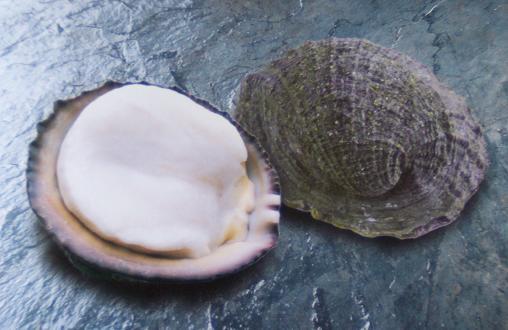
El loco
Concholepas concholepas
IUCN status: Not evaluatedCoralliophila nux
IUCN status: Not evaluatedCoralliophila parva
IUCN status: Not evaluated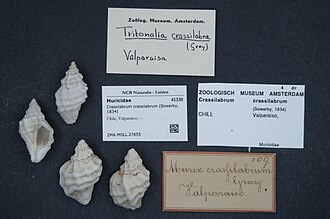
Crassilabrum crassilabrum
IUCN status: Not evaluated
Names and sources
Classification
Learn more
Conservation status: no data (IUCN). Taxonomy: PeRMS / WoRMS (CC BY 4.0).