
Sharks, rays and chimaeras · Urotrygonidae
Tumbes Round Stingray
Urobatis tumbesensis (Chirichigno F. & McEachran, 1979)
- Peruvian Register of Marine Species
- Listed in PeRMS (IMARPE)

Species account
Summary
Urobatis tumbesensis is a small round stingray that lives on the bottom in the eastern Pacific, from Colombia to Peru [1],[2]. It was described in 1979 as a new species from the coast of Peru [3]. Its global category is Vulnerable [4]. In northern Peru it has been seen in the shallows of Los Órganos, resting in caves and crevices on mixed ground of sand, rock and seaweed [5].
Etymology
The genus name, Urobatis, joins two Greek words: oura, tail, and batis, ray [2]. The species was described in 1979 in the genus Urolophus, family Urolophidae [3]. Today it is placed in the genus Urobatis, family Urotrygonidae [6]. That family was split from Urolophidae in 1996, and its species live in the eastern Pacific and the western Atlantic [1].
Identification and similar species
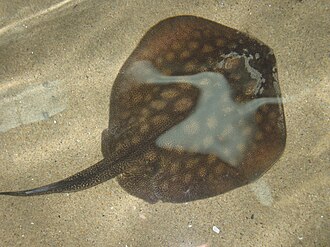
The upper side of the disc is brown, with dark and pale wavy lines and white spots the size of the eye; the underside ranges from brownish to white, pink or cream, usually darker at the edges, and towards the rear of the disc and the pelvic fins it shows a network of pale spots on a darker ground [1]. The upper side of the disc or the tail carries visible dermal denticles, tubercles or thorns, a feature it shares within the genus only with the western Atlantic Urobatis jamaicensis; they have not yet developed in newborns and are hard to see in juveniles [1].
Before 2015, 5 species of the genus were recognised in the eastern Pacific; that year a sixth, Urobatis pardalis, was described from the Pacific coast of Costa Rica, and it differs from Urobatis tumbesensis in having no denticles or tubercles on the upper side of the disc [1].
Similar species
Distribution and habitat
It lives in the eastern Pacific, between Colombia to the north and Peru to the south, which mark the limits of its range [1]. It appears in the updated checklist of cartilaginous fishes of the Peruvian sea, based on its original description and on the 2001 annotated catalogue of Peruvian marine fishes [7].
It is a tropical bottom fish recorded both in the sea and in brackish water; it uses shallow coastal water, estuaries and mangroves, and reaches depths of at least 20 m [2],[6]. At Los Órganos it was recorded between 1 and 6 m, on mixed ground of sand, rock, reefs built by the polychaete Phragmatopoma and seaweeds such as Caulerpa or Ulva [5].
Biology
The largest length FishBase records for the species is 34.5 cm total length [2].
Among the 7 individuals sampled at Los Órganos the ratio of males to females was 1 to 1.3, not a significant difference; the males were above the 30 cm total-length size at maturity given in the literature, while for the females it could not be told whether they were mature, because their size at maturity is unknown [5].
Ecology
At Los Órganos, apart from the eagle rays, which were swimming, every ray recorded on the morning surveys was motionless, fully or partly buried in sand; Urobatis tumbesensis turned up in mixed habitat, inside caves or crevices [5]. There it shares the shore zone with 7 other batoid species, among them Urotrygon chilensis, Zapteryx xyster, Narcine entemedor and Urobatis halleri [5].
It hosts parasites: in 1999 a new tetraphyllidean tapeworm was described from specimens taken in coastal waters of Ecuador, and the genus Pararhinebothroides was erected for it [8]. A later study, with new material from the Gulf of Guayaquil, concluded that this genus is not valid and moved the tapeworm to the genus Anthocephalum [9].
Conservation
Its global category is Vulnerable [4]. The assessment, dated 24 February 2020, lists it under criteria A2cd [2].
FishBase estimates low resilience for it, with a minimum population doubling time of 4.5 to 14 years, and a high vulnerability to fishing, 55 out of 100 [2]. A review of the elasmobranchs endemic to South America lists it among them, with a range from Colombia to Peru [10].
The Los Órganos study notes that these vulnerable species need research before management plans can be drawn up, and proposes finding out whether that stretch of shore works as a gestation area and whether it qualifies as an Important Shark and Ray Area [5].
Where to see it in Peru
In 2016, 2017 and 2019, 20 field trips were made in the coastal zone of Los Órganos, Piura, snorkelling along transects of about 3 km at 1 to 6 m depth and only in the mornings, because from midday conditions such as strong wind lower visibility; 7 Urobatis tumbesensis were recorded [5]. In that work it turned up in caves and crevices of the mixed ground, while other rays, such as Urotrygon chilensis, were on sandy bottoms [5].
References (10)
- Del Moral-Flores, L.F., Angulo, A., López, M.I. et al. (2015). Nueva especie del género Urobatis (Myliobatiformes: Urotrygonidae) del Pacífico oriental tropical. Revista de Biología Tropical 63(2), 501-514. doi:10.15517/rbt.v63i2.15746 (accessed 2026-10-20)
- Froese, R., Pauly, D. (2026). Urobatis tumbesensis, Tumbes round stingray. FishBase (facts only; CC BY-NC). https://www.fishbase.se/summary/57392 (accessed 2026-10-20)
- Chirichigno F., N., McEachran, J.D. (1979). Urolophus tumbesensis, a New Stingray from the Coast of Peru (Batoidea: Urolophidae). Copeia 1979(4), 709-713. doi:10.2307/1443881 (accessed 2026-10-20)
- Kyne, P.M., Charvet, P., Areano, E.M. et al. (2020). Urobatis tumbesensis: Kyne, P.M., Charvet, P., Areano, E.M., Cevallos, A., Espinoza, M., González, A., Herman, K., Mejía-Falla, P.A., Morales-Saldaña, J.M., Navia, A.F. & Velez-Zuazo, X. The IUCN Red List of Threatened Species 2020: e.T63135A124462289. doi:10.2305/IUCN.UK.2020-3.RLTS.T63135A124462289.en (accessed 2026-10-20)
- González-Pestana, A., Molina-Salgado, P., Ponce, A. (2023). Ensamble de batoideos costeros en el norte del Perú: Conocimiento preliminar. Revista de Biología Marina y Oceanografía 57 (Especial, 2022 volume), 302-307. doi:10.22370/rbmo.2022.57.especial.3684 (accessed 2026-10-20)
- WoRMS Editorial Board (2026). Urobatis tumbesensis (Chirichigno F. & McEachran, 1979). World Register of Marine Species. https://www.marinespecies.org/aphia.php?p=taxdetails&id=283089 (accessed 2026-10-20)
- Cornejo, R., Vélez-Zuazo, X., González-Pestana, A. et al. (2015). An updated checklist of Chondrichthyes from the southeast Pacific off Peru. Check List 11(6), 1809. doi:10.15560/11.6.1809 (accessed 2026-10-20)
- Zamparo, D., Brooks, D.R., Barriga, R. (1999). Pararhinebothroides hobergi n. gen. n. sp. (Eucestoda: Tetraphyllidea) in Urobatis tumbesensis (Chondrichthyes: Myliobatiformes) from Coastal Ecuador. The Journal of Parasitology 85(3), 534-539. doi:10.2307/3285791 (accessed 2026-10-20)
- Marques, F.P.L., Caira, J.N. (2016). Pararhinebothroides—Neither the Sister-Taxon of Rhinebothroides Nor a Valid Genus. Journal of Parasitology 102(2), 249-259. doi:10.1645/15-894 (accessed 2026-10-20)
- Branco-Nunes, I., Araújo, C., Ferreira, E. et al. (2025). Endemic Species of Elasmobranchs (Sharks and Rays) in South America: A Review. Endemic Species from around the World - Teaching for Sustainability (IntechOpen). doi:10.5772/intechopen.1008521 (accessed 2026-10-20)
More pictures
If you come across it
Protected or threatened species. Watch it without touching, feeding, chasing or taking it, and keep the recommended viewing distances.
Where it has been recorded
- Filled: scientific records, or confirmed by a curator
- Hatched: isolated record
- Dotted outline: no scientific records and no curator's confirmation (an ORKA sighting is not drawn here)
- Tropical northern sea
Scientific records (3 records)
From openly licensed OBIS and GBIF records (CC0 or CC BY). How each list is built.
Related species
From the same genus (Urobatis) and from the same family (Urotrygonidae).
Round stingray
Urobatis halleri
IUCN status: LC · Least Concern
Leopard round stingray
Urobatis pardalis
IUCN status: LC · Least Concern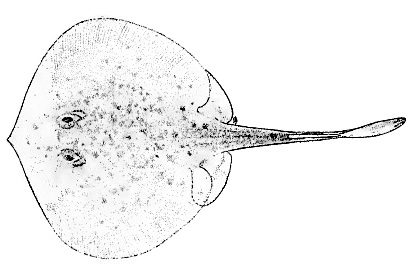
Urotrygon caudispinosus
IUCN status: Not evaluated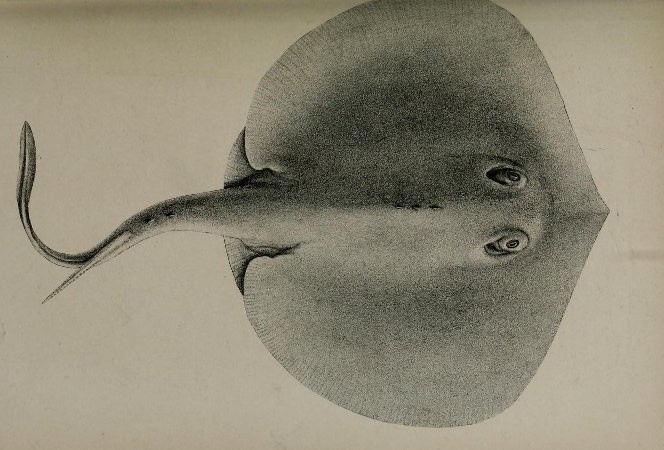
Blotched stingray
Urotrygon chilensis
IUCN status: NT · Near Threatened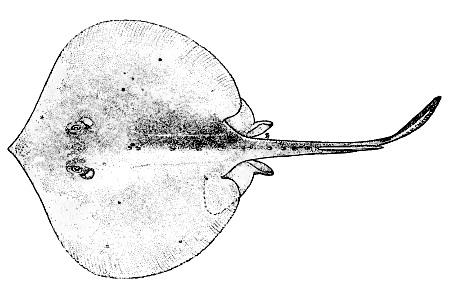
Urotrygon peruanus
IUCN status: Not evaluated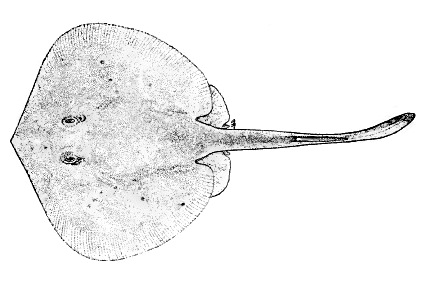
Urotrygon serrula
IUCN status: Not evaluated
Panamic stingray
Urotrygon aspidura
IUCN status: NT · Near ThreatenedSpiny stingray
Urotrygon munda
IUCN status: NT · Near Threatened
Names and sources
In English
- Tumbes Round Stingray — Wikidata
Classification
Learn more
Conservation status: Vulnerable (IUCN Red List, according to Wikidata). Taxonomy: PeRMS / WoRMS (CC BY 4.0).