
Bony fishes · Sciaenidae
Surf croaker
Umbrina xanti Gill, 1862
Spanish: Polla
- Names in Peru
- Polla · Cachicato · Cebra · Polla rayada · Verrugato polla
- Peruvian Register of Marine Species
- Listed in PeRMS (IMARPE)

Species account
Summary
Umbrina xanti is a bony fish of the family Sciaenidae, the drums and croakers, described by Gill in 1862 and accepted as a valid species [1]. It lives over shallow sandy bottoms in the eastern Pacific, from the Gulf of California to Peru [2]. In Peru it is called "polla", "polla rayada", "verrugato polla", "cachicato" or "cebra" [2]. It is caught with nets in Mexico and is not threatened globally [3],[4].
Etymology
The genus name Umbrina derives from Latin umbra (shadow), in the sense of a phantom; it refers to the speed of the fish's movements [2].
Identification and similar species
The body is oblong and compressed, of moderate depth, with an arched back and a prominent snout [2]. The mouth is small and inferior, the lower jaw is enclosed by the upper one, and the chin carries a stiff barbel [2].
The second dorsal fin is short, bearing 20 soft rays, and each pectoral has 19 rays [2]. The colour is dark and silvery, with no stripes on the flanks, the fins are dark, and the prolonged first pelvic ray is white [2]. Usual total length is 22 cm and the recorded maximum is 40 cm [2]; Mexican catches included fish between 17.9 and 42.3 cm [3].
Distribution and habitat
The species occurs in the eastern Pacific, from the Gulf of California to Peru [2]. A Mexican study places it from Baja California to northern Peru [3].
It is a demersal fish found between 0 and 35 m depth over sandy bottoms, and juveniles also turn up in shore pools [2]. It can enter coastal lagoons and estuaries [3].
Biology
At Bahía de Navidad (Jalisco, Mexico), 1202 fish caught in gill nets between 1998 and 2008 were examined; 80 % measured between 28 and 32 cm total length [3]. Females outnumbered males, at a ratio of 1 to 0.88 [3].
Mean length at maturity was 27.37 cm in females and 28.78 cm in males, so more than half of the catch had already spawned at least once [3]. The gonadosomatic index of females peaked in March (4.75) and April (4.62), and that of males in April [3]; mature ovaries were recorded from January to June [3].
Oocytes within one ovary mature asynchronously, which points to multiple spawnings; 7 stages of oocyte development were distinguished in females [3].
Ecology
Conservation
The IUCN Red List classifies Umbrina xanti as Least Concern (LC) globally, based on the 2020 assessment [4].
Human relevance
Where to see it in Peru
The Peruvian literature consulted records the species at Tumbes, in the far north of the country: the monogenean checklist published in 2024 cites there, from the gills of a marine specimen of Umbrina xanti, its parasite Euryhaliotrema sagmatum [5]. The checklist says nothing about access to the place or about where to watch the fish [5].
References (5)
- Froese, R., Pauly, D. (2026). Umbrina xanti Gill, 1862. World Register of Marine Species. https://www.marinespecies.org/aphia.php?p=taxdetails&id=273805 (accessed 2026-10-25)
- Froese, R., Pauly, D. (2026). Umbrina xanti, Polla drum. FishBase. https://www.fishbase.se/summary/14098 (accessed 2026-10-25)
- Ruiz-Ramírez, S., Reséndiz-Cruz, V.E., Lucano-Ramírez, G. et al. (2025). Biología reproductiva de la corvina Umbrina xanti (Perciformes: Sciaenidae) en el Pacífico central mexicano. Ciencias Marinas 51, e3483. doi:10.7773/cm.y2025.3483 (accessed 2026-10-25)
- Chao, L., Espinosa Pérez, H. (2020). Umbrina xanti: Chao, L. & Espinosa Pérez, H. The IUCN Red List of Threatened Species 2020: e.T184038A131130336. doi:10.2305/IUCN.UK.2020-2.RLTS.T184038A131130336.en (accessed 2026-10-25)
- Santillán, G., Cruces, C., Sáez, G. et al. (2024). An Annotated Checklist of Monogeneans (Platyhelminthes, Monogenea) from Aquatic Vertebrates in Peru: A Review of Diversity, Hosts and Geographical Distribution. Animals 14(11), 1542. doi:10.3390/ani14111542 (accessed 2026-10-25)
Where it has been recorded
- Filled: scientific records, or confirmed by a curator
- Hatched: isolated record
- Dotted outline: no scientific records and no curator's confirmation (an ORKA sighting is not drawn here)
- Tropical northern sea
Scientific records (5 records)
- Tropical–cold transition zone
Scientific records (9 records)
- Cold central sea
Scientific records (2 records)
From openly licensed OBIS and GBIF records (CC0 or CC BY). How each list is built.
Related species
From the same genus (Umbrina) and from the same family (Sciaenidae).
Umbrina reedi
IUCN status: LC · Least ConcernBluestreak drum
Elattarchus archidium
IUCN status: LC · Least Concern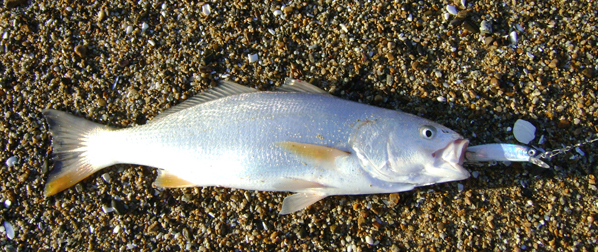
Corvina drum
Cilus gilberti
IUCN status: DD · Data DeficientPeruvian weakfish
Cynoscion analis
IUCN status: LC · Least ConcernBigeye corvina
Isopisthus remifer
IUCN status: LC · Least Concern
Shining drum
Larimus effulgens
IUCN status: LC · Least Concern- No openly licensed image yet
Pacific drum
Larimus pacificus
IUCN status: LC · Least Concern Snakehead kingcroaker
Menticirrhus ophicephalus
IUCN status: LC · Least Concern
Names and sources
In Spanish
- Polla — Peru; SERNANP (2023). Plan Maestro del Santuario Nacional Los Manglares de Tumbes 2023-2027. RP N.° 064-2023-SERNANP, p. 26 of the PDF; fishbase · main name
- Berrugata roncadora — Wikidata; WoRMS
- Cachicato — Peru; fishbase
- Cebra — Peru; fishbase
- Polla rayada — Peru; fishbase
- Rabo amarillo — Wikidata
- Verrugato cochicato — Wikidata
- Verrugato polla — Peru; fishbase; Wikidata
- Verrugato roncador — Wikidata
In English
- Surf croaker — WoRMS; Wikidata
- Common yellowtail croaker — Wikidata
- Polla drum — Wikidata
Classification
Learn more
Conservation status: Least Concern (IUCN Red List, according to Wikidata). Taxonomy: PeRMS / WoRMS (CC BY 4.0).