
Sea snails · Fasciolariidae
Triplofusus princeps
Triplofusus princeps (G. B. Sowerby I, 1825)
Spanish: Caracol tulipán
- Names in Peru
- Caracol tulipán
- Peruvian Register of Marine Species
- Listed in PeRMS (IMARPE)
Species account
Summary
Triplofusus princeps is a large sea snail in the family Fasciolariidae, described by G. B. Sowerby I in 1825 under the name Fasciolaria princeps [1]. In Peru it is called «caracol tulipán» [2],[3]. It has been recorded on rocky reefs in the Gulf of California, Costa Rica, mainland Ecuador, the Galápagos and northern Peru [4],[5],[6],[7],[3]. The management plan of the Reserva Nacional Mar Tropical de Grau counts it among the highly threatened rocky-reef invertebrates and bans taking it in two of the reserve's sectors [3],[3],[3].
Identification and similar species
In the original description, Sowerby presented it as a spindle-shaped orange shell whose 7 upper whorls carry nodules and grooves, with a swollen last whorl crossed by strong, widely spaced grooves [8]. The aperture shows interrupted reddish transverse lines; the operculum is grooved and radiate, and the shell is covered by a dark brown outer layer [8]. The described specimen was 8 inches long, about 20 cm, and the author regarded it as a very scarce shell [8].
WoRMS groups Fasciolaria princeps, Fasciolaria crocata, Fasciolaria acutispsira, Pleuroploca princeps and Pleuroploca acutispira under this name, and credits the current combination, in the genus Triplofusus, to a 2012 study of the genera of the subfamily Fasciolariinae [1]. Older studies therefore use earlier names: Pleuroploca princeps in an ecosystem model of the Galápagos, and a placement in the genus Fasciolaria in the Sechura Bay inventory [7],[2].
Distribution and habitat
At San Pedro Mártir, the most oceanic island in the Gulf of California, it turned up in yearly scuba surveys of the shallow rocky reefs carried out between 2007 and 2017, and the study classes it as an eastern Pacific species [4]. Around the Santa Elena Peninsula, Santa Elena Bay and the Murciélago Islands, on the northern Pacific coast of Costa Rica, a 2018 expedition found it on rocky reef but not on the coral reefs, sargassum beds or sandy bottoms that were also sampled [5].
In mainland Ecuador, a survey of the rocky subtidal in which a diver logged the mobile invertebrates on both sides of 50 m transects recorded it only at Canoa, in Manabí province, out of the 10 areas studied [6]. In the Bolívar Channel, in the Galápagos, it is part of the rocky-reef community described in a model of that ecosystem [7].
In Peru it appears in an inventory of 105 benthic species from Sechura Bay, on the coast of Piura, based on the authors' own collecting and on the collection that a former IMARPE technician assembled over more than 20 years [2]. Further north, the management plan of the Reserva Nacional Mar Tropical de Grau names it among the rocky-reef species of the Arrecifes de Punta Sal and Cabo Blanco – El Ñuro sectors [3],[3].
Ecology
In the food-web model of the Bolívar Channel, in the Galápagos, it is grouped with the carnivorous invertebrates that eat other invertebrates, together with lobsters, crabs and sea stars such as Pentaceraster cumingi [7]. In the Santa Elena area, in Costa Rica, it was recorded on rocky reef together with another snail, Hexaplex princeps [5].
According to the management plan of the Reserva Nacional Mar Tropical de Grau, the rocky-reef fishes and invertebrates hit hardest by poor spearfishing practices are long-lived, large species with naturally small populations, and the caracol tulipán is on the list of highly threatened species that goes with that description [3]. The same plan argues that conserving this group of species shelters, like an umbrella, the whole rocky-reef community [3].
Conservation
In the Reserva Nacional Mar Tropical de Grau, the 2026–2031 management plan includes it among the rocky-reef invertebrates regarded as highly threatened by poor spearfishing practices and by other fishing gear [3]. According to the plan, species in that group are speared or gathered beyond sustainable levels to be sold [3].
The plan bans taking it anywhere in the Arrecifes de Punta Sal sector and anywhere in the Cabo Blanco – El Ñuro sector [3],[3]. At Punta Sal it also sets aside 2 recovery zones totalling almost 579 ha, chosen because they are the places with the most rocky reefs and once had healthy populations of species that are now seriously threatened, the caracol tulipán among them [3],[3].
On the Costa Chica of Guerrero, in Mexico, it is one of the 6 species most sought by the inshore mollusc fishery, and of those 6 only the rock oyster has rules controlling its catch [9].
Human relevance
On the Costa Chica of Guerrero, in southern Mexico, mollusc fishers take it during all 12 months of the year and sell it by the piece; according to those interviewed, large molluscs like this one are scarce and some are caught to order or for the fishers' own table [9].
In western Mexico, Fasciolaria princeps was one of the species most widely used to make shell trumpets in pre-Hispanic times [10]. In that region, the shell trumpets recovered in archaeological excavations all come from burials [10].
Where to see it in Peru
References (10)
- MolluscaBase eds. (2026). Triplofusus princeps (G. B. Sowerby I, 1825). World Register of Marine Species. https://www.marinespecies.org/aphia.php?p=taxdetails&id=607919 (accessed 2026-10-20)
- Tume Ruiz, J., Ibaceta Cipirán, A., Cortez Oyola, M. et al. (2012). Recursos de la zona béntica de la bahía de Sechura. Ciencia y Desarrollo, 19-50. doi:10.21503/cyd.v15i1.1139 (accessed 2026-10-20)
- Servicio Nacional de Áreas Naturales Protegidas por el Estado (2026). Plan Maestro de la Reserva Nacional Mar Tropical de Grau 2026–2031. Anexo de la Resolución de Presidencia Ejecutiva N.° 000052-2026-SERNANP/PE. https://cdn.www.gob.pe/uploads/document/file/9468842/7752998-5-pm_2026-2031_rnmtg-f-f-f-f.pdf (accessed 2026-10-20)
- Amador-Castro, I.G., Fernández-Rivera Melo, F.J., Torre, J. (2021). Marine diversity in the biosphere reserve of the most oceanic island in the Gulf of California: San Pedro Mártir. ZooKeys, 177-201. doi:10.3897/zookeys.1062.67964 (accessed 2026-10-20)
- Fernández-García, C., Salas-Moya, C., Mena, S. et al. (2021). Subtidal habitats diversity of Santa Elena Peninsula and Murciélago Islands, North Pacific, Costa Rica. Revista de Biología Tropical, S160-S179. doi:10.15517/rbt.v69isuppl.2.48774 (accessed 2026-10-20)
- Cárdenas-Calle, M., Mora, E., Torres, G. et al. (2020). Marine invertebrate and seaweed biodiversity of continental coastal Ecuador. Biodiversity Data Journal. doi:10.3897/bdj.8.e53818 (accessed 2026-10-20)
- Wolff, M., Ruiz, D.J., Taylor, M. (2012). El Niño induced changes to the Bolivar Channel ecosystem (Galapagos): comparing model simulations with historical biomass time series. Marine Ecology Progress Series, 7-22. doi:10.3354/meps09542 (accessed 2026-10-20)
- Sowerby, G.B. (1825). A catalogue of the shells contained in the collection of the late Earl of Tankerville : arranged according to the Lamarckian conchological system : together with an appendix, containing descriptions of many new species / by G.B. Sowerby ; illustrated with several coloured plates. Printed by E.J. Stirling for G.B. Sowerby. doi:10.5962/bhl.title.39519 (accessed 2026-10-20)
- Galeana-Rebolledo, L., Flores-Garza, R., Violante-González, J. et al. (2018). Socioeconomic Aspects for Coastal Mollusk Commercial Fishing in Costa Chica, Guerrero, México. Natural Resources, 229-241. doi:10.4236/nr.2018.96015 (accessed 2026-10-20)
- Novella, R. (1991). Shell Trumpets from Western Mexico. Papers from the Institute of Archaeology. doi:10.5334/pia.16 (accessed 2026-10-20)
More pictures
Where it has been recorded
- Filled: scientific records, or confirmed by a curator
- Hatched: isolated record
- Dotted outline: no scientific records and no curator's confirmation (an ORKA sighting is not drawn here)
- Cold central sea
Scientific records (1 record)
From openly licensed OBIS and GBIF records (CC0 or CC BY). How each list is built.
Related species
From the same family.
Goniofusus spectrum
IUCN status: Not evaluatedGoniofusus turris
IUCN status: Not evaluatedFusinus zacae
IUCN status: Not evaluated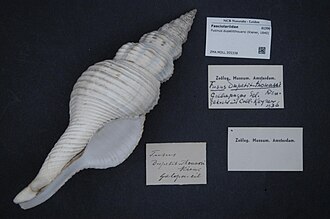
Goniofusus dupetitthouarsi
IUCN status: Not evaluatedPustulatirus hemphilli
IUCN status: Not evaluated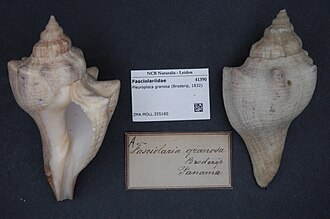
Granolaria salmo
IUCN status: Not evaluated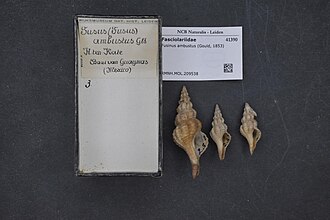
Hesperaptyxis ambustus
IUCN status: Not evaluated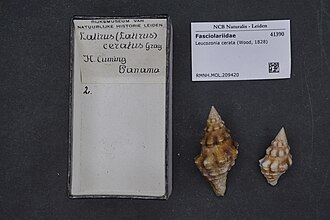
Leucozonia cerata
IUCN status: Not evaluated
Names and sources
In Spanish
- Caracol tulipán — Peru; SERNANP (2026). Plan Maestro de la Reserva Nacional Mar Tropical de Grau 2026–2031. RPE N.° 000052-2026-SERNANP, p. 94 of the PDF · main name
Classification
Learn more
Conservation status: no data (IUCN). Taxonomy: PeRMS / WoRMS (CC BY 4.0).