
Bony fishes · Carangidae
Chilean jack mackerel
Trachurus murphyi Nichols, 1920
Spanish: Jurel
- Names in Peru
- Jurel · Furel · Jurel del Pacifico Sur
- Peruvian Register of Marine Species
- Listed in PeRMS (IMARPE)

Species account
Summary
The Chilean jack mackerel (Trachurus murphyi) is a schooling pelagic fish of the south-eastern Pacific, off the coasts of Peru and Chile [1]. It reaches about 70 cm in total length [1]. Off Peru it spawns mostly between September and December, with a peak in November [2].
It is one of the country's main fishery resources: up to 1963 only a few hundred tonnes a year were landed, in 2001 catches peaked at 723000 t, and its abundance shifts strongly between cold and warm periods [3],[4],[5].
Identification and similar species
The body is long and only slightly flattened from side to side, fusiform in outline [1]. The first dorsal fin has 9 spines and the second 31 to 35 soft rays; the anal fin has 3 spines and 27 to 29 soft rays [1]. The lower part of the first gill arch has 42 to 45 gill rakers [1].
The lateral line is scaled throughout, with the scales growing into large scutes toward the tail; in the middle-curve region they equal 1.1 to 1.6 times the eye diameter [1]. The upper side is metallic blue or dark grey and the underside silvery white; the upper rear edge of the gill cover bears a black spot and the fins are dusky [1].
It grows to 70 cm in total length, and the common size is 45 cm fork length [1]. In an otolith study in Peruvian waters from 1977 to 1979, fish from 3 to 71 cm in total length were measured [6].
Distribution and habitat
FishBase places it in the eastern central and southern Pacific, off Peru and Chile, and also lists reports off Ecuador [1]. Adults live in schools, in coastal and open oceanic waters, between 10 and 306 m depth, and mostly between 10 and 70 m [1].
Off Peru its preferred habitat is the oceanic front where Cold Coastal Waters meet Subtropical Surface Waters [5]. It is less abundant in cold periods and more abundant in warm periods linked to El Niño events [5].
School depth changes with the environment: in strong El Niño years they sit between 100 and 200 m, and under strong upwelling they lie between 0 and 75 m [5]. Acoustic surveys from 1983 to 1994 found it mostly between 10 and 40 m, and between 2007 and 2012 schools were found mostly in the top 40 m [7].
Up to 1996 it was spread over the whole Peruvian sea, but afterwards its distribution was restricted to the centre-south [4].
Biology
The sexes are separate and it spawns in several batches; its egg cells develop asynchronously [2]. Off Peru there is one fairly long spawning period, with a peak in November and the highest intensity between September and December [2]. Between 1967 and 2012 the estimated size at first maturity was 26.5 cm in total length [2].
Spawning schools are small and scattered, in the surface layer above 50 m [5]. A study from October to December 1986, cited in that review, placed them 100 to 150 miles from the coast, in a front with temperatures above 18 °C [5]. Between 1966 and 2010 the annual mean of larvae ranged from 3 to 79 larvae per m2, and the Peruvian sea is a permanent reproductive centre for the species [8].
Age is read from annual rings in the otoliths; the mark was shown to be annual using otoliths with 5 marks and the monthly marginal increment of 240 otoliths [6]. From 977 pairs of otoliths, the von Bertalanffy model gave an infinite length of 80.77 cm and a growth coefficient k of 0.155 [6]. According to the parameters estimated in that study, the fish off Peru would grow faster than the one living farther south [6]. FishBase gives a maximum reported age of 16 years [1].
Ecology
It is mainly a zooplankton feeder: in 21058 stomachs analysed off Peru between 1977 and 2011, about 80 % of the diet by weight was zooplankton and about 20 % was fish [9]. Fish under 21 cm eat more mesozooplankton, and larger ones more macrozooplankton [9].
Between 1977 and 2000, in warm conditions, euphausiids dominated. After 2000, in cold conditions, the diet was more varied: euphausiids, the red squat lobster Pleuroncodes monodon and zoeae [9]. In fish of 31 to 50 cm, the anchoveta Engraulis ringens made up only 2.2 to 5.7 % [9].
Between 1972 and 2012 an inverse relation was seen between the acoustic biomass of jack mackerel and annual anchoveta landings [4]. The studies in the special issue link changes in the abundance and availability of jack mackerel to water masses and other environmental variables [3],[5].
Conservation
The IUCN classifies it globally as Data Deficient, in an assessment from 2008 [10].
It is an exploited and regulated resource. Since September 2002 jack mackerel, sardine and mackerel must go to direct human consumption, catching fish under 31 cm in total length is banned, the minimum purse-seine mesh is 38 mm, and since 2003 catch quotas have been applied for set periods [11]. For 2012 the total allowable catch was 120000 t [11].
In the summer acoustic surveys, which cover the coastal strip, estimated biomass dropped from 8.47 million tonnes in 1993 down to only 1239 t by 2010, and rose a little in the two following years [7]. Because the resource is shared among several countries, its high-seas fishing is managed by the South Pacific regional fisheries organisation [3].
Human relevance
It has been fished for millennia on the coast of Peru: between 10000 and 6000 years before present it already ranked second, after the lorna drum (Sciaena deliciosa), among the fish regularly eaten by the fishers of Quebrada de los Burros, in the south of the country [3]. In the Wari remains at Cerro Baúl, between the years 600 and 1000 CE, fish bones are mostly its own, with greater consumption at ceremonial banquets [3].
Up to 1963 only a few hundred tonnes a year were landed; in 1974 landings reached 129 thousand tonnes, and since then it has ranked between second and fourth in landed volume [3]. It is the country's most important fishery resource for direct human consumption [3].
Catches peaked in 1977, 1996-1997 and 2001, when they reached 723000 t, and in 2011 they came close to 260000 t [4]. It is caught by the artisanal fleet, the industrial purse-seine fleet and factory trawlers [4]. It is sold fresh, canned and as fishmeal [1].
Where to see it in Peru
It is an open-sea schooling fish; the summer acoustic surveys of 1983 to 2012 covered up to 100 miles from the coast, and between 2007 and 2012 schools were mostly in the top 40 m [7]. Before 2002 catches were higher in the north (Máncora to Chimbote) and afterwards in the centre-south (Huacho to Ilo) [4].
The main landing points of the artisanal fleet between 1997 and 2011 were Ilo, Pisco, Huacho, Matarani, Paita, Talara, Callao and Chimbote [4].
References (11)
- Froese, R., Pauly, D. (2026). Trachurus murphyi Nichols, 1920. FishBase. https://www.fishbase.se/summary/367 (accessed 2026-10-25)
- Perea, A., Mori, J., Buitrón, B. et al. (2013). Aspectos reproductivos del jurel Trachurus murphyi. Revista Peruana de Biología, número especial 20(1), 29-34. doi:10.15381/rpb.v20i1.2616 (accessed 2026-10-25)
- Csirke, J. (2013). El Jurel Trachurus murphyi en el Perú. Revista Peruana de Biología, número especial 20(1), 5-8. doi:10.15381/rpb.v20i1.2613 (accessed 2026-10-25)
- Ñiquen, M., Bouchon, M., Ulloa, D. et al. (2013). Análisis de la pesquería del jurel Trachurus murphyi en el Perú. Revista Peruana de Biología, número especial 20(1), 97-106. doi:10.15381/rpb.v20i1.2625 (accessed 2026-10-25)
- Dioses, T. (2013). Patrones de distribución y abundancia del jurel Trachurus murphyi en el Perú. Revista Peruana de Biología, número especial 20(1), 67-74. doi:10.15381/rpb.v20i1.2621 (accessed 2026-10-25)
- Dioses, T. (2013). Edad y crecimiento del jurel Trachurus murphyi en el Perú. Revista Peruana de Biología, número especial 20(1), 45-52. doi:10.15381/rpb.v20i1.2618 (accessed 2026-10-25)
- Segura, M., Aliaga, A. (2013). Biomasa acústica y distribución del jurel Trachurus murphyi en el Perú. Revista Peruana de Biología, número especial 20(1), 87-96. doi:10.15381/rpb.v20i1.2624 (accessed 2026-10-25)
- Ayón, P., Correa, J. (2013). Variabilidad espacial y temporal de larvas de jurel Trachurus murphyi en el Perú entre 1966 –2010. Revista Peruana de Biología, número especial 20(1), 83-86. doi:10.15381/rpb.v20i1.2623 (accessed 2026-10-25)
- Alegre, A., Espinoza, P., Espino, M. (2013). Ecología trófica del jurel Trachurus murphyi en el Perú entre 1977 – 2011. Revista Peruana de Biología, número especial 20(1), 75-82. doi:10.15381/rpb.v20i1.2622 (accessed 2026-10-25)
- Smith-Vaniz, B., Robertson, R., Dominici-Arosemena, A. (2008). Trachurus murphyi: Smith-Vaniz, B., Robertson, R. & Dominici-Arosemena, A. The IUCN Red List of Threatened Species. doi:10.2305/iucn.uk.2010-3.rlts.t183965a8207652.en (accessed 2026-10-25)
- Zuzunaga, J. (2013). Medidas de conservación y ordenación pesquera del jurel Trachurus murphyi en el Perú. Revista Peruana de Biología, número especial 20(1), 107-113. doi:10.15381/rpb.v20i1.2626 (accessed 2026-10-25)
More pictures
Where it has been recorded
- Filled: scientific records, or confirmed by a curator
- Hatched: isolated record
- Dotted outline: no scientific records and no curator's confirmation (an ORKA sighting is not drawn here)
- Tropical northern sea
Scientific records (1 record)
- Cold central sea
Scientific records (5 records)
- Cold southern sea
Scientific records (2 records)
From openly licensed OBIS and GBIF records (CC0 or CC BY). How each list is built.
Related species
From the same family.
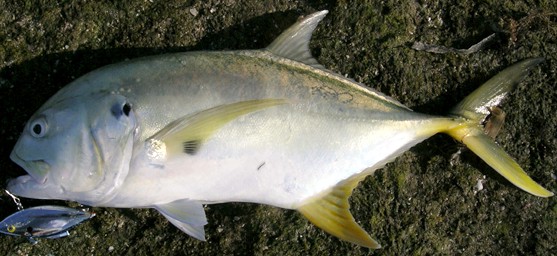
Pacific crevalle jack
Caranx caninus
IUCN status: LC · Least Concern
Jack
Caranx hippos
IUCN status: LC · Least Concern
Pacific bumper
Chloroscombrus orqueta
IUCN status: LC · Least Concern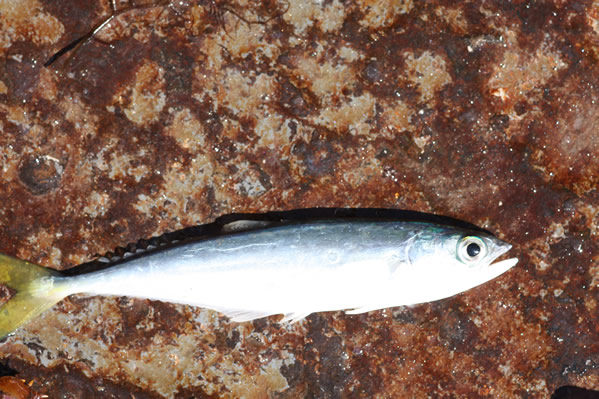
Shortjaw leatherjack
Oligoplites refulgens
IUCN status: LC · Least Concern
Bigeye scad
Selar crumenophthalmus
IUCN status: LC · Least Concern
Pacific moonfish
Selene peruviana
IUCN status: LC · Least Concern
Paloma pompano
Trachinotus paitensis
IUCN status: LC · Least Concern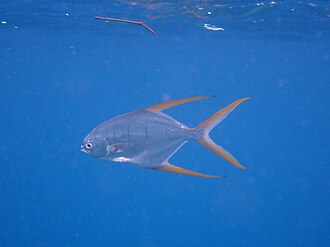
Gafftopsail pompano
Trachinotus rhodopus
IUCN status: LC · Least Concern
Names and sources
In Spanish
- Jurel — Peru; SERNANP (2024). Plan Maestro de la Reserva Nacional Dorsal de Nasca 2024-2029. RP N.° 000040-2024-SERNANP, p. 24 of the PDF; fishbase; Wikidata · main name
- Furel — Peru; fishbase
- Jurel Chileno — Wikidata
- Jurel Común — Wikidata
- Jurel del Pacifico Sur — Peru; fishbase; Wikidata
In English
- Chilean jack mackerel — WoRMS; Wikidata
- Inca Scad — Wikidata
- Jack Mackerel — Wikidata
- Slender Mackerel — Wikidata
Classification
Learn more
Conservation status: Data Deficient (IUCN Red List, according to Wikidata). Taxonomy: PeRMS / WoRMS (CC BY 4.0).