
Bony fishes · Carangidae
Paloma pompano
Trachinotus paitensis Cuvier, 1832
Spanish: Pampano
- Names in Peru
- Pampano · Palometa · Pampanito
- Peruvian Register of Marine Species
- Listed in PeRMS (IMARPE)

Species account
Summary
Trachinotus paitensis is a fish of the family Carangidae, described by Cuvier in 1832 [1]. It has a deep, strongly compressed body and reaches about 51 cm in total length [2]. It lives in the eastern Pacific, from southern California to Chile, and adults form schools over shallow sandy areas near the coast [2]. It feeds on small snails, shrimp larvae and other invertebrates of the seabed [3]. Its global IUCN Red List category is Least Concern [4]. In Peru the Instituto del Mar del Perú calls it pámpano [5].
Identification and similar species
It has a deep, strongly compressed body, a small mouth and tiny bristle-like teeth in the jaws [2]. The dorsal fin carries 6 spines, followed by 1 more spine and 24 to 27 soft rays, and the lower branch of the first gill arch bears 8 to 10 gill rakers [2].
The upper third of the body is dark and the belly is white, with golden glints on the flanks; it has no spots or marks that set it apart [2]. The largest recorded size is 51 cm in total length, and 30 cm is typical [2]. A diet study describes it as having an extremely small mouth, which restricts the type and size of prey it can exploit [6].
Distribution and habitat
It occurs in the eastern Pacific, from Redondo Beach, in southern California, to Chile, and includes the Galápagos Islands [2]. It is one of 35 species of the family Carangidae present in the central-eastern Pacific, with a cited range from California to Chile [3].
It is a marine benthopelagic species, recorded between 0 and 100 m depth; adults live in coastal waters and gather in schools over shallow sandy areas [2]. In Peru, the Instituto del Mar del Perú recorded it in 2019 among the fish cast onto the beach at Parachique, in Sechura province, Piura region [5].
Biology
It is an opportunistic carnivore. In San Ignacio Lagoon, in Baja California Sur (Mexico), 82 stomachs of fish caught with a gillnet in May and August 1992 were examined, and 11 food components were identified [3]. By number, the most frequent were snails of the genus Bittium (45.9 %), mysis stages of shrimps of the genus Penaeus (14.8 %), swimming-crab megalopae (11.7 %), snails of the genus Anachis (9.2 %) and amphipods (7.1 %) [3]. By weight, Anachis (36.1 %) and gastropod remains (30.2 %) predominated [3].
Another analysis from the same lagoon, with 82 stomachs of this species, found only 8 prey types, the fewest among the 5 species compared, and every stomach held food [6]. In spring Bittium and gastropod remains dominated, and in summer Penaeus larvae and Anachis [6]. The authors place it among the mollusc consumers and explain the abundance of Bittium by the size of its mouth, which admits only very small prey [6].
Ecology
In San Ignacio Lagoon it is one of the dominant members of the fish fauna and acts as a predator of invertebrates living on the bottom [3]. Its diet is narrow, with low breadth values, and the overlap of its food with that of the other 4 dominant species in the lagoon was low [6]. Its main prey changed between spring and summer, and the authors regard it as an opportunistic carnivore [6].
Conservation
Human relevance
Where to see it in Peru
In Peru, the literature we could consult gives only one local record: on 12 March 2019, staff of the Instituto del Mar del Perú coastal laboratory in Paita recorded pámpanos among fish stranded along about 1000 m of beach at the cove of Parachique, in Sechura, Piura [5]. It was a stranding during a scallop mortality episode in the bay, with oxygen-poor bottom water, and not an observation of live fish [5].
References (6)
- WoRMS Editorial Board (2026). Trachinotus paitensis Cuvier, 1832. World Register of Marine Species. https://www.marinespecies.org/aphia.php?p=taxdetails&id=273296 (accessed 2026-10-25)
- Froese, R., Pauly, D. (2026). Trachinotus paitensis, Paloma pompano. FishBase. https://www.fishbase.se/summary/Trachinotus-paitensis.html (accessed 2026-10-25)
- Cruz Escalona, V.H., Abitia Cárdenas, L.A. (2014). General characteristics of the diet of Trachinotus paitensis (Teleostei: Carangidae) from San Ignacio Lagoon, Baja California Sur, Mexico. Revista de Biología Tropical 52(1), 139-141. doi:10.15517/rbt.v52i1.14762 (accessed 2026-10-25)
- Smith-Vaniz, B., Robertson, R., Dominici-Arosemena, A. (2008). Trachinotus paitensis: Smith-Vaniz, B, Robertson, R. & Dominici-Arosemena, A. The IUCN Red List of Threatened Species. doi:10.2305/iucn.uk.2010-3.rlts.t183684a8158031.en (accessed 2026-10-25)
- Instituto del Mar del Perú (2019). IMARPE registra mortandad de concha de abanico Argopecten purpuratus y varazón de peces en bahía de Sechura. Nota de prensa, gob.pe. https://www.gob.pe/institucion/imarpe/noticias/50959-imarpe-registra-mortandad-de-concha-de-abanico-argopecten-purpuratus-y-varazon-de-peces-en-bahia-de-sechura (accessed 2026-10-25)
- Cruz-Escalona, V.H., Campos-Dávila, L., Zetina-Rejón, M.J. (2010). Differential use of food resources by dominant fish of San Ignacio Lagoon, Baja California Sur, Mexico. CICIMAR Oceánides 25(1), 1-15. doi:10.37543/oceanides.v25i1.75 (accessed 2026-10-25)
More pictures
Where it has been recorded
- Filled: scientific records, or confirmed by a curator
- Hatched: isolated record
- Dotted outline: no scientific records and no curator's confirmation (an ORKA sighting is not drawn here)
- Tropical northern sea
Scientific records (6 records)
- Tropical–cold transition zone
Scientific records (18 records)
- Cold central sea
Scientific records (5 records)
- Cold southern sea
Scientific records (5 records)
From openly licensed OBIS and GBIF records (CC0 or CC BY). How each list is built.
Related species
From the same genus (Trachinotus) and from the same family (Carangidae).
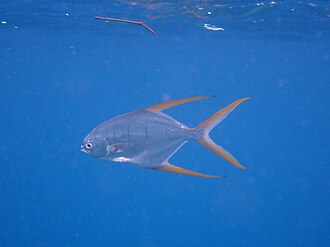
Gafftopsail pompano
Trachinotus rhodopus
IUCN status: LC · Least Concern
Blackblotch pompano
Trachinotus kennedyi
IUCN status: LC · Least Concern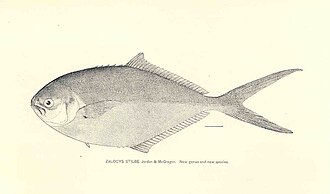
Steel pompano
Trachinotus stilbe
IUCN status: LC · Least Concern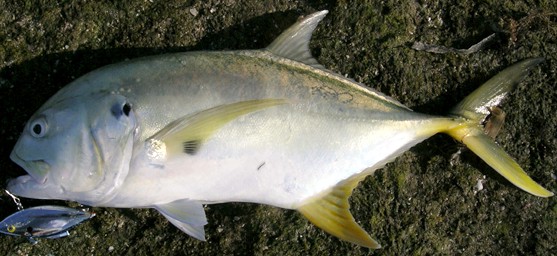
Pacific crevalle jack
Caranx caninus
IUCN status: LC · Least Concern
Jack
Caranx hippos
IUCN status: LC · Least Concern
Pacific bumper
Chloroscombrus orqueta
IUCN status: LC · Least Concern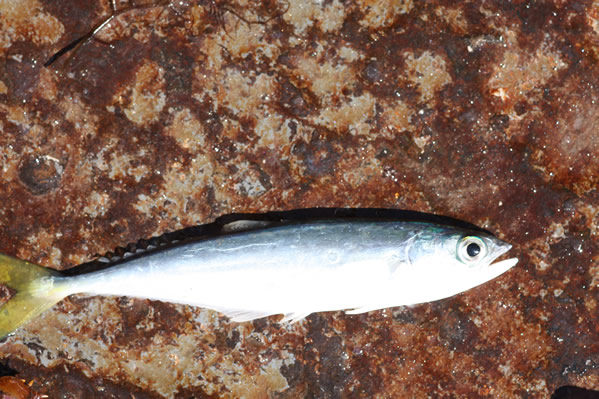
Shortjaw leatherjack
Oligoplites refulgens
IUCN status: LC · Least Concern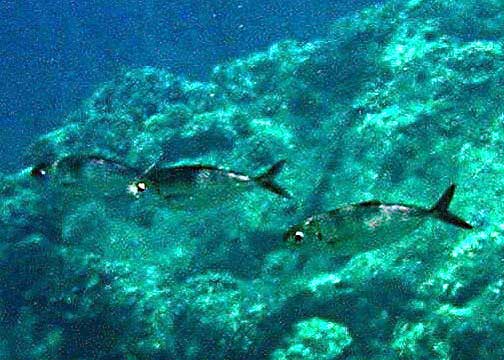
Bigeye scad
Selar crumenophthalmus
IUCN status: LC · Least Concern
Names and sources
In Spanish
- Pampano — Peru; fishbase; Wikidata · main name
- Chaso — Wikidata
- Palometa — Peru; fishbase; Wikidata
- Pampanito — Peru; fishbase; Wikidata
- Pámpano Chaso — Wikidata
- Pampano Paloma — Wikidata; WoRMS
In English
- Paloma pompano — WoRMS; Wikidata
- Pompano — Wikidata
Classification
Learn more
Conservation status: Least Concern (IUCN Red List, according to Wikidata). Taxonomy: PeRMS / WoRMS (CC BY 4.0).