
Seabirds · Diomedeidae
Black-browed albatross
Thalassarche melanophris (Temminck, 1828)
Spanish: Albatros de ceja negra
- Names in Peru
- Albatros de ceja negra
- Peruvian Register of Marine Species
- Listed in PeRMS (IMARPE)
Species account
Summary
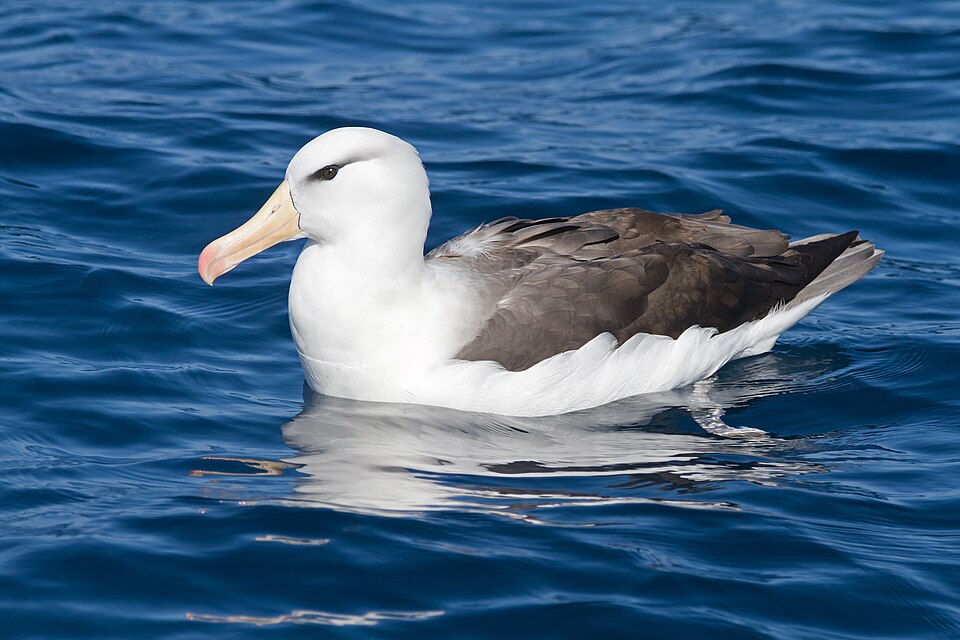
Thalassarche melanophris is an albatross of the family Diomedeidae, described by Temminck in 1828 under the name Diomedea melanophris [1]. In Peru it is called «albatros de ceja negra» [2]. It breeds in colonies on sub-Antarctic islands spread across southern Chile, the South Atlantic, the Indian Ocean and the western Pacific [2]. In the surveys made at sea off Peru in 2019 it was far more abundant in autumn than in spring and appeared only from Callao southwards; the authors read this as the arrival of birds that have just finished breeding and spend the winter here [3]. The IUCN Red List classifies it as Least Concern in its 2018 assessment [4], while Peru's official list of threatened wildlife, approved in 2014, places it in the Endangered category [5].
Identification and similar species
Its age can be estimated by combining bill colour with the state of flight-feather moult; according to earlier work reviewed by Bugoni and Furness, this approach allows age to be assigned up to 6 years [6].
In birds caught at sea off southern Brazil in 2006 and 2007, first-year birds, recently fledged, had a dark grey bill with blackish nails in May, but by August it was already very pale, with black only at the base of the upper part and on the nails; 1-year-old birds had a pale beige bill with grey patches and nails that were still black, though pale-tipped, and 2 adults caught in late July had the reddish nail typical of their age and no grey on the bill [6]. In the same waters a 1-year-old bird turned up with a black bill, darker even than that of the May fledglings, resembling the pattern described from South Georgia; for the authors this indicates that the birds wintering there have varied origins and that bill colour matures differently depending on the colony [6].
Of the birds seen off Peru in 2019, 63 % were adults and 37 % subadults, and among the latter 67 % were second-year birds [3].
Distribution and habitat
It is a colonial species that breeds on several islands in southern Chile, on the Falklands and South Georgia in the Atlantic, on the Crozet, Kerguelen, Heard and McDonald islands in the Indian Ocean, and on Macquarie, Campbell and the Antipodes in the western Pacific [2].
Censuses, almost all aerial photographic surveys made between 2001 and 2006, added up to at least 122920 pairs at 6 sites in Chile, a little over 20 % of the world population; the largest were Diego Ramírez, with 55000 pairs, Ildefonso, with 47000, and Diego de Almagro, with 15594 [7].
In 2 surveys made at sea off Peru in 2019, in autumn and in spring, it was found only between Callao, at about 12° S, and the country's southern limit, at 18°20′ S, with the highest concentration between 16° S and 17° S and mostly over the continental slope [3]. Since it did not appear north of Callao, the authors propose that its northern limit depends on the coastal branch of the Humboldt Current system and on competition with Phoebastria irrorata and Thalassarche salvini, which are abundant in the warmer waters of central and northern Peru [3]. The birds seen in oceanic waters of central and southern Peru come from the colonies of far southern Chile, such as Diego Ramírez, San Ildefonso and Diego de Almagro [2].
Biology
It breeds every year, although it is common for a bird to skip a season; it nests on cliffs or slopes, preferably among tussock grass (Poa flabellata), in a cone-shaped nest of mud and plant material, where it lays 1 single egg per season and does not replace it if lost [2]. The breeding season runs from October to April, and young birds join the breeding population between 7 and 19 years of age, at a mean of 10.3 years [2].
On Bird Island, South Georgia, it was the only one of the 3 albatross species studied that breeds every year; its mean breeding success was 0.300, and breeding successfully had a positive effect on the next reproduction [8]. There, annual adult survival fell from 0.979 in 1989 to 0.875 in 2008, and juvenile survival from 0.910 in 1985 to 0.653 in 1997 [8].
In a colony on the same island followed over the 2004/05 and 2005/06 seasons, the first adults arrived around mid-October; according to an earlier study cited by the authors, 93 % of pairs that stay together reuse the same nest the following season [9].
Ecology
In the Peru Current surveys made between 1980 and 1995 off Chile and Peru, 1368 individuals were recorded; it was one of the regularly seen species, with about 57.7 birds per 100 km² in autumn and winter against about 18.5 in spring and summer [10]. It enters those waters from the south during its non-breeding period and belongs to the group of birds that eat mainly carrion or prey caught at the surface [10].
Beside an artisanal shark longliner sailing from Ilo between May and July 2021, it cautiously approached the shark intestines thrown into the water after white-chinned petrels had arrived; when liver was thrown the contest became more intense and there were fights with those petrels, Thalassarche bulleri arrived late and had to fight it for food, and Thalassarche eremita and Macronectes halli pushed all the other birds aside [11].
At the colonies it is under pressure from predatory birds: on Bird Island, nests at the edge succeeded in 10 % of cases and those in the centre in 23 %, which the authors attribute to brown skuas and giant petrels preferring to attack edge nests, which are easier to reach [9]. On that island, higher krill density during breeding was linked to higher adult survival [8].
Conservation
Its global category is Least Concern [4]. In Peru it is classified as Endangered, and the norm that lists it prohibits hunting, capture, possession, trade, transport and export for commercial purposes of the listed species [5].
In the study colonies on Bird Island, South Georgia, the number of breeding pairs fell from 607 in 1990 to 202 in 2012, and on average the population declined by almost 4 % a year [8]. Trawl fishing effort was associated with lower juvenile survival and demersal longline effort with lower adult survival, effects present all year but mostly outside the breeding season, which add to those of climate [8].
In Chile the trend went the other way. In the Patagonian toothfish fishery, which operates between 47° S and the Beagle Channel, incidental mortality dropped from some 2000 albatrosses a year in 2002 to 0 in the 2006 and 2007 seasons [7]. According to aerial surveys, between 2002 and 2011 bird numbers grew by 52 % at Diego Ramírez and by 18 % at Ildefonso, which the authors attribute to lower mortality in the toothfish longline fishery after the fleet switched to gear whose hooks sink much faster; a new census in 2014 found about 54284 pairs at Ildefonso, roughly the same as in 2011, and 29 % more birds at Diego Ramírez [12].
The same authors of the Chilean census warn that, because of the great extent of its travels, the species remains exposed in distant waters of the southeastern and central Pacific, where large trawlers and pelagic longliners from Northern Hemisphere countries fish for jack mackerel and swordfish [7].
According to the workshops of the Master Plan of the Dorsal de Nasca National Reserve, there is incidental capture of albatrosses in that area [2].
Human relevance
According to information gathered in the workshops of the Master Plan of the Dorsal de Nasca National Reserve, albatrosses are also hunted so that their feathers can be used in fishing for bonito [2].
Where to see it in Peru
In 2 surveys made in 2019 along 36 transects, from the coast to 100 nautical miles offshore, 46 individuals were counted in autumn and only 4 in spring, all between Callao and the country's southern limit and mostly between 16° S and 17° S [3].
Between October 2015 and April 2017, observers aboard artisanal squid boats in southern Peru saw 5 individuals, 4 of them over the continental slope [13]. Between May and July 2021 it came to the shark offal thrown from an artisanal longliner during 2 fishing trips in oceanic waters off Ilo [11].
References (13)
- WoRMS Editorial Board (2026). Thalassarche melanophris (Temminck, 1828). World Register of Marine Species. https://www.marinespecies.org/aphia.php?p=taxdetails&id=343995 (accessed 2026-10-20)
- Servicio Nacional de Áreas Naturales Protegidas por el Estado (SERNANP) (2024). Plan Maestro de la Reserva Nacional Dorsal de Nasca 2024-2029. SERNANP; aprobado por RP N.° 000040-2024-SERNANP. https://cdn.www.gob.pe/uploads/document/file/5997712/5313081-anexo.pdf (accessed 2026-10-20)
- Quiñones, J., Manrique, M., Arata, J. (2021). Occurrence of Black-browed Albatross (Thalassarche melanophris) in southern Peru provides clues on their northern limit. Ornithology Research, 50-55. doi:10.1007/s43388-021-00043-4 (accessed 2026-10-20)
- BirdLife International (2018). Thalassarche melanophris: BirdLife International. The IUCN Red List of Threatened Species 2018: e.T22698375A132643647. doi:10.2305/IUCN.UK.2018-2.RLTS.T22698375A132643647.en (accessed 2026-10-20)
- Ministerio de Agricultura y Riego (2014). Decreto Supremo N.° 004-2014-MINAGRI: actualización de la lista de clasificación y categorización de las especies amenazadas de fauna silvestre legalmente protegidas. El Peruano (08-04-2014); ficha en SINIA, Ministerio del Ambiente. https://sinia.minam.gob.pe/normas/lista-especies-amenazadas-fauna-silvestre-legalmente-protegidas (accessed 2026-10-20)
- Bugoni, L., Furness, R.W. (2009). Ageing Immature Atlantic Yellow-nosed Thalassarche Chlororhynchos and Black-browed T Melanophris Albatrosses in Wintering Grounds Using Bill Colour and Moult. Marine Ornithology, 249-252. doi:10.5038/2074-1235.37.3.852 (accessed 2026-10-20)
- Moreno, C.A., Robertson, G. (2008). ¿Cuántos albatros de ceja negra, Thalassarche melanophrys (Temminck, 1828) anidan en Chile?. Anales del Instituto de la Patagonia, 89-92. doi:10.4067/S0718-686X2008000100008 (accessed 2026-10-20)
- Pardo, D., Forcada, J., Wood, A.G. et al. (2017). Additive effects of climate and fisheries drive ongoing declines in multiple albatross species. Proceedings of the National Academy of Sciences, E10829-E10837. doi:10.1073/pnas.1618819114 (accessed 2026-10-20)
- Forster, I.P., Phillips, R.A. (2009). Influence of Nest Location, Density and Topography on Breeding Success in the Black-browed Albatross Thalassarche Melanophris. Marine Ornithology, 213-217. doi:10.5038/2074-1235.37.3.846 (accessed 2026-10-20)
- Spear, L.B., Ainley, D.G. (2008). The Seabird Community of the Peru Current, 1980-1995, with Comparisons to Other Eastern Boundary Currents. Marine Ornithology, 125-144. doi:10.5038/2074-1235.36.2.781 (accessed 2026-10-20)
- Quiñones, J., Zavalaga, C., Robertson, C.J.R. (2023). Identifying northern Buller´s albatross (Thalassarche bulleri subsp.) in offshore waters of southern Perú. Notornis, 49-59. doi:10.63172/070670wsvhfm (accessed 2026-10-20)
- Robertson, G., Wienecke, B., Suazo, C.G. et al. (2016). Continued increase in the number of black-browed albatrosses (Thalassarche melanophris) at Diego Ramírez, Chile. Polar Biology, 1035-1042. doi:10.1007/s00300-016-2028-5 (accessed 2026-10-20)
- Moreno, C., Quiñones, J. (2022). Albatross and Petrel Interactions with an Artisanal Squid Fishery in Southern Peru during El Niño, 2015-2017. Marine Ornithology, 49-56. doi:10.5038/2074-1235.50.1.1459 (accessed 2026-10-20)
More pictures
If you come across it
Protected or threatened species. Watch it without touching, feeding, chasing or taking it, and keep the recommended viewing distances.national category: Endangered (EN) — Supreme Decree No. 004-2014-MINAGRI, classification of threatened wild fauna species (El Peruano, 8 April 2014), p. 7 of the PDF
Where it has been recorded
- Filled: scientific records, or confirmed by a curator
- Hatched: isolated record
- Dotted outline: no scientific records and no curator's confirmation (an ORKA sighting is not drawn here)
- Tropical northern sea
Scientific records (3 records)
- Cold central sea
Scientific records (19 records)
- Cold southern sea
Scientific records (112 records)
From openly licensed OBIS and GBIF records (CC0 or CC BY). How each list is built.
Related species
From the same genus (Thalassarche) and from the same family (Diomedeidae).
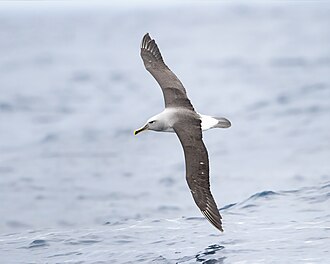
Buller's albatross
Thalassarche bulleri
IUCN status: NT · Near ThreatenedProtected in Peru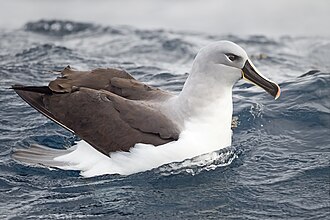
Grey-headed albatross
Thalassarche chrysostoma
IUCN status: Not evaluatedProtected in Peru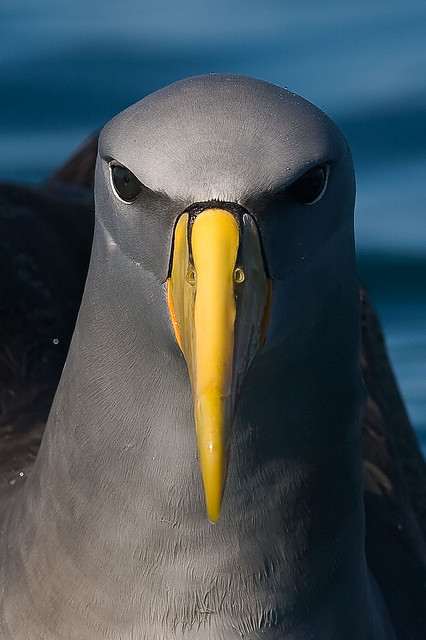
Chatham albatross
Thalassarche eremita
IUCN status: VU · VulnerableProtected in Peru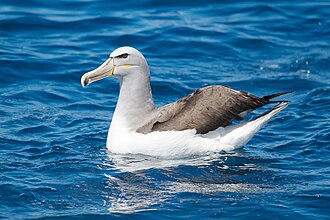
Salvin's albatross
Thalassarche salvini
IUCN status: VU · VulnerableProtected in Peru
Waved albatross
Phoebastria irrorata
IUCN status: CR · Critically EndangeredProtected in Peru
Names and sources
In Spanish
- Albatros de ceja negra — Peru; SERNANP (2024). Plan Maestro de la Reserva Nacional Dorsal de Nasca 2024-2029. RP N.° 000040-2024-SERNANP, p. 40 of the PDF · main name
- Albatros ceja negra — Wikidata
- Albatros ojeroso — Wikidata
- Thalassarche melanophrys — Wikidata
In English
- Black-browed albatross — WoRMS; Wikidata
Classification
Learn more
Conservation status: Least Concern (IUCN Red List, according to Wikidata). Taxonomy: PeRMS / WoRMS (CC BY 4.0).