
Seabirds · Diomedeidae
Chatham albatross
Thalassarche eremita Murphy, 1930
Spanish: Albatros de Chatham
- Names in Peru
- Albatros de Chatham
- Peruvian Register of Marine Species
- Listed in PeRMS (IMARPE)

Species account
Summary
Thalassarche eremita is an albatross of the family Diomedeidae, described by Murphy in 1930 [1]. In Peru it is called «albatros de Chatham» [2]. Its whole population breeds on a single islet, The Pyramid, the southernmost of the Chatham archipelago in New Zealand [3]. Once breeding is over, part of the population disperses to Humboldt Current waters off Chile and Peru [4]. The IUCN Red List classifies it as Vulnerable in its 2018 assessment [5], and Peru's official list of threatened wildlife, approved in 2014, places it in the Critically Endangered category [6].
Etymology
The name dates from 1930, when Murphy described the subspecies Thalassarche cauta eremita from birds that Rollo Beck obtained on 3 March 1926 beside The Pyramid; Beck's diary shows that rough seas kept him from landing and that the specimens were taken on the water around the rock [7]. For a long time it was considered a sedentary race of the Diomedea cauta group, until a review of the albatrosses published in 1997 proposed raising it to a species in the re-established genus Thalassarche [4]. In the English literature it used to be called Chatham Island mollymawk [8],[9].
Identification and similar species
It is a small albatross for its group. A bird seen south of Tasmania in 1995 looked clearly smaller than the Thalassarche cauta group albatrosses it was flying with, with a wingspan judged to be 0.1 to 0.2 m shorter, though bigger than the Thalassarche melanophris group. Its head and neck were dark grey with a brown tinge, making a complete hood that reached the mantle, with the forehead only slightly paler; underneath, the wing was white with a narrow black leading edge, a black patch by the armpit and a black tip, and the belly, rump and upper tail coverts were white too; the bill was bright yellow all over [9].
Breeding adults show a little black at the tip of the bill, and another bird seen there in 1996 had a golden-yellow bill with a dark spot at the tip of the lower mandible [9]. In a bird seen in 1988 off Chiclayo the bill was straw-coloured with a dark tip on the 2 mandibles, a feature that set it apart from the other albatrosses of the Thalassarche cauta group [8]. Off Valparaíso in 2001, 2 immatures stood out in a mixed flock because the head and neck were an even dark brownish grey, the crown only a little paler, blending into the colour of the mantle; the older one, 3 to 4 years old, had a yellow bill with a blackish nail, and the younger one an olive-brown bill with black tips [4].
Similar species
- Thalassarche salvini: Its head and neck are a blotchy brownish grey but the crown is white, and the bill is greyish horn with a black nail; Thalassarche eremita has an even dark hood with no white crown and a yellow bill [4],[9].
- Thalassarche bulleri: It has a pale grey head with a white crown, and a black bill with one yellow stripe along the top and another along the bottom [4].
- Thalassarche cauta: It is larger and lacks the complete grey-brown hood over the head and neck [9].
- Thalassarche melanophris: In a mixed flock seen off Chile it was the only albatross with a white head and neck and a dark underwing [4].
Distribution and habitat
It breeds only on The Pyramid, the southernmost islet of the Chatham archipelago, at 44° 25′ S and 176° 14′ W: it covers 1.7 ha and rises 174 m, and about 4500 pairs breed there each year [3]. The island lies 870 km east of the New Zealand mainland and is almost inaccessible [10]. It is a steep rock, an old volcanic neck; counts along strips of its slopes and photographs taken on a 1964 visit gave an estimate of about 2500 pairs [7].
Outside the breeding season part of the population disperses to the Humboldt Current off Chile and Peru, something established through satellite tracking, band recoveries, bycatch and sightings [4]. Satellite tracking of 3 adults in 1997 and 1998 showed a rapid eastward crossing of the Pacific, a sustained flight north along the South American coast and almost sedentary periods over the slope and shelf, between 26° S and 6° S and between 80° W and 70° W [10].
Away from that route it is a very rare visitor. For Australian waters, a 1997 paper gathered only 5 records, all from the south and west of Tasmania, 2 of them of birds that spent years in a colony on Albatross Island in Bass Strait [9].
Biology
It is a colonial species that breeds every year [2]. Eggs are laid in September and October, chicks hatch in November and December, and fledglings leave the colony in March and April [3]. The youngest bird recorded returning to the colony was 4 years old, and first breeding has been observed at 7 years [2].
While raising small chicks, adults forage fairly close to home. Over 3 consecutive seasons of GPS tracking, from 2007 to 2009, most birds neither left the shelf of the Chatham Rise nor went more than 400 km from the colony, although the greatest distance reached was 405 km in 2007, 651 km in 2008 and 1260 km in 2009 [3]. In 2007 no bird spent more than 3 days at sea on a single trip [3].
It covers huge distances. Satellite tracking gave mean point-to-point speeds, which are a minimum, as high as 85 km per hour, and flight speed turned out to be similar by day and by night [10].
Ecology
During breeding, the places where it forages were linked mainly with water under 2500 m deep, seabed slopes of 1 to 4°, surface temperatures of 15 to 16 °C and chlorophyll concentrations above 1 mg per m3, though none of these variables explained them on its own [3]. The authors think that commercial fishing on the Chatham Rise also shapes where it feeds, because it provides extra food [3].
Off Peru in autumn 2019, a first-year bird was photographed gliding low over the water, settling in the middle of a mixed seabird flock and catching a medium-sized cephalopod, probably a jumbo squid (Dosidicus gigas), 98 km offshore of Punta Caballas [11]. On trips with observers aboard the squid fishery and the shark longline fishery, these albatrosses ate discarded viscera in 37 % of cases, the liver above all, as the catch was cleaned [11].
Of the birds observed off Peru, 53 % were flying, 27 % were sitting on the water, 8 % were feeding on prey in open water and 12 % were eating shark discards; several times they were seen in mixed flocks with Phoebastria irrorata, Thalassarche salvini, Procellaria aequinoctialis and Ardenna grisea [11]. In the artisanal squid fishery of southern Peru, between 2015 and 2017, 21 % of the individuals of this species were seen eating discards [12].
Conservation
Its global category is Vulnerable [5]. In Peru it is classed as Critically Endangered, and the norm that lists it bans hunting, capture, possession, trade, transport and export for commercial purposes of the species included [6].
On the Chatham Rise, where it feeds while breeding, commercial fishing is intense: the birds compete with it for food and die as bycatch, and an assessment cited by the authors rated their risk of being killed in the trawl and longline fisheries there as very high [3]. To protect it, the authors propose reducing that bycatch and safeguarding the shelf and shelf break southeast of the colony, where the tracked birds fed consistently, with strict measures that could include closing it to fishing [3].
Its only breeding site is an islet just 1.6 km round, and strong storms strip away its substrate, which shrinks the space available for nests [2]. Captures on pelagic and bottom longlines in New Zealand waters have also been documented, as have deaths on longliners working off Chile and Peru [2].
In 1999 an adult carrying a satellite transmitter was caught on a longline off Chimbote [4]. Its almost sedentary behaviour off the Peruvian coast, in a highly productive area with intense fishing, could expose it to harmful interactions with vessels [10]. On 16 artisanal squid-fishing trips with observers in southern Peru, from 2015 to 2017, 1 albatross of this species was hooked on a squid jig and released [12]. Off southern Peru, 61 % of the sightings gathered by IMARPE and its colleagues fell within the highest-catch areas of the shark longline fishery, and those authors warn that, given their size, Peru's artisanal fleets could have a very high impact on albatrosses and petrels [11].
Where to see it in Peru
Records gathered from 2004 to 2021 on IMARPE cruises, in the artisanal longline and squid fisheries and on other trips add up to 82 Chatham albatrosses, between Callao (12° S) and the maritime boundary with Chile (19° S), 12 to 290 km from the coast; none was seen north of 12° S [11]. Of these, 71 % were seen in autumn, 21 % in winter, 5 % in spring and only 4 % in summer [11].
It is a bird of the open ocean: only 2 % were seen over the continental shelf, against 55 % over the slope, 28 % over the abyssal plain and 15 % over the Peru-Chile Trench, at a mean distance of 110.9 km from the coast [11]. The largest concentration, 63 % of sightings, was in oceanic waters between Mollendo and the southern part of the Hague Triangle, 50 to 220 km from the coast [11].
In southern Peru, aboard squid-jigging boats, 19 individuals were counted between October 2015 and April 2017, 68 % of them over the continental slope, and none in spring [12]. There are also scattered records further north, such as a bird seen on 22 July 1988, 165 nautical miles off Chiclayo [8].
References (12)
- WoRMS Editorial Board (2026). Thalassarche eremita Murphy, 1930. World Register of Marine Species. https://www.marinespecies.org/aphia.php?p=taxdetails&id=225779 (accessed 2026-10-20)
- Servicio Nacional de Áreas Naturales Protegidas por el Estado (SERNANP) (2024). Plan Maestro de la Reserva Nacional Dorsal de Nasca 2024-2029. SERNANP; aprobado por RP N.° 000040-2024-SERNANP. https://cdn.www.gob.pe/uploads/document/file/5997712/5313081-anexo.pdf (accessed 2026-10-20)
- Deppe, L., McGregor, K.F., Tomasetto, F. et al. (2014). Distribution and predictability of foraging areas in breeding Chatham albatrosses Thalassarche eremita in relation to environmental characteristics. Marine Ecology Progress Series, 287-301. doi:10.3354/meps10624 (accessed 2026-10-20)
- Latham, P.C.M., Marin, M., Powlesland, R.G. (2004). Chatham albatross (Thalassarche eremita) off the Chilean coast. Notornis, 47-49. doi:10.63172/899663hujkgn (accessed 2026-10-20)
- BirdLife International (2018). Thalassarche eremita: BirdLife International. The IUCN Red List of Threatened Species 2018: e.T22698393A132644476. doi:10.2305/IUCN.UK.2018-2.RLTS.T22698393A132644476.en (accessed 2026-10-20)
- Ministerio de Agricultura y Riego (2014). Decreto Supremo N.° 004-2014-MINAGRI: actualización de la lista de clasificación y categorización de las especies amenazadas de fauna silvestre legalmente protegidas. El Peruano (08-04-2014); ficha en SINIA, Ministerio del Ambiente. https://sinia.minam.gob.pe/normas/lista-especies-amenazadas-fauna-silvestre-legalmente-protegidas (accessed 2026-10-20)
- Dawson, E.W. (1973). Albatross populations at the Chatham Islands. Notornis, 210-230. doi:10.63172/670004lcgykb (accessed 2026-10-20)
- Haase, B. (1994). A Chatham Island mollymawk off the Peruvian coast. Notornis, 50. doi:10.63172/827693zwzgrm (accessed 2026-10-20)
- Reid, T., James, D. (1997). The Chatham Island mollymawk (Diomedea eremita) in Australia. Notornis, 125-128. doi:10.63172/466009yyilyu (accessed 2026-10-20)
- Nicholls, D.G., Robertson, C.J.R. (2007). Assessing flight characteristics for the Chatham albatross (Thalassarche eremita) from satellite tracking. Notornis, 168-179. doi:10.63172/809540eaqpte (accessed 2026-10-20)
- Quiñones, J., Romero, C., Mangel, J.C. et al. (2022). At-sea surveys reveal new insights of fine-scale distribution and foraging behaviour of Chatham albatrosses (Thalassarche eremita) in central southern Peru. Notornis, 72-78. doi:10.63172/668707vinuns (accessed 2026-10-20)
- Moreno, C., Quiñones, J. (2022). Albatross and Petrel Interactions with an Artisanal Squid Fishery in Southern Peru during El Niño, 2015-2017. Marine Ornithology, 49-56. doi:10.5038/2074-1235.50.1.1459 (accessed 2026-10-20)
More pictures
If you come across it
Protected or threatened species. Watch it without touching, feeding, chasing or taking it, and keep the recommended viewing distances.national category: Critically Endangered (CR) — Supreme Decree No. 004-2014-MINAGRI, classification of threatened wild fauna species (El Peruano, 8 April 2014), p. 6 of the PDF
Where it has been recorded
- Filled: scientific records, or confirmed by a curator
- Hatched: isolated record
- Dotted outline: no scientific records and no curator's confirmation (an ORKA sighting is not drawn here)
- Cold central sea
Scientific records (7 records)
- Cold southern sea
Scientific records (20 records)
From openly licensed OBIS and GBIF records (CC0 or CC BY). How each list is built.
Related species
From the same genus (Thalassarche) and from the same family (Diomedeidae).
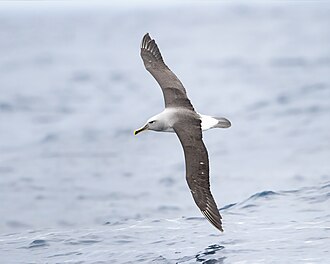
Buller's albatross
Thalassarche bulleri
IUCN status: NT · Near ThreatenedProtected in Peru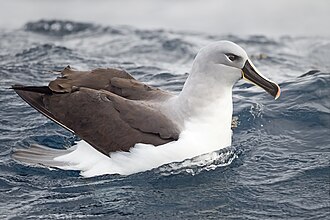
Grey-headed albatross
Thalassarche chrysostoma
IUCN status: Not evaluatedProtected in Peru
Black-browed albatross
Thalassarche melanophris
IUCN status: LC · Least ConcernProtected in Peru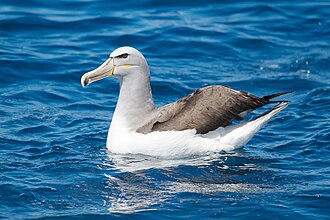
Salvin's albatross
Thalassarche salvini
IUCN status: VU · VulnerableProtected in Peru
Waved albatross
Phoebastria irrorata
IUCN status: CR · Critically EndangeredProtected in Peru
Names and sources
In Spanish
- Albatros de Chatham — Peru; SERNANP (2024). Plan Maestro de la Reserva Nacional Dorsal de Nasca 2024-2029. RP N.° 000040-2024-SERNANP, p. 35 of the PDF · main name
- Albatros de las Chatham — Wikidata
In English
- Chatham albatross — WoRMS; Wikidata
Classification
Learn more
Conservation status: Vulnerable (IUCN Red List, according to Wikidata). Taxonomy: PeRMS / WoRMS (CC BY 4.0).