
Seabirds · Diomedeidae
Grey-headed albatross
Thalassarche chrysostoma (Forster, 1785)
Spanish: Albatros de cabeza gris
- Names in Peru
- Albatros de cabeza gris
- Peruvian Register of Marine Species
- Listed in PeRMS (IMARPE)

Species account
Summary
Thalassarche chrysostoma is an albatross of the family Diomedeidae, order Procellariiformes, described by Forster in 1785 [1]. In Peru it is called «albatros de cabeza gris» and the official 2014 list of threatened wildlife classifies it as Vulnerable [2]. In the country it is a non-breeding visitor with very few records [3].
Distribution and habitat
Peru's Red Book of threatened wildlife describes it as a bird of the seas of the southern hemisphere and, for Peru, only as a non-breeding visitor with scarce records [3]. That work gathers the records from Laguna Grande, near Independencia Bay, in Ica, mentioned by Tovar in 1974, and the visual records from Matarani and Mollendo reported by Plenge and colleagues in 1989 [3].
Between October 2015 and April 2017, observers aboard artisanal Humboldt squid fishing boats in southern Peru saw a single grey-headed albatross among 300 birds of 11 species counted; it was over the continental slope, at a spot about 3185 m deep [4]. No bird of any species was recorded over the continental shelf in that study [4].
Outside the breeding season, adults from South Georgia disperse across oceanic waters, mostly in the Subantarctic Zone, between the Antarctic Polar Front and the Subtropical Front [5]. The species breeds on distant subantarctic islands; at South Georgia, which holds roughly half the world population, about 47674 pairs were estimated in 2003-2004 [5].
Biology
It is a mostly biennial breeder: the non-breeding period lasts about 16 months, and only a minority attempt to breed every year [5]. The modal age at first breeding at South Georgia is 12 years [5]. Breeding success is low and variable [5].
On Bird Island, South Georgia, follow-up of marked individuals between 1972 and 2012 showed that breeding success averaged 0.365 and juvenile survival 0.764 [6]. Adult survival was stable at 0.952 and fell to 0.828 in the year 2000; between 2005 and 2010 it was low again, at 0.931 [6]. The monitored part of that population declined by 60% in 35 years [6].
Ecology
Its diet is made up mostly of cephalopods, with some fish and Antarctic krill, so it occupies mid to high trophic levels [5]. On Bird Island, krill density had a positive effect on adult survival [6].
The authors of that study found that the years after an El Niño event reduce food availability and that, in the year 2000, a lagged El Niño reduced krill and sea ice just as longline fishing peaked, with a sudden drop in adult survival [6].
In southern Peru, observers of the artisanal squid fishery saw albatrosses and petrels feeding on offal and discards thrown overboard by the boats, and the grey-headed albatross, sighted only once, showed behaviour similar to that of the other species [4].
Conservation
In Peru the species is classified as Vulnerable by the 2014 supreme decree [2]. The Red Book notes that no conservation measures are aimed at it in the country and that it is on the list of the Agreement on the Conservation of Albatrosses and Petrels [3].
At South Georgia, longline fishing reduced adult survival: pelagic longline fishing in the non-breeding season and demersal longline fishing during breeding [6]. Bycatch of this species was infrequent but still had an effect, which added to the lower food availability after El Niño events [6].
In its entry for the Chatham albatross, the Red Book states that, for all albatrosses, 8 or more species have been recorded in the bycatch of artisanal longline fishing in Peru, with an estimate of 194 to 544 entangled birds per year among all of them, and that mitigation measures are not yet applied [3]. In the artisanal squid jig fishery studied in 2015-2017, the bycatch rate was low, and the only albatross hooked was a Chatham albatross [4].
Health, toxicological and chemical relevance
Not medical advice. For a sting, a poisoning or an allergy, seek medical care.
In feathers from adults on Bird Island sampled in the 2013-2014 season (78 birds), total mercury averaged 13.04 µg per g dry weight, with a range of 2.06 to 35.14, and 83% of the feathers exceeded 5 µg per g [5]. In earlier studies of the same population the average was 4.20 in 1989 and 8.93 in 1998, and the authors describe a threefold increase over about 25 years [5].
Mercury rose with trophic level and was lower in feathers grown in Antarctic waters (4.12 µg per g) than in those from the Subantarctic Zone (14.33) [5]. Males that failed to breed had more mercury (14.96) than those that fledged a chick (11.53), although this is a correlation [5].
Human relevance
The Red Book records that Tovar, in 1974, found bodies of this bird killed by fishermen to take the breast feathers and use them as fishing bait [3].
Where to see it in Peru
There is no site in Peru where it can be seen regularly. The published records are from the southern coast, at Laguna Grande, next to Independencia Bay, in Ica, and at Matarani and Mollendo [3]. The only at-sea sighting in the cited literature is of one individual between October 2015 and April 2017, over the southern continental slope, seen from a fishing boat [4].
References (6)
- WoRMS Editorial Board (2026). Thalassarche chrysostoma (Forster, 1785). World Register of Marine Species. https://www.marinespecies.org/aphia.php?p=taxdetails&id=225760 (accessed 2026-10-21)
- Ministerio de Agricultura y Riego (2014). Decreto Supremo N.° 004-2014-MINAGRI: actualización de la lista de clasificación y categorización de las especies amenazadas de fauna silvestre legalmente protegidas. El Peruano (08-04-2014); ficha en SINIA, Ministerio del Ambiente. https://sinia.minam.gob.pe/normas/lista-especies-amenazadas-fauna-silvestre-legalmente-protegidas (accessed 2026-10-21)
- Servicio Nacional Forestal y de Fauna Silvestre (SERFOR) (2018). Libro Rojo de la Fauna Silvestre Amenazada del Perú. SERFOR, Ministerio de Agricultura y Riego; documento en SINIA, Ministerio del Ambiente, 237. https://sinia.minam.gob.pe/sites/default/files/sinia/archivos/public/docs/libro_rojo.pdf (accessed 2026-10-21)
- Moreno, C., Quiñones, J. (2022). Albatross and Petrel Interactions with an Artisanal Squid Fishery in Southern Peru during El Niño, 2015-2017. Marine Ornithology, 49-56. doi:10.5038/2074-1235.50.1.1459 (accessed 2026-10-21)
- Mills, W.F., Bustamante, P., McGill, R.A.R. et al. (2020). Mercury exposure in an endangered seabird: long-term changes and relationships with trophic ecology and breeding success. Proceedings of the Royal Society B: Biological Sciences, 287: 20202683. doi:10.1098/rspb.2020.2683 (accessed 2026-10-21)
- Pardo, D., Forcada, J., Wood, A.G. et al. (2017). Additive effects of climate and fisheries drive ongoing declines in multiple albatross species. Proceedings of the National Academy of Sciences. doi:10.1073/pnas.1618819114 (accessed 2026-10-21)
More pictures
If you come across it
Protected or threatened species. Watch it without touching, feeding, chasing or taking it, and keep the recommended viewing distances.national category: Vulnerable (VU) — Supreme Decree No. 004-2014-MINAGRI, classification of threatened wild fauna species (El Peruano, 8 April 2014), p. 8 of the PDF
Related species
From the same genus (Thalassarche) and from the same family (Diomedeidae).
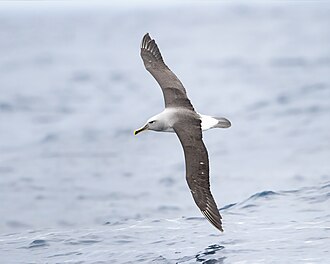
Buller's albatross
Thalassarche bulleri
IUCN status: NT · Near ThreatenedProtected in Peru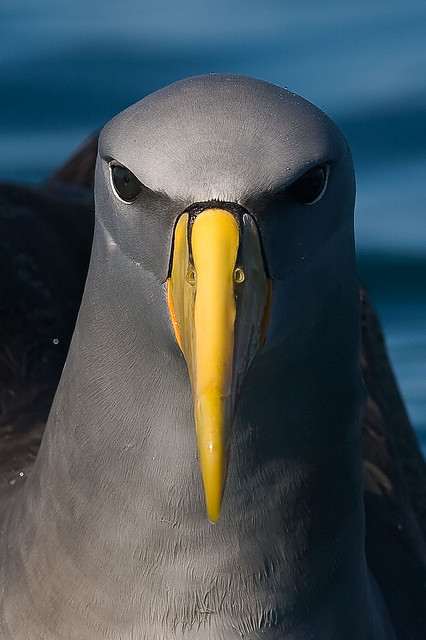
Chatham albatross
Thalassarche eremita
IUCN status: VU · VulnerableProtected in Peru
Black-browed albatross
Thalassarche melanophris
IUCN status: LC · Least ConcernProtected in Peru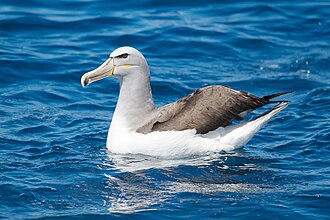
Salvin's albatross
Thalassarche salvini
IUCN status: VU · VulnerableProtected in Peru
Waved albatross
Phoebastria irrorata
IUCN status: CR · Critically EndangeredProtected in Peru
Names and sources
In Spanish
- Albatros de cabeza gris — Peru; D.S. N.° 004-2014-MINAGRI, categorización de especies amenazadas de fauna silvestre (El Peruano, 08-04-2014), p. 8 of the PDF · main name
- Albatros cabecigrís — Wikidata
- Albatros cabeza gris — Wikidata
In English
- Grey-headed albatross — WoRMS; Wikidata
- Grey-headed Mollymawk — Wikidata
Classification
Learn more
Conservation status: no data (IUCN). Taxonomy: PeRMS / WoRMS (CC BY 4.0).