
Seabirds · Diomedeidae
Buller's albatross
Thalassarche bulleri (Rothschild, 1893)
Spanish: Albatros de Buller
- Names in Peru
- Albatros de Buller
- Peruvian Register of Marine Species
- Listed in PeRMS (IMARPE)

Species account
Summary
Thalassarche bulleri is an albatross of the family Diomedeidae, described by Rothschild in 1893 [1]. It comprises 2 populations treated as subspecies: Thalassarche bulleri bulleri, which breeds on the Snares and Solander Islands south of New Zealand, and Thalassarche bulleri platei, which breeds on the Chatham Islands and in a small colony in the Three Kings Islands [2]. In Peru it is called «albatros de Buller» [3]. Once breeding is over, birds of all ages move to the waters of Chile and Peru [3]. The IUCN Red List classifies it as Near Threatened in its 2018 assessment [4], and Peru's official list of threatened wildlife, approved in 2014, also places it in the Near Threatened category [5].
Identification and similar species
The 2 subspecies are very alike in measurements and plumage, and telling them apart at sea is hard: light alters the tones in photographs and the bird is best seen very close [6]. In the adult of the southern form the head and neck are a pale greyish brown, like that of Thalassarche salvini, the pale forehead and crown reach the nape, and the dark patch over the eyebrow and the area between eye and bill is small and hardly ever reaches the base of the bill [6].
In the adult of the northern form the silvery cap covers only the front of the forehead and crown, and behind the eye the head and neck are dark grey, close in tone to Thalassarche eremita; the blackish eyebrow runs forward to the base of the bill and, together with the dark area in front of the eye, gives it a frowning look [6]. The yellow stripe on the lower mandible is usually narrower in this form and tapers towards the tip, although its width varies and overlaps between forms and sexes [6].
In museum skins the northern form also differs in a broader bill profile, with a rounder upper end to the culmen plate, and a narrower orange line along the lower mandible; adults of the two forms overlap in some features and young birds even more [2]. In 5 northern-form birds caught off southern Peru in 2021, the culmen averaged 123.1 mm and the weight 3.02 kg [6].
Distribution and habitat
As a breeding bird it is confined to the New Zealand region [2]. The southern form nests on 2 island groups: the Snares held 8704 breeding pairs in 2014, 61 % of the subspecies total, and the Solanders about 5620 in 2016, close to 39 % [7]. The annual breeding population of the whole species is put at a little over 32000 pairs [7].
The northern form breeds on The Sisters and The Forty-Fours in the Chatham archipelago, where 19400 pairs were estimated in 2016, and a few birds nest on Rosemary Rock, a 0.9 ha islet 50 m high in the Three Kings, 1420 km north-west of the Chathams; that colony was found on 1 December 1983, with 6 birds [8].
Outside the breeding season it crosses the Pacific. Northern-form birds followed with geolocators reached Chilean and Peruvian waters between March and July and left them between August and October, and southern-form birds tracked the same way reached Peruvian waters in August and September [6]. A chick ringed on the Snares in 1972 was caught on a longline in 1979 at 12°23' S, 105°06' W, and an adult ringed in the Chathams in 1973 was caught in January 2007 on the longline of an artisanal fisher targeting Coryphaena hippurus, about 333 km off Callao [6].
There are old records from the Peruvian coast: 2 birds were collected on 26 June 1913 some 20 miles west of Cañete [6]. The type specimen of Diomedea platei, the name the northern form now bears, is an immature collected in 1893 at Cavancha, south of Iquique, in northern Chile [2].
Biology
It breeds every year in colonies and its breeding cycle lasts about 8 months; at least 3 years after leaving the nest, immatures begin to return to the colony [3]. The 2 forms breed at different times: in the southern one birds return to the islands from mid-December, lay between late December and late February, peaking from 21 to 26 January, and chicks fledge from 22 August to 23 October; in the northern one they return from early September, lay from 27 October to 23 November and chicks fledge between late May and early July, so the cycles are about 2.5 months apart [6].
It lays a single egg, and fidelity to both partner and nest site is high [9]. Yearly checks of 3 study colonies on the Snares, from 1992 to 2001, showed that most pairs nested each year and that 71 % of nesting attempts succeeded, against 58 % for birds nesting for the first time [9]. Pairs seldom split up (1.1 % to 3.5 % a year); a bird that had to find a new partner, after a divorce or the death of the previous one, took on average 2.1 years to nest again if male and 2.6 if female, so each new pairing cost it about one breeding season [9]. Between 1992 and 1997 the yearly survival of breeders was 95.5 % [9].
It is very long-lived. A female ringed as a breeder on the Snares in 1948 was still incubating in 1993, on the same nest in 1992 and 1993 and in the same colony as in 1948 and 1969; since the minimum age of first breeding is 5 years, she was at least 50 years old, and her 1993 egg was the smallest measured in the species in the 3 years on record [10].
Ecology
It usually feeds alone, but can gather in large numbers where food is concentrated, such as crustacean swarms, and sometimes makes shallow plunges [3]. On the Snares and the Solanders, the food adults bring to chicks was dominated by fish, present in 92 % of samples and making up 65 % of the weight of solid food, mostly fishery discards such as the hake Macruronus novaezelandiae and jack mackerels of the genus Trachurus; cephalopod remains appeared in 53 % of samples, and Pyrosoma and Iasis zonaria were the most numerous prey, with 44 % by number and 24 % by weight [3].
Off Peru, its presence was spatially linked to that of fish, and the bird was drawn to offal discarded by small-scale fishing [3]. Beside an artisanal shark longliner off southern Peru in 2021, the northern form reached the offal after white-chinned petrels (Procellaria aequinoctialis) and black-browed albatrosses (Thalassarche melanophris), and had to fight the latter for food; when shark liver was thrown, Chatham albatrosses and northern giant petrels arrived and pushed the other birds aside [6]. According to feather isotope analyses those authors cite, the 2 forms have almost identical signatures, and the northern one seems to forage in somewhat more oceanic waters [6].
Conservation
Its global category is Near Threatened [4]. In Peru it is classified as Near Threatened on the official list of threatened wild fauna [5].
On the Solanders, a photographic census from a helicopter in March 2024 estimated 5377 occupied nests, 4 % fewer than the 5620 pairs of 2016, and of 54 nests checked on the ground only 33 held an egg [7]. In the Snares study colonies, there were about 39 % fewer pairs in 2024 than in 2022 and 36 % fewer nesting pairs than in 2006 [7]. On the Snares, those changes mainly reflect the fall in yearly adult survival since 2005, linked to incidental capture in fisheries, which in New Zealand waters is estimated at several hundred birds a year; a reassessment of fishing risk within New Zealand's exclusive economic zone singled out the southern form as the most exposed species [7].
Incidental mortality in fishing is probably its main threat: the southern form is caught regularly on pelagic and bottom longlines and in squid and fish trawls in New Zealand, and captures on pelagic longlines have been recorded in Australia [3]. It has also been reported interacting with artisanal longline fishing in southern Peru, near the Dorsal de Nasca National Reserve, and fishers from Pisco say albatrosses interact with the bottom longline for bacalao [3]. Climate change, with storms and flooding on the slopes where it nests, is another threat, though less serious than for other albatrosses [3].
Where to see it in Peru
On anchoveta assessment cruises run by IMARPE in autumn and spring 2019, with transects reaching 100 nautical miles from the coast, it was recorded in the southern part of the central zone and throughout the southern zone of Peru, far from the coast and mostly over the continental slope; only in autumn was one individual seen at the shelf edge [3]. Adults seen in autumn probably come from the Chatham Islands, and those of spring from the Snares [3].
On 2 trips of a 12 m artisanal longliner out of the port of Ilo, between late May and early July 2021, 41 birds were logged, 40 of the northern form and 1 of the southern; all were between 126 and 223 km from the coast, 28 over the abyssal plain, 10 over the Peru-Chile Trench and 3 over the slope, and none over the continental shelf, which the authors take to show that the northern form is a truly oceanic bird [6]. Aboard squid boats in southern Peru, between October 2015 and April 2017, only 2 individuals were seen, both over the continental slope [11].
References (11)
- WoRMS Editorial Board (2026). Thalassarche bulleri (Rothschild, 1893). World Register of Marine Species. https://www.marinespecies.org/aphia.php?p=taxdetails&id=225776 (accessed 2026-10-20)
- Schweizer, M., Frahnert, S., Shepherd, L.D. et al. (2024). Genetic data confirm that Diomedea platei Reichenow, 1898, is the correct name for the population of Buller’s albatross Thalassarche bulleri breeding at the Chatham Islands, New Zealand. Notornis, 165-175. doi:10.63172/000374tvcnwr (accessed 2026-10-20)
- Servicio Nacional de Áreas Naturales Protegidas por el Estado (SERNANP) (2024). Plan Maestro de la Reserva Nacional Dorsal de Nasca 2024-2029. SERNANP; aprobado por RP N.° 000040-2024-SERNANP. https://cdn.www.gob.pe/uploads/document/file/5997712/5313081-anexo.pdf (accessed 2026-10-20)
- BirdLife International (2018). Thalassarche bulleri: BirdLife International. The IUCN Red List of Threatened Species 2018: e.T22728328A132656798. doi:10.2305/IUCN.UK.2018-2.RLTS.T22728328A132656798.en (accessed 2026-10-20)
- Ministerio de Agricultura y Riego (2014). Decreto Supremo N.° 004-2014-MINAGRI: actualización de la lista de clasificación y categorización de las especies amenazadas de fauna silvestre legalmente protegidas. El Peruano (08-04-2014); ficha en SINIA, Ministerio del Ambiente. https://sinia.minam.gob.pe/normas/lista-especies-amenazadas-fauna-silvestre-legalmente-protegidas (accessed 2026-10-20)
- Quiñones, J., Zavalaga, C., Robertson, C.J.R. (2023). Identifying northern Buller´s albatross (Thalassarche bulleri subsp.) in offshore waters of southern Perú. Notornis, 49-59. doi:10.63172/070670wsvhfm (accessed 2026-10-20)
- Frost, P.G.H., Baker, G.B., Fischer, J.H. et al. (2025). Population Survey of Southern Buller’s Albatross Thalassarche bulleri bulleri on the Solander Islands / Hautere, March 2024. Marine Ornithology, 361-371. doi:10.5038/2074-1235.53.2.1666 (accessed 2026-10-20)
- Frost, P.G.H., Fitzgerald, N., Robinson, R. et al. (2018). Buller’s mollymawk (Thalassarche bulleri) on Rosemary Rock, Three Kings Islands, New Zealand. Notornis, 164-167. doi:10.63172/329425jjfsvz (accessed 2026-10-20)
- Sagar, P.M., Stahl, J.-C., Molloy, J. (2002). The influence of experience, pair bond duration, and partner change on breeding frequency and success in southern Buller’s mollymawk (Thalassarche bulleri bulleri). Notornis, 145-152. doi:10.63172/718107oqacpj (accessed 2026-10-20)
- Sagar, P.M., Warham, J. (1993). A long-lived southern Buller’s mollymawk (Diomedea bulleri bulleri) with a small egg. Notornis, 303-304. doi:10.63172/984022kannsg (accessed 2026-10-20)
- Moreno, C., Quiñones, J. (2022). Albatross and Petrel Interactions with an Artisanal Squid Fishery in Southern Peru during El Niño, 2015-2017. Marine Ornithology, 49-56. doi:10.5038/2074-1235.50.1.1459 (accessed 2026-10-20)
More pictures
If you come across it
Protected or threatened species. Watch it without touching, feeding, chasing or taking it, and keep the recommended viewing distances.national category: Near Threatened (NT) — Supreme Decree No. 004-2014-MINAGRI, classification of threatened wild fauna species (El Peruano, 8 April 2014), p. 9 of the PDF
Where it has been recorded
- Filled: scientific records, or confirmed by a curator
- Hatched: isolated record
- Dotted outline: no scientific records and no curator's confirmation (an ORKA sighting is not drawn here)
- Cold central sea
Scientific records (13 records)
- Cold southern sea
Scientific records (264 records)
From openly licensed OBIS and GBIF records (CC0 or CC BY). How each list is built.
Related species
From the same genus (Thalassarche) and from the same family (Diomedeidae).
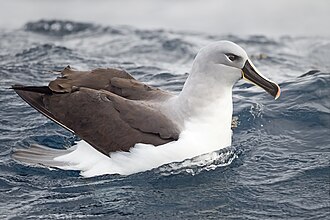
Grey-headed albatross
Thalassarche chrysostoma
IUCN status: Not evaluatedProtected in Peru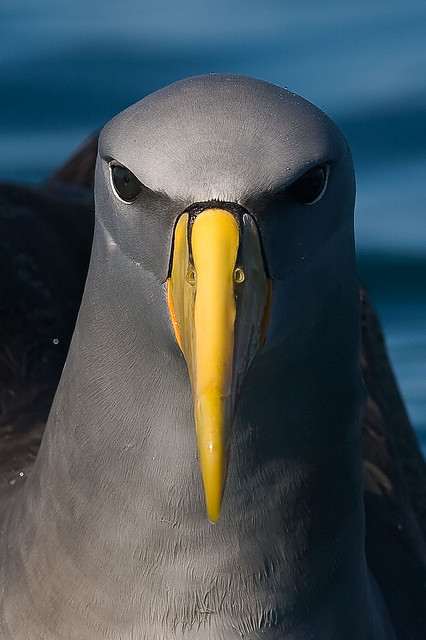
Chatham albatross
Thalassarche eremita
IUCN status: VU · VulnerableProtected in Peru
Black-browed albatross
Thalassarche melanophris
IUCN status: LC · Least ConcernProtected in Peru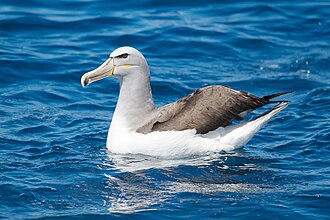
Salvin's albatross
Thalassarche salvini
IUCN status: VU · VulnerableProtected in Peru
Waved albatross
Phoebastria irrorata
IUCN status: CR · Critically EndangeredProtected in Peru
Names and sources
In Spanish
- Albatros de Buller — Peru; SERNANP (2024). Plan Maestro de la Reserva Nacional Dorsal de Nasca 2024-2029. RP N.° 000040-2024-SERNANP, p. 37 of the PDF; Wikidata · main name
- Albatros del Pacífico — Wikidata
In English
- Buller's albatross — WoRMS; Wikidata
- Buller's Mollymawk — Wikidata
- Southern Buller's albatross — WoRMS
Classification
Learn more
Conservation status: Near Threatened (IUCN Red List, according to Wikidata). Taxonomy: PeRMS / WoRMS (CC BY 4.0).