
Sea snails · Muricidae
Thaisella chocolata
Thaisella chocolata (Duclos, 1832)
Spanish: Locate
- Names in Peru
- Locate · Caracol
- Peruvian Register of Marine Species
- Listed in PeRMS (IMARPE)
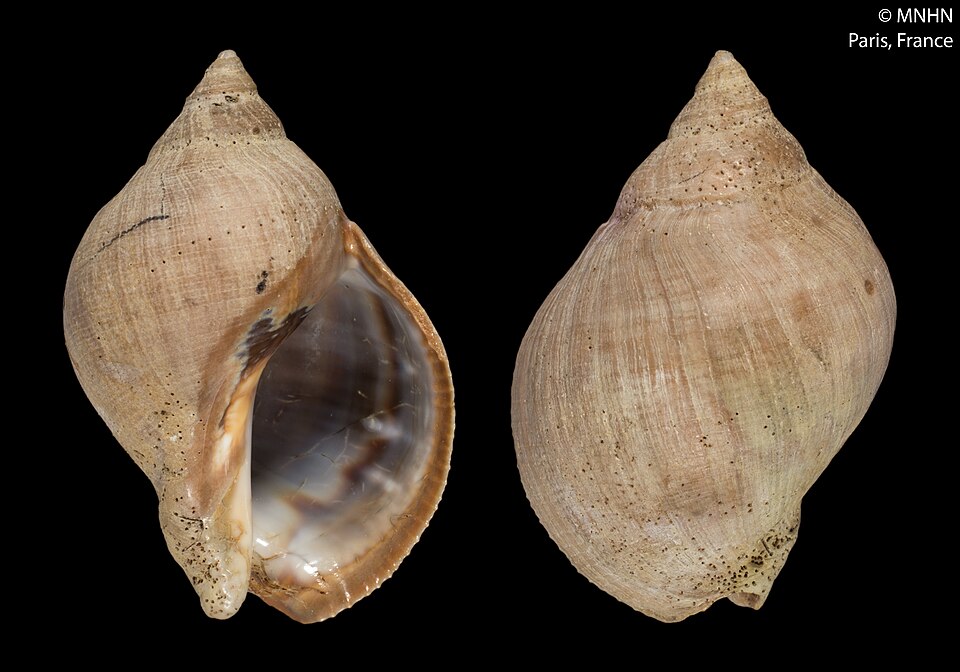
Species account
Summary
Thaisella chocolata is a carnivorous sea snail of the family Muricidae that lives on rocky bottoms of the south-eastern Pacific, from northern Peru to central Chile [1]. In Peru it is one of the most fished invertebrates in the country [1]; in La Libertad it is taken by shellfish divers, and it is eaten fresh locally and exported frozen [2].
At Guañape Norte island its populations form aggregations and nearly all the measured animals were smaller than the 60 mm minimum catch size [2]. Imposex in females, an effect of the tributyltin in ship paints, has also been detected at several points on the Peruvian coast [3],[4].
Identification and similar species
The accepted name is Thaisella chocolata (Duclos, 1832); the species was described as Purpura chocolatum, and Thais chocolata and Stramonita chocolata are listed as unaccepted names [5]. It belongs to the family Muricidae, carnivorous gastropods [2],[5].
In Peruvian studies size is measured as peristome length, the length of the shell opening. At Guañape Norte island, in March 2016, the measured animals ranged from 9 to 77 mm and weighed between 0.2 and 75.8 g, with a mean length of between 36.9 and 41.4 mm depending on depth [2].
Distribution and habitat
The species ranges from northern Peru, around 5° S, to the central coast of Chile, around 33° S, on rocky substrates between about 5 and 40 m depth [1]. The type locality lies within Peru's exclusive economic zone [5].
At Guañape Norte (La Libertad) it was present at 5, 10, 15 and 20 m, on both flat and irregular relief and on every type of substrate. The literature cited in that study links the species to rocky bottoms, broken shell, coarse sand and beds of the tunicate Pyura chilensis [2].
Mean density was 4.6 ind/m2 at 5 m, 13.5 at 10 m, 17.6 at 15 m and 9.2 at 20 m, and the highest mean biomass, 271 g/m2, was recorded at 10 m. At all four levels the distribution was aggregated [2].
Biology
It is a carnivorous predator that feeds on carrion and small organisms [2]. The Guañape Norte study attributes the depth distribution to feeding, reproduction and substrate; it cites the small mussel Semimytilus algosus as food in the upper zone and barnacle remains at the bottom [2].
It is a broadcast spawner whose pelagic larva can stay in the water for up to 4 months, and it reproduces all year round, according to the synthesis by Louis and colleagues based on earlier work [1]. At Guañape Norte, shellfish divers take advantage of the snails gathering when they deposit their breeding capsules [2].
At Guañape Norte, in March 2016, females predominated at every depth level, although a 1:1 ratio could not be rejected at 5 and 20 m. In both sexes the stage of maximum gonadal maturity dominated, followed by the immature stage [2].
Ecology
At Guañape Norte island it is regarded as a top predator of the benthic community, a role it shares with another gastropod, Concholepas concholepas, which has similar feeding and reproductive habits [2].
Its abundance rises markedly in each El Niño phase, and warm water also favours demographic expansion of its populations [1]. Genetic analyses of 4 localities on the Peruvian coast indicate a single population, with gene flow northward and southward and no signal of a recent bottleneck [1].
Conservation
There is no IUCN Red List category on file for this species. The minimum catch size is 60 mm peristome length, set by Ministerial Resolution 209-2001-PE of June 2001 [2].
At Guañape Norte, in March 2016, between 91.4 % and 99.6 % of the measured animals were below that size depending on depth, and the author describes intense, uncontrolled exploitation that is reducing the populations [2]. Louis and colleagues note that between 80 % and 98 % of the individuals caught are below the minimum size and that there is local depletion in northern Peru [1].
Because the genetics point to a single management unit, the authors call for continued precautionary measures. In Chile the populations collapsed in the 1990s through overfishing and afterwards fishing was allowed only in some regions [1].
Health, toxicological and chemical relevance
Not medical advice. For a sting, a poisoning or an allergy, seek medical care.
This species suffers imposex, the appearance of male features in females caused by tributyltin (TBT) from antifouling paints, which in gastropods can cause sterility [4]. At 10 sites on the Peruvian coast under the influence of the Callao and Chimbote harbours, TBT reached 662 ng Sn per gram and imposex was high at 6 of them, mostly near harbour terminals [3].
At 7 localities on the central coast, with 1188 specimens studied between 2013 and 2016, imposex affected 36.39 % of females, with per-locality values from 5.88 % to 52.10 %, and tended to decline over those years [4].
At Matarani (Arequipa), in 2021, arsenic, cadmium, copper and selenium in tissue exceeded at least one of the 8 international comparison standards, but the consumption risk calculation indicated no non-carcinogenic risk; imposex was 9.6 % [6].
Human relevance
It is one of the most fished invertebrates in Peru, mainly by artisanal fishers, with hundreds of tonnes caught each year [1]. In La Libertad it is taken by shellfish divers on the banks of the islands of Corcovado, Chao, Guañape Sur, Guañape Norte and Macabí [2].
According to the statistics of the IMARPE coastal laboratory at Huanchaco, landings rose from 1.5 tonnes in 2009 to a peak of 35.5 tonnes in 2016 and fell to 22.5 tonnes in 2017. It is eaten fresh locally and exported frozen [2].
Where to see it in Peru
The Peruvian literature documents it at islands and points along the coast: Guañape Norte, in La Libertad, where it was measured down to 20 m depth in March 2016 [2]; the islands of Chincha Sur, Lobos de Tierra and Grande, and Ilo, where samples were taken for the genetic study published in 2024 [1]; and, between 2013 and 2016, Chorrillos, Pucusana, San Bartolo, San Lorenzo island, Agua Dulce, La Punta and Callao [4].
References (6)
- Louis, V., Kochzius, M., Jiménez, J. et al. (2024). Genetic diversity, demography and connectivity in the marine snail Thaisella chocolata (Duclos, 1832): implications for sustainable fisheries management along the Peruvian coast. Journal of Molluscan Studies 90(1), eyae003. doi:10.1093/mollus/eyae003 (accessed 2026-10-25)
- Alfaro, S. (2020). Distribución batimétrica de Thaisella chocolata (Duclos) en la isla Guañape norte, La Libertad, Perú. Marzo 2016. Boletín del Instituto del Mar del Perú 35(1), 19-28. https://revistas.imarpe.gob.pe/index.php/boletin/article/view/284 (accessed 2026-10-25)
- Castro, Í.B., Fillmann, G. (2012). High tributyltin and imposex levels in the commercial muricid Thais chocolata from two Peruvian harbor areas. Environmental Toxicology and Chemistry 31(5), 955-960. doi:10.1002/etc.1794 (accessed 2026-10-25)
- Iannacone, J., Alvariño, L., Esqueche-Angeles, C.A. et al. (2023). Variación interanual del imposex en el caracol marino Thaisella chocolata (Muricidae) en la costa central del Perú. Revista de Investigaciones Veterinarias del Perú 34(4), e25954. doi:10.15381/rivep.v34i4.25954 (accessed 2026-10-25)
- WoRMS Editorial Board (2026). Thaisella chocolata (Duclos, 1832). World Register of Marine Species. https://www.marinespecies.org/aphia.php?p=taxdetails&id=714218 (accessed 2026-10-25)
- Luna-Pacompea, N., Juárez-Laguna, F., Jaén-Rodriguez, C. et al. (2022). Metales pesados e imposex en Thaisella chocolata (Gasteropoda: Muricidae) en Matarani, Arequipa, Perú. Revista de Investigaciones Veterinarias del Perú 33(5), e23793. doi:10.15381/rivep.v33i5.23793 (accessed 2026-10-25)
More pictures
Where it has been recorded
- Filled: scientific records, or confirmed by a curator
- Hatched: isolated record
- Dotted outline: no scientific records and no curator's confirmation (an ORKA sighting is not drawn here)
- Tropical–cold transition zone
Scientific records (1 record)
- Cold central sea
Scientific records (16 records)
- Cold southern sea
Scientific records (18 records)
From openly licensed OBIS and GBIF records (CC0 or CC BY). How each list is built.
Related species
From the same genus (Thaisella) and from the same family (Muricidae).
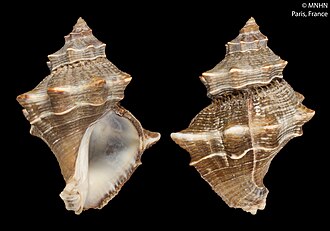
Thaisella kiosquiformis
IUCN status: Not evaluated
Acanthais brevidentata
IUCN status: Not evaluatedNeorapana muricata
IUCN status: Not evaluated
Stramonita biserialis
IUCN status: Not evaluated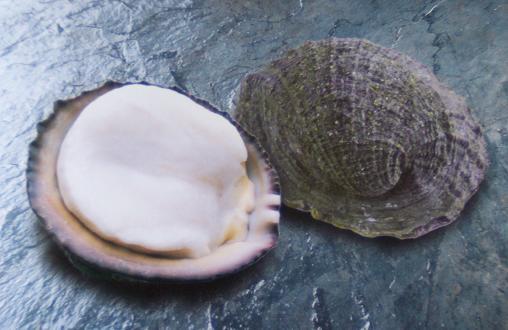
El loco
Concholepas concholepas
IUCN status: Not evaluatedCoralliophila nux
IUCN status: Not evaluatedCoralliophila parva
IUCN status: Not evaluated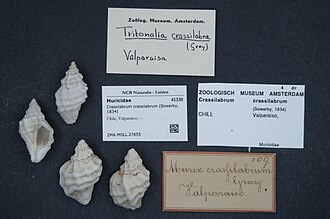
Crassilabrum crassilabrum
IUCN status: Not evaluated
Names and sources
In Spanish
- Locate — Peru; sealifebase · main name
- Caracol — Peru; sealifebase
Classification
Learn more
Conservation status: no data (IUCN). Taxonomy: PeRMS / WoRMS (CC BY 4.0).