
Seabirds · Sulidae
Nazca booby
Sula granti Rothschild, 1902
Spanish: Piquero Nazca
- Names in Peru
- Piquero Nazca · Piquero de Nazca
- Peruvian Register of Marine Species
- Listed in PeRMS (IMARPE)
Species account
Summary
Sula granti is a seabird of the family Sulidae that Rothschild described in 1902 [1]. In Peru it is called «piquero Nazca» [2] or «piquero de Nazca» [3]. It nests on islands of the tropical eastern Pacific, and in 2000 it was confirmed for the first time that it also breeds on the Lobos de Afuera islands, off Lambayeque, its southernmost known breeding point [4]. It travels hundreds of kilometres from its colony to hunt fish and squid [5]. The IUCN Red List considers it Least Concern [6], while in Peru it is categorised as Endangered [3].
Identification and similar species
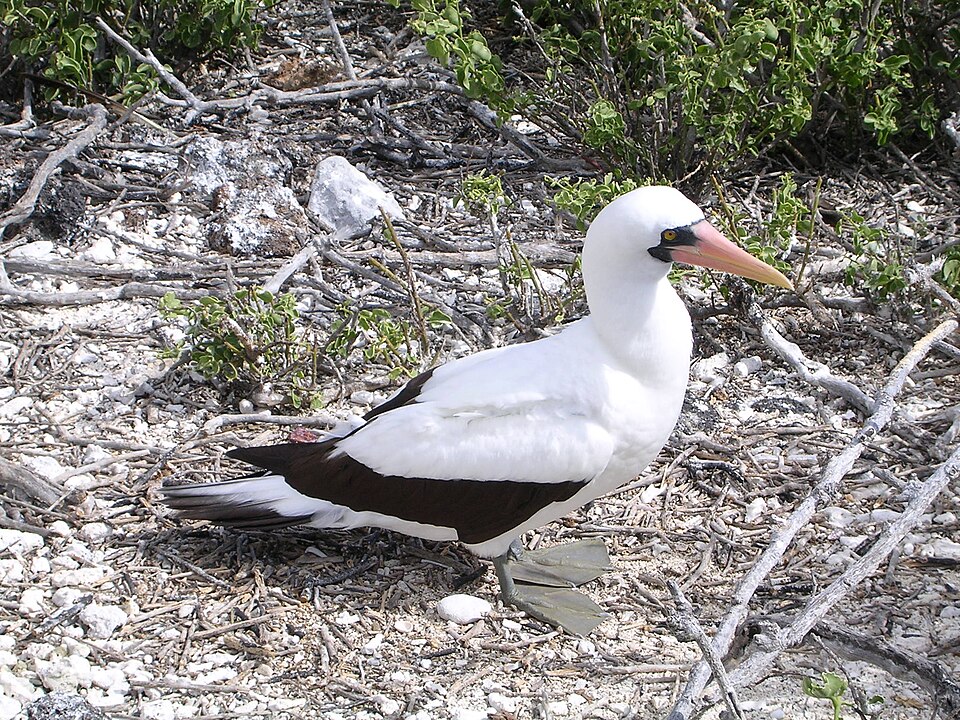
The adult is white and its bill has an orange or pinkish-orange base; in the masked booby, by contrast, the bill ranges from greenish yellow to yellow, a difference that lets observers separate almost every bird in the field from its third plumage onwards [7]. The male has an orange bill and the female a coral-red one, and the legs are khaki grey [4].
Females are larger. On Malpelo Island, Colombia, 42 females averaged 1914.6 g and 58 males 1655.9 g, so females were 13.5 % heavier; there the sex is told by voice, since males whistle and females give duck-like honks, and by the feet, which are purple with an olive-green tinge in the male and a darker, more definite purple in the female [8]. In Galápagos, the adult birds tagged in one study weighed between 1450 and 2200 g [5].
Young birds are brown on the head, back, rump and wing coverts, and that brown turns white with each moult until the definitive plumage, which according to the literature is reached in the third or fourth cycle [7]. In the photographs reviewed in California, the young birds the author assigns to this species showed a horn-coloured bill base and a brighter golden-yellow tip, and some birds looked adult once they had finished their first primary moult, at around 20 to 22 months [7].
Similar species
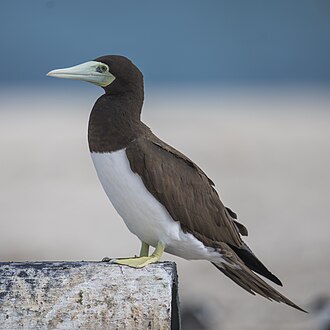
- Sula dactylatra: A masked booby shows a yellow bill and pale olive legs, whereas Sula granti has an orange or coral-red bill and khaki-grey legs [4]. In young birds the distinction is harder: the white collar on the nape appears more often in Sula dactylatra and the base of the central tail feathers is whiter in Sula granti, although the two species overlap in these features [7].
Distribution and habitat
It nests on Galápagos and La Plata in Ecuador, on Malpelo off Colombia, on Clipperton and on Mexico's Revillagigedo Islands [4]. Galápagos holds most of its breeding, and on Clipperton and the Revillagigedos it breeds only in small numbers; as a vagrant it has reached California and Oregon, and at least one adult got as far as the Gulf of Alaska [7]. Malpelo, an island of 1.2 km² lying 380 km from the Colombian mainland, holds the largest nesting colony in the world, with about 80000 individuals [8].
In March 2000, on Lobos de Afuera, at 6°56′S and 80°42′W, 2 islands totalling 235 ha some 93 km off the coast of Lambayeque, 9 Nazca boobies were seen: 3 incubating pairs, 1 pair beside an empty nest and 1 lone adult, with no chicks or juveniles, in the same rocky area used by the blue-footed booby [4]. Those islands, 635 km south of La Plata, became the southernmost known breeding point of the species; moreover, according to a researcher cited by the author, boobies that had been reported breeding on Lobos de Tierra Island as masked boobies, before the two species were split, look more like the Nazca booby [4].
According to the 2016 master plan of the Reserva Nacional Sistema de Islas, Islotes y Puntas Guaneras, the coastal strip of Lobos de Tierra Island running from Playa Ñopo to Punta Sáenz, including Islote Colorado, holds a colony of the species, which the plan places at one of the extremes of its global range [2].
Within Galápagos, a study using 8 microsatellite markers found genetic differences between almost all colonies on different islands and 3 genetic clusters; its authors put this down to the birds usually breeding in the colony where they hatched [9].
Biology
At the Punta Cevallos colony on Española Island (Galápagos), breeding is seasonal: eggs are laid from October to January and most chicks leave the nest by June; chicks have been banded there every year since 1984, so the age of many adults is known [5]. The colony holds some 10000 boobies on flat, rocky ground, where the median distance between nests is just 2 m; incubation lasts 43 to 50 days and the parents care for the young for 5 to 6 months after hatching [10].
Each pair raises a single young, but often lays a second egg that makes up for poor hatching success; if 2 chicks hatch, the older one invariably attacks the younger and pushes it out of the nest within a few days, a case of obligate siblicide [11]. At hatching, its chicks carry more androgens in their blood than those of the blue-footed booby. As adults, some Nazca boobies seek out other birds' chicks left alone in the colony and direct a mixture of aggression, care and sexual behaviour at them; those that do so most turned out to be the ones that, as chicks, had killed their sibling [11].
Pairs often change from one season to the next, and it is the females that usually reject their previous mate [10]. Over 74 days of observation, between October 2001 and January 2002, 1638 sexual encounters were recorded; 23.1 % of the 1276 copulations by breeding females were with males that were not their mate, and yet molecular analysis found no chicks sired by another father [10].
Breeding success changes with age: it is low in birds aged 4 to 7 years, peaks at around 12 to 14, is low again at 18 to 20 and close to nil from 21 onwards, and the authors cite unpublished data on birds at least 28 years old [5].
Ecology
At Punta Cevallos (Galápagos), sardine (Sardinops sagax), a fish with about 8 % lipid, was the main prey from 1983 to 1997. After the 1997-1998 El Niño, flying fish, with less than 1 % lipid, took its place; on that poor diet breeding output dropped sharply and the population growth rate fell below 1, a sign of a shrinking population [12]. In this species, most nests that fail do so for lack of food [5].
On Española Island, 64 chick-rearing adults were fitted with GPS and depth loggers, and all of them fished east of the island. Of the trips, 67 % were completed within the day, in 2 to 15 hours and with 1 to 19 dives, while the other 33 % included nights at sea and lasted from 28 hours to 7.2 days [13]. At night the birds hardly dived and rested on the water; 24 % of them were missing more than 25 % of the tissue of their webbed feet, a loss that increases with age and is probably caused by predatory fish [13].
In the breeding season it flies hundreds of kilometres, alternating flapping and gliding. In the strong El Niño of 2015 adults spent less time away from the nest and gained weight faster than in the weak La Niña season of 2016, and males, the smaller sex, gained less weight during each absence from the nest [5].
On Malpelo, regurgitations from 109 adults were analysed in 2004 and 2005: those of females averaged 189.8 g and those of males 125.0 g, and the females' prey averaged 15.3 cm against 12.9 cm; more than 60 % of the fish measured 11 to 15 cm, and females ate more flying fish (Exocoetidae) and Scombridae, while males ate more Hemiramphidae and Carangidae [8].
In Peru, a study on Lobos de Tierra Island cited by Figueroa found that in normal years these boobies, then recorded as masked boobies, fed mainly on anchoveta (Engraulis ringens), along with saury, flying fish and mullet, and that in El Niño years they switched to prey such as chub mackerel, Anchoa nasus, skipjack tuna and sardine [4]. On Lobos de Afuera a territorial dispute with a pair of blue-footed boobies was observed [4].
Conservation
Its global category on the IUCN Red List is Least Concern [6]. In Peru, D.S. N.° 004-2014-MINAGRI places it in the Endangered (EN) category [3].
On Lobos de Tierra Island, the 2026-2031 master plan of the Reserva Nacional Sistema de Islas, Islotes y Puntas Guaneras requires its feeding, resting and breeding areas to be kept undisturbed; in the coastal strip where its colony lies, guano extraction and new infrastructure are not allowed, and motorboats may not sail within 200 m of the low-tide line [14].
The 2026-2031 master plan of the Reserva Nacional Mar Tropical de Grau names the Nazca booby, categorised as Endangered by MIDAGRI, among the species present in the Banco de Máncora sector [15].
In Galápagos the water around the islands is expected to warm by 4.5 °C over the next 100 years, beyond what sardines tolerate; if that prey disappears from its fishing range, the authors expect the population they study to keep shrinking [12].
Health, toxicological and chemical relevance
Not medical advice. For a sting, a poisoning or an allergy, seek medical care.
Toxoplasma gondii is a parasite that can pass from animals to people. In blood samples taken between 2017 and 2022 on cat-free Galápagos islands, 5 of 38 Nazca boobies carried antibodies against it; the authors suggest that birds fishing far offshore, like this one, may be less exposed than those feeding near the coast [16].
Human relevance
The Punta Cevallos colony, with chicks banded every year since 1984, is the basis of a long-term study of how age affects breeding and flight in a wild bird [5]. The shift in its diet from sardine to flying fish gives researchers rare evidence of how ocean warming can affect a tropical marine vertebrate [12].
Where to see it in Peru
In Peru it breeds on northern guano islands. On the Lobos de Afuera islands, 93 km off the coast of Lambayeque, incubating pairs were recorded in March 2000 [4]. The 2026 master plan names part of the western end of Isla Independencia, one of the Lobos de Afuera islands, at Laguna Grande, as a resting and breeding area for the species [14], and in those wild zones research and photography require prior assessment and authorisation from the reserve's headquarters [14].
On Lobos de Tierra Island, its colony lies in the coastal strip between Playa Ñopo and Punta Sáenz, which includes Islote Colorado; according to the 2016 master plan, research for scientific or educational purposes and tourism there require authorisation from the protected area's headquarters, and motorised boats may not sail within a 200 m strip from the low-tide line [2].
Offshore, the 2026 master plan of the Reserva Nacional Mar Tropical de Grau lists it among the species of the Banco de Máncora sector [15].
References (16)
- WoRMS Editorial Board (2026). Sula granti Rothschild, 1902. World Register of Marine Species. https://www.marinespecies.org/aphia.php?p=taxdetails&id=343958 (accessed 2026-10-20)
- Servicio Nacional de Áreas Naturales Protegidas por el Estado (2016). Plan Maestro de la Reserva Nacional Sistema de Islas, Islotes y Puntas Guaneras 2016-2020. SERNANP; copia en SINIA, Ministerio del Ambiente. https://sinia.minam.gob.pe/sites/default/files/archivos/public/docs/PM_RNSIIPG_2016-2020.pdf (accessed 2026-10-20)
- Ministerio de Agricultura y Riego (2014). Decreto Supremo N.° 004-2014-MINAGRI: actualización de la lista de clasificación y categorización de las especies amenazadas de fauna silvestre legalmente protegidas. El Peruano (08-04-2014); ficha en SINIA, Ministerio del Ambiente. https://sinia.minam.gob.pe/normas/lista-especies-amenazadas-fauna-silvestre-legalmente-protegidas (accessed 2026-10-20)
- Figueroa, J. (2004). First Record of Breeding by the Nazca Booby Sula Granti on Lobos De Afuera Islands, Peru. Marine Ornithology, 117-118. doi:10.5038/2074-1235.32.1.608 (accessed 2026-10-20)
- Howard, J.L., Tompkins, E.M., Anderson, D.J. (2021). Effects of age, sex, and ENSO phase on foraging and flight performance in Nazca boobies. Ecology and Evolution, 4084-4100. doi:10.1002/ece3.7308 (accessed 2026-10-20)
- BirdLife International (2021). Sula granti: BirdLife International. The IUCN Red List of Threatened Species 2021: e.T22728990A163626479. doi:10.2305/IUCN.UK.2021-3.RLTS.T22728990A163626479.en (accessed 2026-10-20)
- Pyle, P. (2020). Molt, age, and identification of the Masked and Nazca boobies in California. Western Birds, 129-149. doi:10.21199/wb51.2.6 (accessed 2026-10-20)
- García-R., S., López-Victoria, M. (2021). Diferencias entre sexos en el tamaño corporal y la dieta en el piquero de nazca (Sula granti). Ornitología Colombiana (n.° 7, 2008), 59-65. doi:10.59517/oc.e178 (accessed 2026-10-20)
- Levin, I.I., Parker, P.G. (2012). Philopatry drives genetic differentiation in an island archipelago: comparative population genetics of Galapagos Nazca boobies (Sula granti) and great frigatebirds (Fregata minor). Ecology and Evolution, 2775-2787. doi:10.1002/ece3.386 (accessed 2026-10-20)
- Anderson, D.J., Huyvaert, K.P., Espinosa, P.M. et al. (2025). Female sexual agency and frequent extra-pair copulations, but no extra-pair paternity, in Nazca boobies (Sula granti). PLoS ONE, e0324762. doi:10.1371/journal.pone.0324762 (accessed 2026-10-20)
- Müller, M.S., Brennecke, J.F., Porter, E.T. et al. (2008). Perinatal Androgens and Adult Behavior Vary with Nestling Social System in Siblicidal Boobies. PLoS ONE, e2460. doi:10.1371/journal.pone.0002460 (accessed 2026-10-20)
- Tompkins, E.M., Townsend, H.M., Anderson, D.J. (2017). Decadal-scale variation in diet forecasts persistently poor breeding under ocean warming in a tropical seabird. PLoS ONE, e0182545. doi:10.1371/journal.pone.0182545 (accessed 2026-10-20)
- Zavalaga, C.B., Emslie, S.D., Estela, F.A. et al. (2012). Overnight foraging trips by chick-rearing Nazca Boobies Sula granti and the risk of attack by predatory fish. Ibis, 61-73. doi:10.1111/j.1474-919X.2011.01198.x (accessed 2026-10-20)
- Servicio Nacional de Áreas Naturales Protegidas por el Estado (2026). Plan Maestro de la Reserva Nacional Sistema de Islas, Islotes y Puntas Guaneras 2026-2031. SERNANP, RPE N.° 000102-2026-SERNANP/PE. https://sis.sernanp.gob.pe/biblioteca/descargarPublicacionAdjunto.action?strIdInterno=74619742068490316891459270400894950465 (accessed 2026-10-20)
- Servicio Nacional de Áreas Naturales Protegidas por el Estado (2026). Plan Maestro de la Reserva Nacional Mar Tropical de Grau 2026-2031. SERNANP, RPE N.° 000052-2026-SERNANP. https://cdn.www.gob.pe/uploads/document/file/9468842/7752998-5-pm_2026-2031_rnmtg-f-f-f-f.pdf (accessed 2026-10-20)
- Mosquera, J.D., Valle, C.A., Nieto-Claudin, A. et al. (2023). Prevalence of Toxoplasma gondii in Galapagos birds: Inference of risk factors associated with diet. PLoS ONE, e0287403. doi:10.1371/journal.pone.0287403 (accessed 2026-10-20)
More pictures
If you come across it
Protected or threatened species. Watch it without touching, feeding, chasing or taking it, and keep the recommended viewing distances.national category: Endangered (EN) — Supreme Decree No. 004-2014-MINAGRI, classification of threatened wild fauna species (El Peruano, 8 April 2014), p. 7 of the PDF
Where it has been recorded
- Filled: scientific records, or confirmed by a curator
- Hatched: isolated record
- Dotted outline: no scientific records and no curator's confirmation (an ORKA sighting is not drawn here)
- Tropical northern sea
Scientific records (16 records)
- Tropical–cold transition zone
Scientific records (24 records)
- Cold central sea
Scientific records (24 records)
- Cold southern sea
Scientific records (65 records)
From openly licensed OBIS and GBIF records (CC0 or CC BY). How each list is built.
Related species
From the same genus (Sula).


Names and sources
In Spanish
- Piquero Nazca — Peru; SERNANP (2016). Plan Maestro de la Reserva Nacional Sistema de Islas, Islotes y Puntas Guaneras 2016-2020, p. 33 of the PDF; Wikidata · main name
- Piquero de Nazca — Peru; D.S. N.° 004-2014-MINAGRI, categorización de especies amenazadas de fauna silvestre (El Peruano, 08-04-2014), p. 7 of the PDF
In English
- Nazca booby — WoRMS; Wikidata
Classification
Learn more
Conservation status: Least Concern (IUCN Red List, according to Wikidata). Taxonomy: PeRMS / WoRMS (CC BY 4.0).