
Crabs, lobsters and shrimps · Epialtidae
Stenocionops ovatus
Stenocionops ovatus (Bell, 1836)
Spanish: Cangrejo araña
- Names in Peru
- Cangrejo araña
- Peruvian Register of Marine Species
- Listed in PeRMS (IMARPE)

Species account
Summary
Stenocionops ovatus is an eastern Pacific spider crab, originally described as Pericera ovata and now placed in the family Epialtidae [1]. The IMARPE catalogue of decapod crustaceans gives its range as Baja California, in Mexico, to Paita, in Peru, plus the Galápagos Islands [2].
It lives on sand and mud bottoms and on substrates of coral, shell, algae or sponges, between 15 and 275 m deep [2]. Its biology is known mainly from a Gulf of California sample, in which males outnumbered females and females carrying eggs appeared in October and November [3].
Identification and similar species
According to the Peruvian catalogue, the body is dusty pink, with a reddish-brown to dark brown pubescence on the carapace, almost black on the walking legs, and white carapace spines with reddish tones [2].
Males are larger than females. In the Gulf of California, females measured 65.6 to 88.5 mm in carapace width and males 63 to 140 mm; in carapace length, females measured 71.5 to 103.4 mm and males 74.2 to 153.1 mm [3]. In weight, females ranged from 93.4 to 231.7 g and males from 100 to 1500 g [3].
The authors of that study concluded that the species shows sexual dimorphism in size and weight, already recognised before, and recorded a male 140 mm wide, 9.5 mm more than the largest size known until then [3]. The Peruvian specimens examined in the catalogue, from Puerto Pizarro, measured 36.8 to 38.55 mm in carapace length for the 4 males and 33.1 to 45.2 mm for the 9 females [2].
Distribution and habitat
The Peruvian catalogue gives the distribution as Baja California, in Mexico, to Paita, in Peru, and the Galápagos Islands, in Ecuador [2]. Its habitat is sandy and muddy bottoms and substrates of coral, shell, algae or sponges, between 15 and 275 m [2].
In the Gulf of California it was caught with monofilament gill nets of 6 inch mesh at 180 m depth, off Isla Danzante, between October 1993 and January 1994 [3]. The authors note that this species and another spider crab live in deep water on the continental shelf and are hard to collect, and they cite that Stenocionops ovatus is abundant north of Isla Tiburón, in Sonora [3].
Biology
In a sample of 433 individuals from the Gulf of California there were 338 males and 95 females, a ratio of 3.5 males per female that differs significantly from 1:1 [3].
Females carrying egg masses were present only in October and November, with a frequency of 98.9 % [3]. The authors note that an earlier work had recorded breeding of the species in the Gulf of California in April [3].
Conservation
The SeaLifeBase record states that the species has not been evaluated under CITES [4].
Human relevance
The Gulf of California specimens studied by Villalejo-Fuerte and colleagues were incidental catches in gill nets [3]. These authors regard the malacostracan crustaceans of that region as a potentially important but little studied fishery resource [3]. In Peru, the IMARPE catalogue mentions no use of the species [2].
Where to see it in Peru
The IMARPE catalogue, published in 2012, examined specimens collected in January 1987 near the fishing terminal of Puerto Pizarro, and gives Paita as the southern limit of the range [2]. The same catalogue gives a depth of 15 to 275 m, an interval that reaches well below recreational diving depths; none of the sources consulted describes sightings of the species by divers [2].
References (4)
- WoRMS Editorial Board (2026). Stenocionops ovatus (Bell, 1836). World Register of Marine Species. https://www.marinespecies.org/aphia.php?p=taxdetails&id=442136 (accessed 2026-10-25)
- Moscoso, V. (2012). Catálogo de crustáceos decápodos y estomatópodos del Perú. Boletín del Instituto del Mar del Perú 27(1-2), 8-207. https://revistas.imarpe.gob.pe/index.php/boletin/issue/download/12/27-1-2 (accessed 2026-10-25)
- Villalejo-Fuerte, M., Ceballos-Vázquez, B.P., Arellano-Martínez, M. et al. (2001). Contribution to the biology of the spider crabs Maiopsis panamensis Faxon, 1893 and Stenocionops ovata (Bell, 1835) (Decapoda: Majoidea) from the Gulf of California, Mexico. Revista de Biología Marina y Oceanografía 36(2), 199-203. doi:10.4067/S0718-19572001000200008 (accessed 2026-10-25)
- Palomares, M.L.D., Pauly, D. (2026). Stenocionops ovatus (Bell, 1835), Velvet spidercrab. SeaLifeBase. https://www.sealifebase.se/summary/Stenocionops-ovatus.html (accessed 2026-10-25)
More pictures
Where it has been recorded
- Filled: scientific records, or confirmed by a curator
- Hatched: isolated record
- Dotted outline: no scientific records and no curator's confirmation (an ORKA sighting is not drawn here)
- Tropical northern sea
Scientific records (3 records)
- Tropical–cold transition zone
Scientific records (8 records)
- Cold central sea
Scientific records (1 record)
From openly licensed OBIS and GBIF records (CC0 or CC BY). How each list is built.
Related species
From the same family.
Jacknife spider crab
Acanthonyx petiverii
IUCN status: Not evaluated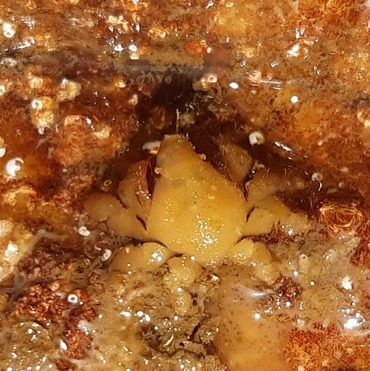
Pisoides edwardsii
IUCN status: Not evaluated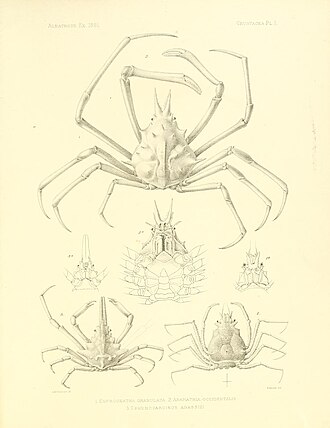
Rhinocarcinus agassizi
IUCN status: Not evaluated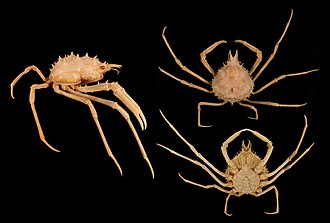
Solinca aulix
IUCN status: Not evaluated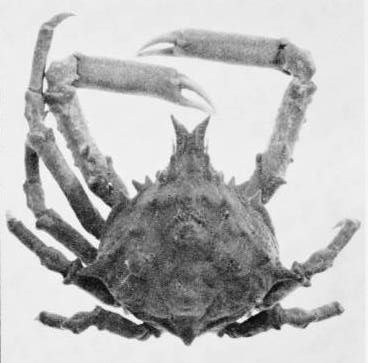
Stratiolibinia rostrata
IUCN status: Not evaluated
Taliepus dentatus
IUCN status: Not evaluatedTaliepus marginatus
IUCN status: Not evaluated
Chorilia turgida
IUCN status: Not evaluated
Names and sources
In Spanish
- Cangrejo araña — Peru; sealifebase · main name
Classification
Learn more
Conservation status: no data (IUCN). Taxonomy: PeRMS / WoRMS (CC BY 4.0).