
Sharks, rays and chimaeras · Sphyrnidae
Smooth hammerhead
Sphyrna zygaena (Linnaeus, 1758)
Spanish: Tiburón martillo
- Names in Peru
- Tiburón martillo
- Peruvian Register of Marine Species
- Listed in PeRMS (IMARPE)
Species account
Summary
Sphyrna zygaena is a hammerhead shark of the family Sphyrnidae, described by Linnaeus in 1758 [1]. In Peru it is known as «tiburón martillo» [2]. Between 1996 and 2010 it was the third most landed shark in the country, with 15 % of the total [3]. Off northern Peru it behaves as a top predator that eats mostly squid [4]. The IUCN Red List classifies it as Vulnerable [5].
Identification and similar species
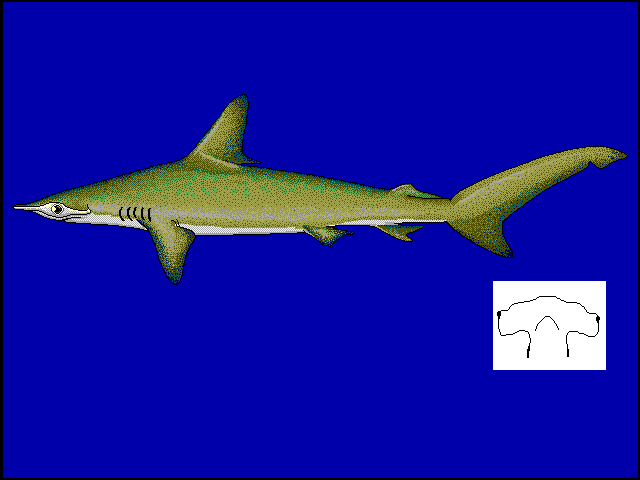
It is a large hammerhead, exceeding 3 m. The head is very wide but short from front to back, its width between 26 and 29 % of total length; its front edge forms a broad arch, with indentations at the sides and no notch at all in the centre, at any age [6]. The first dorsal fin is moderately falcate and its free tip sits well ahead of the pelvic fins; the second dorsal is low and its inner margin, about 2 times its height, ends well before the origin of the caudal fin; the pelvic fins are not falcate and the anal fin has a deeply notched rear edge [6]. The back is dark olive or grey-brown, the belly white, and the underside of the pectoral fin tips is dusky [6].
Similar species
- Sphyrna lewini: Its head does have a clear notch in the centre of the front edge, and the free tip of its second dorsal fin reaches almost to the origin of the caudal fin [6].
Distribution and habitat
It lives in temperate and tropical seas worldwide; in the eastern Pacific it ranges from northern California to the Gulf of California, Panama and the Galapagos Islands, and from Ecuador to Chile [6]. It is an active coastal-pelagic and semi-oceanic shark, found both close inshore in shallow water and offshore over continental and island shelves, and it is apparently the hammerhead that best tolerates temperate water [6].
Off northern Peru, what it eats suggests that neonates and small juveniles live near the coast and that larger individuals move into oceanic water [4]. Three nursery areas there have been compared, Máncora, San José and Salaverry: the San José area lies on the continental shelf, with small islands, and the Salaverry area opens further into oceanic water [7].
Biology
It is viviparous, with a yolk-sac placenta, and bears between 29 and 37 pups per litter; at birth it measures 50 to 61 cm, it matures at around 210 to 240 cm and reaches a maximum of about 370 to 400 cm [6].
In landings at Pacasmayo and Salaverry between March and September 2022, no individual exceeded 200 cm, the minimum size at sexual maturity used by the authors, and 92 % were neonates of 50 to 70 cm or juveniles of 71 to 150 cm [8]. From those sizes they estimated fast growth up to about the first year of age, a recruitment peak between May and July and a natural mortality of 0.46 per year, higher than the values of 0.23 to 0.39 published in other studies [8].
Ecology
Between December 2012 and June 2015, 485 stomachs were examined from sharks of 53 to 294 cm landed at 7 ports in northern Peru, from Zorritos to Salaverry; the calculated trophic position was 4.3, typical of a top predator [4]. On average, cephalopods occurred in 89 % of stomachs and fishes in 11 %; the Patagonian squid Doryteuthis gahi (37 % of the index of relative importance) and the jumbo squid Dosidicus gigas (27 %) together made up more than 60 % of the diet [4].
The diet changes with size: neonates and small juveniles mostly eat coastal prey, such as the Patagonian squid, and larger juveniles and adults eat oceanic prey, such as the jumbo squid; the giant squid Architeuthis dux, which lives between 200 and 1000 m deep, appeared only in sharks of 191 to 294 cm [4]. Of the stomach contents, 92 % were heavily digested, which the authors take to mean that it feeds at intervals rather than continuously [4].
In juveniles of 70 to 120 cm caught incidentally in gillnets in February and March 2019, stable isotopes and fatty acids showed significant differences in trophic niche among the three nursery areas, although the isotopic niches overlapped by more than 60 %; Máncora had the broadest isotopic niche and the Salaverry juveniles appeared to feed in more oceanic water than those from San José [7]. The species caught alongside them, mostly fishes, are probably not what they eat; the few jumbo squid samples analysed point to it as possible prey, which the authors say still needs confirming with more samples [7].
Conservation
Its global category on the IUCN Red List is Vulnerable [5]. Since September 2014 it has been listed in CITES Appendix II [4], and that listing, agreed in March 2013, requires Peru to regulate and control its international trade [3].
An IMARPE assessment for 1996-2014 found the stock fully exploited; since 2016 fishing for it has been allowed from 11 March to 31 December and banned from 1 January to 10 March, a summer closure meant to protect reproduction and recruitment, and that year the catch limit for the artisanal fleet was 482 t [2]. For 2026 the limit is 444 t, sharks must be landed with their fins attached and, since July 2026, those caught incidentally in gillnets during the closure may be landed, up to 10 % of the catch of each fishing trip [9].
Between 1991 and 2000, 97 % of the individuals landed at San José had not yet reached sexual maturity [3]. No adult turned up in the 2022 La Libertad landings, and the authors' model put the fishery at roughly 10 % of its former biomass; they therefore recommend safeguarding the areas where pups are born and grow, introducing a legal minimum size and capping both the volume caught and the length of the season [8].
Health, toxicological and chemical relevance
Not medical advice. For a sting, a poisoning or an allergy, seek medical care.
Its meat is among the most eaten of Peru's sharks and rays. In the muscle of 27 sharks from the north of the country, all neonates or juveniles, mercury ranged from 0.13 to 0.85 mg/kg wet weight, below the 1 mg/kg limit recommended by the World Health Organization; larger sharks held less mercury, and the authors call for measuring it in adults as well [10].
FAO's shark catalogue regards it as dangerous to people, although of the attacks attributed to large hammerheads only a few can be assigned to it, and tentatively [6].
Human relevance
Between 1996 and 2010 it made up 15 % of the sharks landed in Peru, behind the blue shark and the mako; its landings grew by about 7 % a year between 2000 and 2010, peaking in 1998 and 2003, and between 1996 and 2000, 83 % were caught in gillnets [3]. Between 2002 and 2011 Peru landed a greater biomass of this species than the other reporting countries combined: Spain, Ecuador, Portugal and New Zealand [3].
More than half of those landings come from artisanal fishers on the northern and central coast who work in the nursery areas, and Peru is among the 20 largest exporters of shark fins [7]. At the ports of La Libertad, fishers behead, gut and sell the sharks very quickly after landing [8].
Where to see it in Peru
Recent studies of the species in Peru worked with sharks from the northern coast: landed between December 2012 and June 2015 at Zorritos, Acapulco, Cancas, Máncora, Yacila, San José and Salaverry [4], juveniles from the Máncora, San José and Salaverry nursery areas in 2019 [7], and landings at Pacasmayo and Salaverry in 2022 [8].
References (10)
- WoRMS Editorial Board (2026). Sphyrna zygaena (Linnaeus, 1758). World Register of Marine Species. https://www.marinespecies.org/aphia.php?p=taxdetails&id=105819 (accessed 2026-10-20)
- Ministerio de la Producción (2016). Resolución Ministerial N.° 008-2016-PRODUCE: Establecen temporada de pesca del recurso tiburón martillo a nivel nacional. El Peruano (15-01-2016), Normas Legales, p. 575501; copia en FAOLEX. https://faolex.fao.org/docs/pdf/per157977.pdf (accessed 2026-10-20)
- Gonzalez-Pestana, A., Kouri J., C., Velez-Zuazo, X. (2016). Shark fisheries in the Southeast Pacific: A 61-year analysis from Peru. F1000Research, 164. doi:10.12688/f1000research.4412.2 (accessed 2026-10-20)
- Gonzalez-Pestana, A., Acuña-Perales, N., Coasaca-Cespedes, J. et al. (2017). Trophic ecology of the smooth hammerhead shark (Sphyrna zygaena) off the coast of northern Peru. Fishery Bulletin, 451-459. doi:10.7755/FB.115.4.2 (accessed 2026-10-20)
- Rigby, C.L., Barreto, R., Carlson, J. et al. (2018). Sphyrna zygaena: Rigby, C.L., Barreto, R., Carlson, J., Fernando, D., Fordham, S., Herman, K., Jabado, R.W., Liu, K.M., Marshall, A., Pacoureau, N., Romanov, E., Sherley, R.B. & Winker, H. The IUCN Red List of Threatened Species 2019: e.T39388A2921825. doi:10.2305/IUCN.UK.2019-3.RLTS.T39388A2921825.en (accessed 2026-10-20)
- Compagno, L.J.V. (1984). FAO species catalogue. Vol. 4. Sharks of the world. An annotated and illustrated catalogue of shark species known to date. Part 2: Carcharhiniformes. FAO Fisheries Synopsis No. 125, Vol. 4, Part 2. FAO, Rome, 545-554. https://www.fao.org/docrep/pdf/009/ad123e/ad123e35.pdf (accessed 2026-10-20)
- Segura-Cobeña, E., Alfaro-Shigueto, J., Mangel, J. et al. (2021). Stable isotope and fatty acid analyses reveal significant differences in trophic niches of smooth hammerhead Sphyrna zygaena (Carcharhiniformes) among three nursery areas in northern Humboldt Current System. PeerJ, e11283. doi:10.7717/peerj.11283 (accessed 2026-10-20)
- De La Cruz Barrueto, K.N., Kaneshima González, K., Culquichicón Malpica, Z.G. et al. (2024). Landings of Sphyrna zygaena (Linnaeus, 1758) in northern Peru indicate a lack of adult specimens. Latin American Journal of Aquatic Research, 233-241. doi:10.3856/vol52-issue2-fulltext-3121 (accessed 2026-10-20)
- Ministerio de la Producción (2026). Resolución Ministerial N.° 00211-2026-PRODUCE: Autorizan desembarque de ejemplares del recurso tiburón martillo (Sphyrna zygaena) capturados incidentalmente durante el periodo de veda por embarcaciones pesqueras artesanales que operan con redes cortina. El Peruano (26-07-2026). https://busquedas.elperuano.pe/dispositivo/NL/2538195-1 (accessed 2026-10-20)
- Gonzalez-Pestana, A., Alfaro-Shigueto, J., Mangel, J.C. et al. (2017). Niveles de mercurio en el tiburón martillo Sphyrna zygaena (Carcharhiniformes: Sphyrnidae) del norte del Perú. Revista Peruana de Biología, 407-411. doi:10.15381/rpb.v24i4.14066 (accessed 2026-10-20)
More pictures
If you come across it
Protected or threatened species. Watch it without touching, feeding, chasing or taking it, and keep the recommended viewing distances.
Where it has been recorded
- Filled: scientific records, or confirmed by a curator
- Hatched: isolated record
- Dotted outline: no scientific records and no curator's confirmation (an ORKA sighting is not drawn here)
- Tropical northern sea
Scientific records (1 record)
- Tropical–cold transition zone
Scientific records (1 record)
- Cold central sea
Scientific records (2 records)
- Cold southern sea
Scientific records (1 record)
From openly licensed OBIS and GBIF records (CC0 or CC BY). How each list is built.
Related species
From the same genus (Sphyrna).
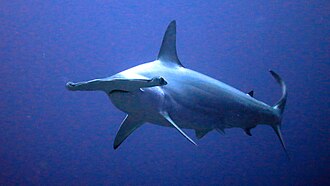
Scalloped hammerhead
Sphyrna lewini
IUCN status: CR · Critically Endangered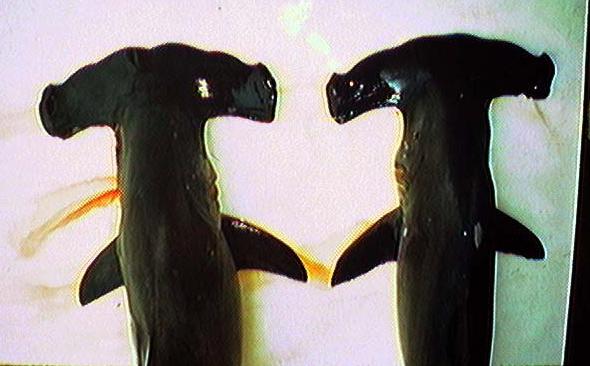
Scalloped bonnethead
Sphyrna corona
IUCN status: CR · Critically Endangered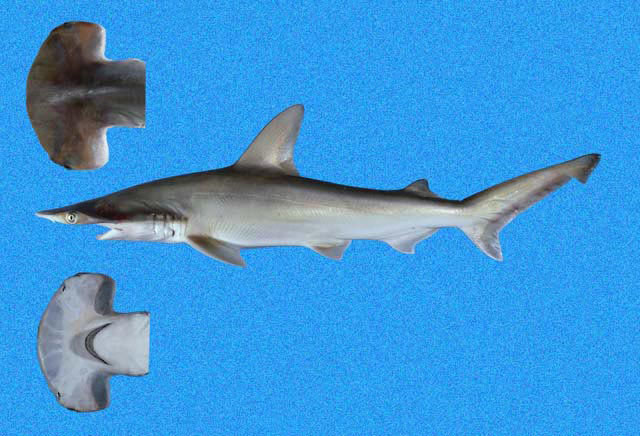
Scoophead
Sphyrna media
IUCN status: CR · Critically Endangered
Great hammerhead
Sphyrna mokarran
IUCN status: CR · Critically EndangeredSphyrna vespertina
IUCN status: Not evaluated
Names and sources
In Spanish
- Tiburón martillo — Peru; SERNANP (2026). Plan Maestro de la Reserva Nacional Mar Tropical de Grau 2026–2031. RPE N.° 000052-2026-SERNANP, p. 47 of the PDF; fishbase · main name
- Cornuda cruz — WoRMS
- Cornuda prieta — WoRMS
- Pez martillo — WoRMS
- Tiburón martillo cruz — WoRMS
In English
- Smooth hammerhead — WoRMS; Wikidata
- Hammerhead — WoRMS
- Hammerhead shark — WoRMS
- Shovelhead shark — WoRMS
Classification
Learn more
Conservation status: Vulnerable (IUCN Red List, according to Wikidata). Taxonomy: PeRMS / WoRMS (CC BY 4.0).