
Sharks, rays and chimaeras · Sphyrnidae
Scalloped bonnethead
Sphyrna corona Springer, 1940
Spanish: Tiburón cabeza de paleta
- Names in Peru
- Tiburón cabeza de paleta
- Peruvian Register of Marine Species
- Listed in PeRMS (IMARPE)
Species account
Summary
Sphyrna corona is a small hammerhead shark of the family Sphyrnidae, in the order Carcharhiniformes [1]. It lives on the continental shelf of the eastern Pacific, from southern Mexico to Peru, and is one of the smallest of the hammerheads [2]. It feeds mostly on crustaceans and its global category on the IUCN Red List is Critically Endangered [3],[4].
Etymology
Springer described it in 1940 in the Stanford Ichthyological Bulletin; the holotype is an adult male of 663 mm, catalogued as SU-11882, and its type locality is Panama, in the eastern Pacific [2]. The FAO catalogue gives it the English name scalloped bonnethead and the Spanish name cornuda coronada [2].
Identification and similar species
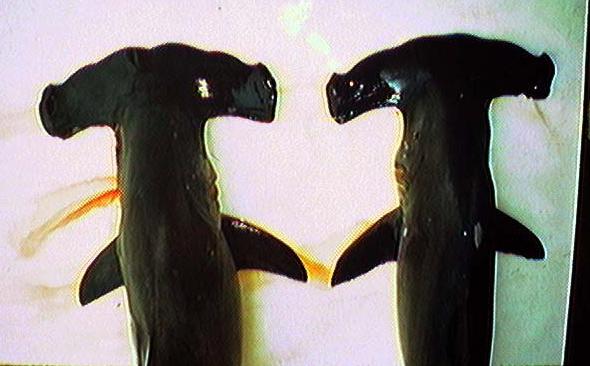
It is a small hammerhead whose head, seen from above, is shaped like a mallet, with an arched front edge that has a shallow notch in the middle and another on each side [2]. The width of the head is 24 % to 29 % of total length, the snout is relatively long and the small mouth forms a pronounced arch; the grooves that run in front of the nostrils in other hammerheads are barely developed [2]. The front teeth have long, slender, unserrated cusps, and the rear ones almost always carry a cusp and are not flattened [2].
The body is grey above and white below, without conspicuous fin markings [2]. The first dorsal fin is moderately falcate, and the anal fin is larger than the second dorsal and nearly straight along its rear edge [2]. The FAO catalogue gives a maximum of about 92 cm and judges it probably the smallest hammerhead [2], although a recent study reports it up to 120 cm in total length [3].
6 species of the genus Sphyrna have been recorded in Peru [5].
Similar species
- Sphyrna media: Sphyrna media has a shorter snout and a broader, more arched mouth, and its anal fin is more deeply concave than that of Sphyrna corona [2].
- Sphyrna tudes: Sphyrna tudes has clearly visible grooves in front of the nostrils, a head with sharper notches and a more erect first dorsal fin [2].
- Sphyrna tiburo: Sphyrna tiburo has a narrow, shovel-shaped head with no notch in its front edge, and its rear teeth are flattened like molars [2].
Distribution and habitat
It is reported from the eastern Pacific, from southern Mexico to Peru, with doubt over the Gulf of California [2]. A later study describes it as endemic to the eastern Pacific and places it from southern Mexico to northern Peru [3]. It appears on the updated checklist of chondrichthyans of the Peruvian sea [5].
It inhabits the continental shelf, in bottom and near-bottom environments down to about 100 m, according to that study's summary [3]. In the Colombian Pacific it was studied in a mangrove area with mud and sand bottoms, where both sexes were landed at a fishing community inside a national park [3].
Biology
The FAO catalogue noted in 1984 that almost nothing was known of its biology, and described it as viviparous with a yolk-sac placenta [2]. More recent work presents it as placental viviparous, with 2 young per uterus, births of 22 to 23 cm in total length and a gestation of 8 to 10 months [3].
That work gives a size at first maturity of 57.6 cm in males and 56.9 cm in females, and a maximum length of about 120 cm [3]. The 11 specimens measured in the Colombian Pacific were between 46 and 89.5 cm [3].
Ecology
A study in the Colombian Pacific analysed stable isotopes in the vertebrae of 11 specimens and concluded that it is a coastal mesopredator that specialises in crustaceans [3]. According to the models, crustaceans make up 53.5 % of the diet, coastal pelagic fishes 15.8 %, coastal squid 10.4 %, benthopelagic fishes 7.8 % and bottom fishes 5.7 % [3].
Small individuals use a wider range of resources than large ones, which points to a more opportunistic diet in early life and a more specialised one with growth [3]. The results come from a single area of the central Colombian Pacific [3].
Conservation
Its global category on the IUCN Red List is Critically Endangered [4]. A recent study notes that its range is restricted, that it has low fecundity and is highly vulnerable to fishing and habitat degradation, and that it is listed in CITES Appendix II [3].
In Peru, the National Plan of Action for sharks served until 2015 as the country's list of chondrichthyans, but it was limited to species of commercial importance, and misidentifications at ports are common [5].
Human relevance
The FAO catalogue assumed that local coastal fisheries take it where it lives, though without data [2]. In Colombia it is known to be caught in trawl nets, drift nets, longlines and hand lines, in both artisanal and industrial fisheries, with low catches and landings [3].
In shrimp trawling its catch rate was 0.11 individuals per hour, and it made up 1.27 % of landings between 2006 and 2010 [3]. The specimens in the study were obtained from 2 longline vessels landing at Juanchaco [3].
Where to see it in Peru
The checklist of chondrichthyans of Peru includes this species in the Peruvian sea, but gives no specific place of record for it [5]. It does give one for Sphyrna media and Sphyrna tiburo (Puerto Pizarro, Tumbes), which are among the species whose distribution in Peruvian waters the article treats as a likely range expansion [5]. With that source, no site in Peru can be named where Sphyrna corona can be observed [5].
References (5)
- Froese, R., Pauly, D. (2026). Sphyrna corona Springer, 1940. World Register of Marine Species. https://www.marinespecies.org/aphia.php?p=taxdetails&id=271377 (accessed 2026-10-21)
- Compagno, L.J.V. (1984). FAO species catalogue Vol. 4. Sharks of the world. An annotated and illustrated catalogue of shark species known to date. Part 2. Carcharhiniformes. FAO Fisheries Synopsis No. 125, Vol. 4, Part 2. FAO, Rome, 543-544. https://www.fao.org/4/ad123e/ad123e00.htm (accessed 2026-10-21)
- Estupiñán-Montaño, C., Delgado-Huertas, A., Herrera, M.A. et al. (2026). First trophic ontogeny data for the scalloped bonnethead Sphyrna corona in the Colombian Pacific. Endangered Species Research, 1-16. doi:10.3354/esr01498 (accessed 2026-10-21)
- Pollom, R., Pérez Jiménez, J.C., Bizzarro, J. et al. (2019). Sphyrna corona: Pollom, R., Pérez Jiménez, J.C., Bizzarro, J., Burgos-Vázquez, M.I., Cevallos, A., Espinoza, M., Herman, K., Mejía-Falla, P.A., Navia, A.F., Sosa-Nishizaki, O. & Velez-Zuazo, X. The IUCN Red List of Threatened Species 2020: e.T44591A124434064. doi:10.2305/IUCN.UK.2020-3.RLTS.T44591A124434064.en (accessed 2026-10-21)
- Cornejo, R., Vélez-Zuazo, X., González-Pestana, A. et al. (2015). An updated checklist of Chondrichthyes from the southeast Pacific off Peru. Check List, 1809. doi:10.15560/11.6.1809 (accessed 2026-10-21)
More pictures
If you come across it
Protected or threatened species. Watch it without touching, feeding, chasing or taking it, and keep the recommended viewing distances.
Related species
From the same genus (Sphyrna).
Scalloped hammerhead
Sphyrna lewini
IUCN status: CR · Critically Endangered
Smooth hammerhead
Sphyrna zygaena
IUCN status: VU · Vulnerable
Scoophead
Sphyrna media
IUCN status: CR · Critically Endangered
Great hammerhead
Sphyrna mokarran
IUCN status: CR · Critically EndangeredSphyrna vespertina
IUCN status: Not evaluated
Names and sources
In Spanish
- Tiburón cabeza de paleta — Peru; fishbase · main name
- Cornuda Coronada — Wikidata; WoRMS
In English
- Scalloped bonnethead — WoRMS; Wikidata
- Crown Shark — Wikidata
- Mallethead Shark — Wikidata
Classification
Learn more
Conservation status: Critically Endangered (IUCN Red List, according to Wikidata). Taxonomy: PeRMS / WoRMS (CC BY 4.0).