
Bony fishes · Tetraodontidae
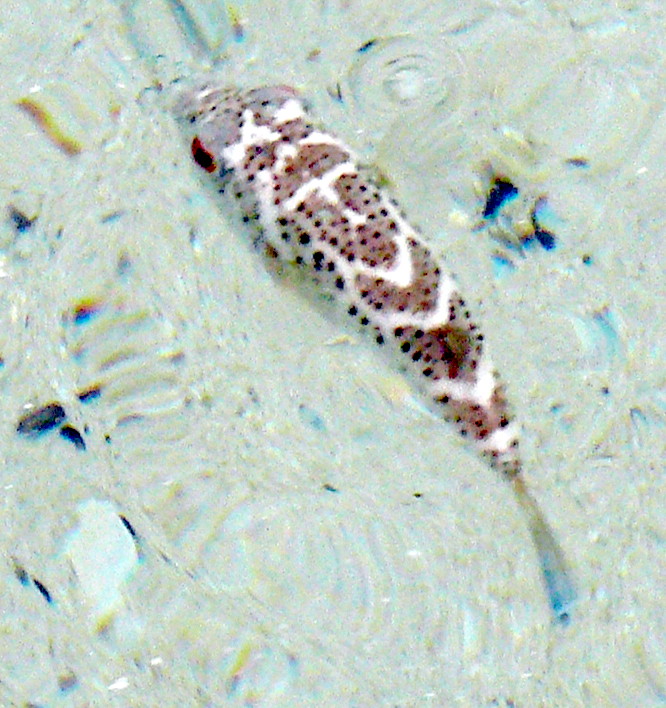
Bullseye puffer
Sphoeroides annulatus (Jenyns, 1842)
Spanish: Tamborín
- Names in Peru
- Tamborín · Pez globo
- Peruvian Register of Marine Species
- Listed in PeRMS (IMARPE)
Species account
Summary
Sphoeroides annulatus is a pufferfish of the family Tetraodontidae that lives in the eastern Pacific, from California to Peru or northern Chile, depending on the source [1],[2]. In Peru it is called pez globo or tamborín, and the management plan of the Los Manglares de Tumbes National Sanctuary lists it among the mangrove fishes [3]. It reaches 44 cm in total length [1]. In Mexico, where it is known as botete diana, it supports an important artisanal fishery [4],[5]. Wild fish can accumulate tetrodotoxin, mostly in the liver [5]. Its global IUCN Red List category is Least Concern [6].
Etymology
Identification and similar species
The body is short and deep, with no fin spines: the dorsal fin has 8 soft rays and the anal fin 7 [1]. FishBase also notes a very winding lateral line, unusually shaped nostrils and a rasping sound that the fish makes [1].
The largest recorded fish measured 44 cm in total length and weighed 1.6 kg [1]. Between 2010 and 2011, the 745 fish landed at Teacapán (Sinaloa, Mexico) measured 15 to 40 cm and weighed 100 to 1600 g, with a size distribution of two peaks, at 20 and 28 cm [4].
Distribution and habitat
It is an eastern Pacific species. FishBase gives its range as California to Pisco, in Peru, and the Galápagos Islands [1]. A 2026 Mexican study, citing the 1995 FAO guide, extends the southern limit to northern Chile, so the sources do not agree on where its range ends [2].
It lives over soft bottoms, reef-associated, between 10 and 60 m deep [1]. Juveniles occupy estuaries [1]; in Sinaloa, the Teacapán fleet works at the mouth of an estuarine system and lands fish under 20 cm [4].
Biology
Its reproduction was studied with 745 fish landed at Teacapán between May 2010 and April 2011: 375 males and 370 females, a sex ratio that did not depart from 1 to 1 [4]. Females reached 50 % maturity at 26.52 cm and males at 27.41 cm in total length [4]. The main reproductive period ran from June to September, with a weaker one in November and December in females and in December in males [4]. The weight-length relationship was TW = 0.044 TL raised to 2.815, with a slope below 3 [4].
In a hatchery, fertilised eggs were incubated at 28 °C and began to hatch after 72 hours, and by day 4 the larvae had absorbed their yolk sac [5]. In the wild, the species forms spawning aggregations from March to October at the mouths of estuaries and rivers and on coastal reefs [2].
Ecology
In a coastal lagoon of the southeastern Gulf of California, sampled from December 2001 to July 2005, 20877 fish of 191 species and 47 families were analysed [7]. Sphoeroides annulatus had the largest biomass, at 10.47 % of the total, and ranked among the top five by biomass in every season except the two summers analysed [7].
FishBase estimates its trophic level at 3.1, from the food items known for it [1]. Because of its spawning season, fishers find it concentrated at estuary and river mouths and on coastal reefs, which makes it easy to catch [2].
Conservation
The IUCN Red List classifies it globally as Least Concern [6]. FishBase dates that assessment to 1 May 2008 [1].
In northwest Mexico, an assessment of 111 reef and demersal fish stocks classified Sphoeroides annulatus as unsustainable in both provinces studied, under all 3 exploitation approaches used [8]. An earlier work cited by the Teacapán study had described it as fully exploited in 4 of the 5 years with Gulf of California data, between 1979 and 1988 [4].
Health, toxicological and chemical relevance
Not medical advice. For a sting, a poisoning or an allergy, seek medical care.
The viscera of pufferfishes can contain tetrodotoxin [5]. According to earlier work summarised by a Mexican study, in wild fish of this species the liver held 22 µg of toxin per gram, the gonads 0.46 and the intestine 0.42, and the muscle was not toxic; the same text counts 37 human casualties from pufferfish consumption in Mexico over 40 years and gives a lethal dose for people of 0.5 to 2.0 mg [5]. A review of the toxin reports that in fish of this species from the Baja California peninsula the main analogue was 4,9-anhydroTTX [9].
In fish reared in tanks at Mazatlán (Mexico), the mouse assay found only mild toxicity, below 1 mouse unit or 0.2 µg per gram, in the muscle of juveniles, in the viscera of pre-adults and in the muscle, liver and gonad of adults; the mice recovered within 1 to 2 hours [5]. The authors conclude that the species reared under those conditions poses no food safety risk, and note that the origin of the toxin remains undetermined [5].
Human relevance
In Mexico it is eaten in the northwest and in some central states, and about 600 tonnes are exported each year, which makes the country the second largest pufferfish exporter [5]. It is caught on hooks from small boats, baited with shrimp heads and crabs, in midwater trawls and as bycatch of shrimp trawling; its fillets are firm, white and boneless, and 1 kg of fillets sold directly by the fisher to the consumer costs 4.5 to 5.5 US dollars [2].
Between 2000 and 2024, official Mexican statistics recorded 22495.5 tonnes of live weight, but conversion factors based on biometric relationships gave an estimate of 38958.3 tonnes, that is 16462.8 tonnes more (1.73 times the recorded figure) [2]. A 2012 article presents it as a candidate for marine aquaculture in the tropical eastern Pacific, with hatchery techniques developed in the preceding decade [5].
Where to see it in Peru
The 2023-2027 management plan of the Los Manglares de Tumbes National Sanctuary refers to its Annex 13 for the list of fishes of the Tumbes mangrove ecosystem, where the pez globo or tamborín (Sphoeroides annulatus) appears, and states that there is no fish record for the sanctuary itself; the list therefore does not show that the species can be seen inside the sanctuary [3].
References (9)
- Froese, R., Pauly, D. (2026). Sphoeroides annulatus, Bullseye puffer. FishBase. https://www.fishbase.se/summary/Sphoeroides-annulatus.html (accessed 2026-10-25)
- Aguirre Villaseñor, H., Cisneros-Mata, M.Á., Morales-Bojórquez, E. (2026). Factores de conversión de peso vivo para las categorías comerciales del botete (Sphoeroides annulatus) en el Pacífico mexicano: Una revisión histórica y la corrección del subregistro. Ciencia Pesquera 34, 39-46. doi:10.64106/cienciapesquera.v34i1.76 (accessed 2026-10-25)
- SERNANP (2023). Plan Maestro del Santuario Nacional Los Manglares de Tumbes 2023-2027 (Resolución de Presidencia N.° 064-2023-SERNANP). Servicio Nacional de Áreas Naturales Protegidas por el Estado. https://www.gob.pe/institucion/sernanp/normas-legales/3907709-064-2023-sernanp (accessed 2026-10-25)
- Valdez Pineda, M.C., Moran Angulo, R.E., Voltolina, D. et al. (2014). Population structure and reproductive aspects of puffer fish Sphoeroides annulatus (Jenyns, 1842) (Osteichthyes: Tetraodontidae), landed in Teacapan, Sinaloa, Mexico. Latin American Journal of Aquatic Research 42, 121-126. doi:10.3856/vol42-issue1-fulltext-9 (accessed 2026-10-25)
- Nuñez-Vazquez, E.J., Garcia-Ortega, A., Campa-Cordova, A.I. et al. (2012). Toxicity of Cultured Bullseye Puffer Fish Sphoeroides annulatus. Marine Drugs 10, 329-339. doi:10.3390/md10020329 (accessed 2026-10-25)
- Nielsen, J.G., Munroe, T., Tyler, J. (2008). Sphoeroides annulatus: Nielsen, J.G., Munroe, T. & Tyler, J. IUCN Red List of Threatened Species. doi:10.2305/iucn.uk.2010-3.rlts.t183652a8152064.en (accessed 2026-10-25)
- Amezcua, F., Amezcua-Linares, F. (2014). Seasonal Changes of Fish Assemblages in a Subtropical Lagoon in the SE Gulf of California. The Scientific World Journal 2014, 968902. doi:10.1155/2014/968902 (accessed 2026-10-25)
- Juárez-Vera, V., Ramírez-Ortiz, G., Aranceta-Garza, F. et al. (2026). Assessing the sustainability of reef and demersal fish stocks in Northwest México under a data-limited approach. PeerJ 14, e21404. doi:10.7717/peerj.21404 (accessed 2026-10-25)
- Bane, V., Lehane, M., Dikshit, M. et al. (2014). Tetrodotoxin: Chemistry, Toxicity, Source, Distribution and Detection. Toxins 6, 693-755. doi:10.3390/toxins6020693 (accessed 2026-10-25)
More pictures
Where it has been recorded
- Filled: scientific records, or confirmed by a curator
- Hatched: isolated record
- Dotted outline: no scientific records and no curator's confirmation (an ORKA sighting is not drawn here)
- Tropical northern sea
Scientific records (7 records)
- Tropical–cold transition zone
Scientific records (8 records)
- Cold central sea
Scientific records (8 records)
From openly licensed OBIS and GBIF records (CC0 or CC BY). How each list is built.
Related species
From the same genus (Sphoeroides) and from the same family (Tetraodontidae).
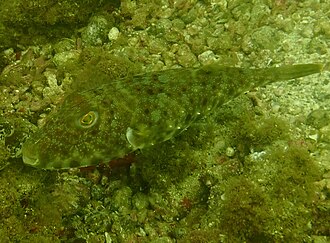
Longnose puffer
Sphoeroides lobatus
IUCN status: LC · Least ConcernSphoeroides rosenblatti
IUCN status: LC · Least Concern- No openly licensed image yet
Peruvian puffer
Sphoeroides sechurae
IUCN status: LC · Least Concern - No openly licensed image yet
Sphoeroides andersonianus
IUCN status: DD · Data Deficient Narrow-headed Puffer
Sphoeroides angusticeps
IUCN status: LC · Least Concern- No openly licensed image yet
Slick Puffer
Sphoeroides kendalli
IUCN status: LC · Least Concern - No openly licensed image yet
Pygmy puffer
Sphoeroides trichocephalus
IUCN status: LC · Least Concern 
Pufferfish
Lagocephalus lagocephalus
IUCN status: LC · Least Concern
Names and sources
In Spanish
- Tamborín — Peru; SERNANP (2023). Plan Maestro del Santuario Nacional Los Manglares de Tumbes 2023-2027. RP N.° 064-2023-SERNANP, p. 147 of the PDF; fishbase; Wikidata · main name
- Botete Diana — Wikidata; WoRMS
- Botete Tamborín — Wikidata
- Pez globo — Peru; SERNANP (2023). Plan Maestro del Santuario Nacional Los Manglares de Tumbes 2023-2027. RP N.° 064-2023-SERNANP, p. 147 of the PDF
- Tambolero — Wikidata
- Tamboril — Wikidata
- Tambulero — Wikidata
In English
- Bullseye puffer — WoRMS; Wikidata
- Gulf Puffer — Wikidata
- Puffer — Wikidata
Classification
Learn more
Conservation status: Least Concern (IUCN Red List, according to Wikidata). Taxonomy: PeRMS / WoRMS (CC BY 4.0).