
Bivalves · Mytilidae
Semimytilus patagonicus
Semimytilus patagonicus (Hanley, 1843)
Spanish: Chorito
- Names in Peru
- Chorito
- Peruvian Register of Marine Species
- Listed in PeRMS (IMARPE)
Species account
Summary
Semimytilus patagonicus is a small mussel of the family Mytilidae, originating along South America's Pacific seaboard and living on wave-exposed rock [1]. For years it was known as Semimytilus algosus, a name that, according to a 2021 study, yields to the one holding priority [2],[3]. It is hermaphroditic and breeds throughout the year in its native range [4],[1]. Outside that range it has become invasive, for example on the west coast of South Africa [1].
Identification and similar species
The shell is elongate and typically mussel-shaped, with a nacreous interior, a hinge without teeth and a compact ligament ridge; outside it is smooth, with irregular concentric rings from the umbo to the posterior edge [1].
In central Chile two morphotypes are described: one with a thick, smooth shell on compact rocky platforms, and one with a thinner, ringed shell on emergent rocks [5]. In 20 large specimens from a fishing vessel that reached Argentina from Callao, shell length was 19.5 to 49.5 mm, averaging 38.8 mm [1]. In 120 specimens collected near Lima the mean was 32.3 mm [6].
Distribution and habitat
The native range runs from Manta, Ecuador, to the Gulf of Arauco, Chile, at about 37 degrees south [1]. It is recorded on intertidal and subtidal rocky shores, and as a fouling organism on scallop culture structures [1].
It is a common organism on wave-exposed rocky shores of the South American Pacific [1]. On the west coast of South Africa it has colonised the lower intertidal along about 500 km [1]. The type material against which the species was compared comes from Callao, Lima [1].
Biology
Hermaphrodites predominated among the 20 mature mussels from that vessel: 14 had hermaphroditic gonads, 1 had only male and 5 only female gonads [1]. A genetic study showed that, although hermaphroditic, the species probably has doubly uniparental inheritance of mitochondrial DNA, with two mitochondrial genomes that differ by 34.7 % [4].
In its native range reproduction takes place all year, with recruits present in every month and a summer peak [1]. Larval development is completed in about 27 days and the pediveliger metamorphoses at a maximum size of 150 micrometres [1].
In the laboratory, with 72 individuals kept for 21 days at 17, 20, 23 and 26 degrees, mortality was 0 % at 17 degrees in all treatments, and the filtration rate fell as microplastic concentration rose [7].
Ecology
In central Chile, the mussel's predators include the crab Acanthocyclus gayi and two snails, Nucella crassilabrum and Concholepas concholepas [5]. Experiments with waterborne cues showed that the presence of predators, above all the crab, increases shell thickness [5].
When it forms dense beds the species excludes others from exposed subtidal zones, and in South Africa it occupies the lower intertidal along about 500 km, where non-native species dominate some rocky shores [1]. A fishing vessel that had been anchored for one month in Callao in 2012 carried reproductively active specimens to Puerto Madryn, Argentina, in its sea chests [1].
Health, toxicological and chemical relevance
Not medical advice. For a sting, a poisoning or an allergy, seek medical care.
In a bioassay with 120 mussels from Miraflores, near Lima, an anionic detergent whose active ingredient was sodium dodecylbenzene sulfonate gave a median lethal concentration of 34.95 mg per litre at 72 hours [6]. The study therefore classed the risk to the mussel as harmful, and proposed it as a tool for assessing the acute toxicity of detergents in the sea [6].
Exposure to plastic particles smaller than 125 micrometres at 0.125 and 0.250 mg per litre lowered its filtration rate, and mortality reached 67 % in one treatment [7].
Human relevance
In Peru the species is gathered from the wild for human consumption, and in Chile it has been raised in limited quantities at some aquaculture sites [1]. It is also a fouling species in scallop aquaculture facilities [1]. Its economic effect in South Africa, where it is invasive, had not yet been evaluated [1].
Where to see it in Peru
References (7)
- Bigatti, G., Signorelli, J.H., Schwindt, E. (2014). Potential invasion of the Atlantic coast of South America by Semimytilus algosus (Gould, 1850). BioInvasions Records 3(4), 241-246. doi:10.3391/bir.2014.3.4.05 (accessed 2026-10-25)
- Signorelli, J.H., Pastorino, G. (2021). Semimytilus patagonicus (d’Orbigny, 1842) (Bivalvia: Mytilidae) revealed as the valid name with priority over Semimytilus algosus (Gould, 1850). Archiv für Molluskenkunde 150, 55-63. doi:10.1127/arch.moll/150/055-063 (accessed 2026-10-25)
- MolluscaBase eds. (2026). Semimytilus patagonicus (Hanley, 1843). World Register of Marine Species. https://www.marinespecies.org/aphia.php?p=taxdetails&id=1518612 (accessed 2026-10-25)
- Lubośny, M., Przyłucka, A., Śmietanka, B. et al. (2020). Semimytilus algosus: first known hermaphroditic mussel with doubly uniparental inheritance of mitochondrial DNA. Scientific Reports 10, 11256. doi:10.1038/s41598-020-67976-6 (accessed 2026-10-25)
- Caro, A.U., Castilla, J.C. (2004). Predator-inducible defences and local intrapopulation variability of the intertidal mussel Semimytilus algosus in central Chile. Marine Ecology Progress Series 276, 115-123. doi:10.3354/meps276115 (accessed 2026-10-25)
- Príncipe-Morillo, F.M., Minaya-Angoma, D., Alvariño-Flores, L. et al. (2022). El mejillón Semimytilus patagonicus (Mytilida: Mytilidae) y el gusano Pseudonereis gallapagensis (Phyllodocida: Nereididae) como herramientas ecotoxicológica para la contaminación por detergentes en ambientes marinos. Revista de Biología Tropical 70(1), 658-667. doi:10.15517/rev.biol.trop..v70i1.50167 (accessed 2026-10-25)
- Gomez, A., Gonzales, S., Francia-Quiroz, J.C. (2021). Effect of temperature and microplastic concentration on the filtration rate of the mussel Semimytilus algosus (Myiloida: Mytilidae). Revista de Biología Tropical 69(4), 1242-1251. doi:10.15517/rbt.v69i4.45426 (accessed 2026-10-25)
More pictures
Where it has been recorded
- Filled: scientific records, or confirmed by a curator
- Hatched: isolated record
- Dotted outline: no scientific records and no curator's confirmation (an ORKA sighting is not drawn here)
- Tropical northern sea
Isolated record (1 record)
- Tropical–cold transition zone
Scientific records (9 records)
- Cold central sea
Scientific records (27 records)
- Cold southern sea
Scientific records (11 records)
From openly licensed OBIS and GBIF records (CC0 or CC BY). How each list is built.
Related species
From the same family.

Brachidontes adamsianus
IUCN status: Not evaluated
Brachidontes semilaevis
IUCN status: Not evaluated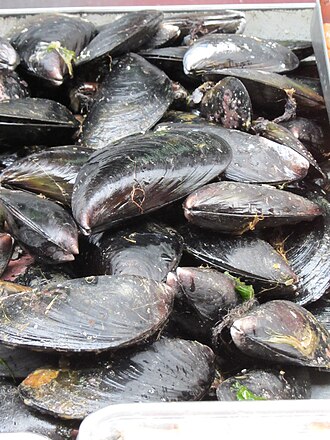
Aulacomya atra
IUCN status: Not evaluated
Brachidontes granulatus
IUCN status: Not evaluatedBrachidontes playasensis
IUCN status: Not evaluatedBrachidontes puntarenensis
IUCN status: Not evaluated
Chorus mussel
Choromytilus chorus
IUCN status: Not evaluated
Perumytilus purpuratus
IUCN status: Not evaluated
Names and sources
In Spanish
- Chorito — Peru; SERNANP (2016). Plan Maestro de la Reserva Nacional Sistema de Islas, Islotes y Puntas Guaneras 2016-2020, p. 19 of the PDF · main name
Also cited as
- Semimytilus algosus
Learn more
Conservation status: no data (IUCN). Taxonomy: PeRMS / WoRMS (CC BY 4.0).