
Bony fishes · Scombridae
Pacific sierra
Scomberomorus sierra Jordan & Starks, 1895
Spanish: Verle
- Names in Peru
- Verle · Sierra
- Peruvian Register of Marine Species
- Listed in PeRMS (IMARPE)
Species account
Summary
Scomberomorus sierra is a coastal, schooling pelagic fish of the family Scombridae, which groups the mackerels, bonitos and tunas. It lives in the tropical eastern Pacific, from southern California to the Galápagos and Paita in northern Peru, and in Peru it is known as sierra or verle [1]. Adults feed mostly on small fishes such as anchovies and sardines [2]. It reaches about 97 cm fork length and can exceed 5.4 kg, although it is usually no longer than 60 cm [1]. It supports artisanal fisheries, above all in Mexico [3], and the IUCN rates it Least Concern [4].
Identification and similar species
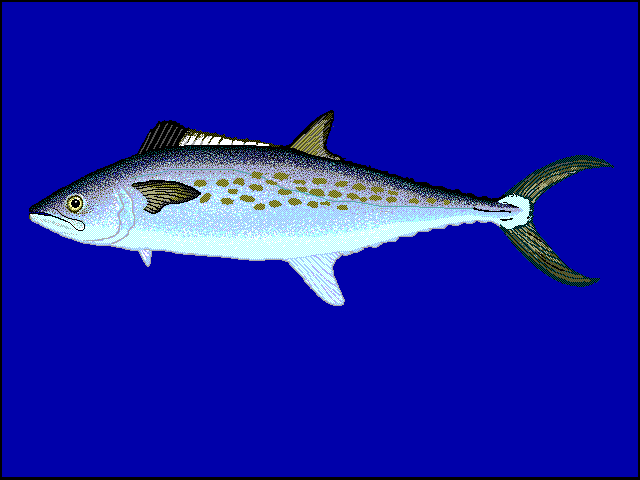
The flanks are silvery with round brown spots, orange in the living animal: three rows below the lateral line and one above it [1]. The first dorsal fin is black along its outer edge and white at the base, the second has a yellowish tinge with a black margin, and the anal fin is white [1].
The counts that define it are 15 to 18 spines in the first dorsal fin, 16 to 19 rays in the second followed by 7 to 10 finlets, and 16 to 21 anal rays followed by 7 to 10 finlets. It has 12 to 17 gill rakers on the first arch, 20 to 24 pectoral rays (nearly always 21) and 46 to 49 vertebrae, normally 48 [1].
For a long time several authors treated it as a synonym or subspecies of Scomberomorus maculatus, a mistake that the FAO catalogue points out explicitly [1].
Similar species
- Scomberomorus brasiliensis: Scomberomorus brasiliensis, from the western Atlantic, has shorter pelvic fins, 3.6 to 5.9 % of fork length, against 4.7 to 6.4 % in the sierra [1].
Distribution and habitat
The FAO catalogue places its range in the tropical eastern Pacific, from La Jolla (southern California) to the Galápagos and Paita in Peru, and mentions a 1978 record from Antofagasta, Chile [1]. It is an epipelagic, neritic species, meaning that it lives in schools in the water column near the coast, and it is believed to spawn close to shore over most of its range [1].
A genetic study compared samples from Sinaloa, Michoacán, Oaxaca, Chiapas and one Peruvian sample of 49 fish collected in 2005. It found at least two distinct genetic groups in the northern and central parts of the range, and slight differences between them and the Peruvian sample [5]. According to the authors, fish exchange little between the places where the species is most abundant, which are usually spawning sites as well [5].
In northern Peru the species is still caught: the 58 fish in a parasitological study came from the artisanal fishery of Puerto Pizarro, in Tumbes, between October 2019 and August 2022 [6].
Biology
In the Mazatlán fishery, in the southern Gulf of California, 1574 fish were measured between February 2002 and March 2003, with fork lengths from 105 to 740 mm, and the size analysis separated six age groups [3].
In Navidad Bay, Jalisco, nine years of monthly sampling between 1998 and 2007 produced fish from 26.0 to 102.8 cm total length, averaging 53.3 cm. The ratio of females to males was 1:0.9, not significantly different from 1:1 [7].
Females reach maturity at around 59.3 cm total length and males at around 56.4 cm in Jalisco [7]. In the southern Gulf of California, the fork length at first maturity of females was estimated at 443 mm, at roughly 3 years of age [3]. In Colombia, according to the FAO catalogue, fork length at first maturity ranges from 26 to 32 cm [1].
The breeding season changes with the area: April to June in Jalisco [7], May in the southern Gulf of California [3], and according to FAO July to September off Mexico, late August to November in Costa Rica and November to April in Colombia [1]. In species of this genus the larval phase is short, 8.3 to 9.1 days [5].
Ecology
In Acapulco Bay (Guerrero, Mexico), 209 sierra stomachs were examined between October 2016 and June 2018, and 74.6 % were empty. Both juveniles and adults with food in the stomach ate five kinds of prey, mostly fishes of the families Engraulidae and Clupeidae, and the trophic level was calculated as 4, that of a tertiary predator [2].
It forms schools, sometimes together with other scombrids, and makes seasonal migrations tied to feeding and to reproduction [2].
Among 58 sierra from Tumbes, 98 % (57 fish) carried at least one external metazoan parasite species, and 1085 ectoparasites of nine morphospecies were counted, all found on the gills. The most frequent were a didymozoid trematode and the monogenean Thoracocotyle crocea; no endoparasites were recorded, and five of the taxa were new records from sierra in Peru [6].
Conservation
Its global category on the IUCN Red List is Least Concern [4].
Fishing falls mostly on young fish. In Jalisco most of the fish caught were smaller than the mean size at maturity [7], and in Sinaloa 70 % of the catch was females smaller than the size at first maturity, 443 mm fork length. Landings there showed apparent stability over 17 seasons, but the authors recommend a management strategy with reference points [3].
Human relevance
The FAO catalogue describes it as an excellent food fish, frequently taken by sport anglers and abundant enough to support a commercial fishery. For FAO fishing areas 77 and 87, landings ranged from 3644 t in 1978 to 5675 t in 1981, mostly from Mexico [1].
In 2002 Mexico landed 10932 t, 2.21 % of the volume of its artisanal production. The fleet uses small boats with beach seines or gillnets of 400, 600 and 800 m and, as an alternative, trolling lines [3].
The catalogue records the local names sierra and verle for Peru [1].
Where to see it in Peru
The fish in a study carried out in northern Peru were obtained from the artisanal fishery of Puerto Pizarro, in Tumbes, between October 2019 and August 2022 [6]. The FAO catalogue puts the southern end of its range at Paita, although it mentions a 1978 record further south, in Antofagasta, Chile [1].
References (7)
- Collette, B.B., Nauen, C.E. (1983). FAO species catalogue. Vol. 2. Scombrids of the world. An annotated and illustrated catalogue of tunas, mackerels, bonitos and related species known to date. FAO Fisheries Synopsis No. 125, Vol. 2. FAO, Rome, 78-79. https://www.fao.org/3/ac478e/ac478e00.htm (accessed 2026-10-25)
- Sandoval-Ramírez, A., Cerdenares-Ladrón de Guevara, G., Rojas-Herrera, A.A. et al. (2020). Feeding habits of the fishes Euthynnus lineatus and Scomberomorus sierra (Perciformes: Scombridae) in the Eastern Tropical Pacific. Revista de Biología Tropical, 1073-1083. doi:10.15517/rbt.v68i4.40588 (accessed 2026-10-25)
- Aguirre-Villaseñor, H., Morales-Bojórquez, E., Morán-Angulo, R.E. et al. (2006). Biological indicators for the Pacific sierra (Scomberomorus sierra) fishery in the southern Gulf of California, Mexico. Ciencias Marinas, 471-484. doi:10.7773/cm.v32i3.1130 (accessed 2026-10-25)
- Collette, B.B., Hastings, P.A. (2022). Scomberomorus sierra: Collette, B.B. & Hastings, P.A. The IUCN Red List of Threatened Species 2023: e.T170325A170086853. doi:10.2305/IUCN.UK.2023-1.RLTS.T170325A170086853.en (accessed 2026-10-25)
- López, M.D., Alcocer, M.U., Jaimes, P.D. (2010). Phylogeography and historical demography of the Pacific Sierra mackerel (Scomberomorus sierra) in the Eastern Pacific. BMC Genetics, 34. doi:10.1186/1471-2156-11-34 (accessed 2026-10-25)
- Ferré-Alcántara, K., Minaya, D., Alvariño, L. et al. (2023). Ectoparasitic community of the gills of Pacific sierra Scomberomorus sierra Jordan & Starks, 1895 (Actinopteri: Scombridae) from northern Peru. Revista del Museo Argentino de Ciencias Naturales, 333-344. doi:10.22179/revmacn.25.818 (accessed 2026-10-25)
- Lucano-Ramírez, G., Ruiz-Ramírez, S., Palomera-Sánchez, F.I. et al. (2011). Reproductive biology of the Pacific sierra Scomberomorus sierra (Pisces, Scombridae) in the central Mexican Pacific. Ciencias Marinas, 249-260. doi:10.7773/cm.v37i3.1892 (accessed 2026-10-25)
More pictures
Where it has been recorded
- Filled: scientific records, or confirmed by a curator
- Hatched: isolated record
- Dotted outline: no scientific records and no curator's confirmation (an ORKA sighting is not drawn here)
- Tropical northern sea
Scientific records (3 records)
- Tropical–cold transition zone
Scientific records (1 record)
- Cold southern sea
Scientific records (1 record)
From openly licensed OBIS and GBIF records (CC0 or CC BY). How each list is built.
Related species
From the same family.

Black skipjack
Euthynnus lineatus
IUCN status: LC · Least Concern
Little tunny
Euthynnus alletteratus
IUCN status: LC · Least Concern
Skipjack tuna
Katsuwonus pelamis
IUCN status: LC · Least Concern
Pacific bonito
Sarda chiliensis
IUCN status: LC · Least Concern
Chub mackerel
Scomber japonicus
IUCN status: LC · Least Concern
Yellowfin tuna
Thunnus albacares
IUCN status: LC · Least Concern
Atlantic bluefin tuna
Thunnus thynnus
IUCN status: LC · Least Concern
Wahoo
Acanthocybium solandri
IUCN status: LC · Least Concern
Names and sources
In Spanish
- Verle — Peru; fishbase; Wikidata · main name
- Carite Sierra — Wikidata
- Macarela — Wikidata
- Serrucho — Wikidata
- Sierra — Peru; fishbase; Wikidata
- Sierra Del Pacifico — Wikidata; WoRMS
In English
- Pacific sierra — WoRMS; Wikidata
Classification
Learn more
Conservation status: Least Concern (IUCN Red List, according to Wikidata). Taxonomy: PeRMS / WoRMS (CC BY 4.0).