
Bony fishes · Scomberesocidae
Scomberesox scombroides
Scomberesox scombroides (Richardson, 1843)
Spanish: Agujilla
- Names in Peru
- Agujilla · Espadita · Pez aguja
- Peruvian Register of Marine Species
- Listed in PeRMS (IMARPE)
Species account
Summary
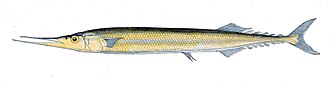
Scomberesox scombroides is a fish of the family Scomberesocidae, order Beloniformes, and WoRMS accepts it as a species under that name [1]. FishBase describes it as a pelagic, schooling fish of open-sea surface waters, found in the Atlantic, Indian and Pacific oceans, generally in temperate waters of the Southern Hemisphere [2]. It appears as «Agüjilla» (Scomberesox saurus scombroides) in an annex of transboundary fishes of the southeastern Pacific, in a paper presented by a Peruvian official at a FAO consultation [3].
Etymology
The species carries the authority (Richardson, 1843) [1]. WoRMS lists seven unaccepted names, among them Sairis scombroides Richardson, 1843, Scomberesox forsteri Valenciennes, 1846 and Scomberesox stolatus de Buen, 1959 [1]. The South African studies and the FAO list cited here call it Scomberesox saurus scombroides [4],[3].
Distribution and habitat
According to FishBase the species is generally circumglobal in temperate waters of the Southern Hemisphere, most common between 30° and 40° S, though it reaches farther north to 15° S near Africa and to near the equator off Ecuador; along the west coast of South America it is mostly the young that are found [2]. That record does not mention Peru. The «Agüjilla» is on the list of fishes found in two or more exclusive economic zones of the southeastern Pacific, in a listing whose note points to a document of a CPPS meeting held in Callao in April 1998 [3].
It is an epipelagic, gregarious fish of the open-sea surface, which sometimes enters bays and inlets [2]. In South Africa the late juveniles and adults appear in summer on the west coast and mainly from late summer into winter in Algoa Bay, and are often abundant downstream of upwelling plumes when warmer water lies close inshore [4]. Off the southwestern Cape in 1977 and 1978, the young tended to occupy water of 18 °C or more in every season [5].
Biology
FishBase gives a maximum length of about 50 cm (standard length) and a length at first maturity of 28.7 cm [2]. It states that the species migrates from spawning areas to cool temperate, plankton-rich waters [2].
In the southwest of South Africa most spawning was found on the stretch from Cape Columbine down to Cape Point, with less to the east of the latter; most of it happens in summer, and large larvae and early juveniles peak towards the end of that season [5]. Instantaneous natural mortality was estimated at 0.14 per day between 5 and 30 mm and 0.02 per day between 30 and 100 mm, a marked drop that the study does not explain [5].
In a small group of larvae reared in tanks from eggs taken from the sea about 20 km west of the Cape Peninsula, average growth was 0.62 mm per day over the first 47 days (at 18–19 °C) and 0.45 mm per day between day 47 and day 120 (at 14.8–15.5 °C) [6]. In Cape waters, the size of larvae and early juveniles is consistent with passive drift from south to north on the known currents, while that of late juveniles and adults increases from the northwest to the southeast [4].
Ecology
According to FishBase it feeds on small planktonic organisms and its estimated trophic level is 4.1; it names yellowfin tuna, the Cape gannet and marine mammals among its predators [2].
In South Africa the important predators of late juveniles and adults are fast, surface-feeding species: the yellowfin tuna Thunnus albacares, plus two seabirds, Cory's shearwater (Calonectris diomedea) and the Cape gannet (Morus capensis); gannets were estimated to eat 2277 to 6044 tonnes a year [4]. Purse seines sometimes land it mixed in with catches of Etrumeus whiteheadi (round herring) and Sardinops ocellatus (pilchard) [4].
In northern Peru, of 485 gut-content samples of the smooth hammerhead Sphyrna zygaena examined, 78 % held food, and Scomberesox saurus scombroides was among the 25 prey items, of minimal importance (0.1 % of the IRI index) next to the squids [7].
Human relevance
FishBase rates it a minor commercial fishery, usually used as bait, and notes that the large schools are too sporadic to be commercially important [2]. For Peruvian waters we found no catch statistics: all that is on record is its place on the list of transboundary fishes of the southeastern Pacific [3].
References (7)
- WoRMS Editorial Board (2026). Scomberesox scombroides (Richardson, 1843). World Register of Marine Species. https://www.marinespecies.org/aphia.php?p=taxdetails&id=1013882 (accessed 2026-10-25)
- Froese, R., Pauly, D. (2026). Scomberesox scombroides (Richardson, 1843), king gar. FishBase. https://www.fishbase.se/summary/Scomberesox-scombroides.html (accessed 2026-10-25)
- Zuzunaga, J. (2003). Some shared fish stocks of South Eastern Pacific. Papers Presented at the Norway-FAO Expert Consultation on the Management of Shared Fish Stocks (Bergen, 7-10 October 2002), FAO Fisheries Report No. 695 (Supplement). https://www.fao.org/4/y4652e/y4652e0h.htm (accessed 2026-10-25)
- Berruti, A. (1988). Distribution of and predation on saury Scomberesox saurus scombroides in continental shelf waters off the Cape Province, South Africa. South African Journal of Marine Science. doi:10.2989/025776188784480690 (accessed 2026-10-25)
- Dudley, S.F.J., Field, J.G., Shelton, P.A. (1985). Distribution and abundance of eggs, larvae and early juveniles of saury Scomberesox saurus scombroides (Richardson) off the south-western Cape, South Africa, 1977/78. South African Journal of Marine Science. doi:10.2989/025776185784461234 (accessed 2026-10-25)
- Brownell, C.L. (1983). Early growth rate and feeding of a small group of laboratory-reared saury, Scomberesox saurus scombroides (Pisces: Scomberesocidae). South African Journal of Marine Science. doi:10.2989/025776183784447430 (accessed 2026-10-25)
- Gonzalez-Pestana, A., Acuña-Perales, N., Coasaca-Cespedes, J. et al. (2017). Trophic ecology of the smooth hammerhead shark (Sphyrna zygaena) off the coast of northern Peru. Fishery Bulletin, 451-459. doi:10.7755/FB.115.4.2 (accessed 2026-10-25)
More pictures
Where it has been recorded
- Filled: scientific records, or confirmed by a curator
- Hatched: isolated record
- Dotted outline: no scientific records and no curator's confirmation (an ORKA sighting is not drawn here)
- Tropical–cold transition zone
Scientific records (1 record)
- Cold central sea
Scientific records (9 records)
- Cold southern sea
Scientific records (7 records)
From openly licensed OBIS and GBIF records (CC0 or CC BY). How each list is built.
Related species
From the same genus (Scomberesox) and from the same family (Scomberesocidae).

Names and sources
In Spanish
- Agujilla — Peru; fishbase · main name
- Espadita — Peru; fishbase
- Pez aguja — Peru; fishbase
Classification
Learn more
Conservation status: no data (IUCN). Taxonomy: PeRMS / WoRMS (CC BY 4.0).