
Bony fishes · Scomberesocidae
Saury
Scomberesox saurus (Walbaum, 1792)
Spanish: Paparda
- Peruvian Register of Marine Species
- Listed in PeRMS (IMARPE)
Species account
Summary
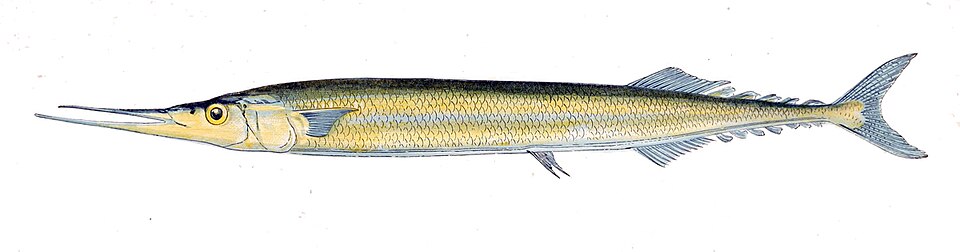
Scomberesox saurus (Walbaum, 1792) is a fish of the family Scomberesocidae, order Beloniformes, and WoRMS accepts it as a valid species [1]. It is an oceanic, gregarious, schooling fish that lives between the surface and about 30 m deep and leaps out of the water when chased [2]. The IUCN classifies it as Least Concern [3].
Etymology
Distribution and habitat
According to WoRMS, the species is known from the Gulf of St. Lawrence to North Carolina and Bermuda [1]. FishBase adds that in the eastern Atlantic it ranges from Iceland and Norway to Morocco, including the Mediterranean, and lives from the surface down to about 30 m [2].
WoRMS does not accept the subspecies of Scomberesox saurus: the one described as Scomberesox saurus scombroides (Richardson, 1843) is now listed as the distinct species Scomberesox scombroides [1]. The South African studies that use that trinomial therefore do not deal with Scomberesox saurus in the strict sense, and are cited here only as a reference for a sister species [4].
Biology
FishBase gives a maximum length of 50 cm, a common size of 32 cm and the onset of maturity at about 26.5 cm [2].
In April and July 1967, Hartmann took 354 samples in the top 60 cm of the subtropical northeastern Atlantic; the fish measured 6 to 113 mm. Those of 6 to 29 mm stayed in that layer at all times, while those of 50 to 113 mm were there only at night, and the first 10 cm held about 12 times more individuals than each neighbouring layer [5].
In the same study, fish longer than 62 mm carried immature eggs of about 2 mm, and the diet passed through 4 stages, from protozoans and gastropods in the smallest fish to crustaceans in those of 46 to 113 mm [5].
In the sister species of the Southern Hemisphere, spawning off southwestern South Africa took place mostly in summer [6], and laboratory-reared larvae grew 0.62 mm a day over the first 47 days at 18–19 °C [7].
Ecology
FishBase states that it feeds on zooplankton and fish larvae, and that its diet also includes fish eggs and small fishes [2].
According to FishBase, it is preyed on by fishes such as tunas, marlin, bluefish and cod, and also by pollock, dolphins and porpoises [2]. In South Africa, for the sister species, important predators include the yellowfin tuna Thunnus albacares and two seabirds, Calonectris diomedea and Morus capensis; the latter eats an estimated 2277 to 6044 tonnes a year [4].
Off southwestern South Africa, the young of the sister species occupied water of 18 °C or more, and instantaneous daily mortality fell from 0.14 in larvae of 5 to 30 mm to 0.02 in juveniles of 30 to 100 mm [6].
Conservation
Human relevance
FishBase describes it as the object of a minor commercial fishery, sometimes used as bait, under-exploited in many areas, suitable for canning and harmless to people [2]. In South Africa, the sister species is sometimes caught in purse seines together with the round herring Etrumeus whiteheadi and the pilchard Sardinops ocellatus [4].
References (7)
- WoRMS Editorial Board (2026). Scomberesox saurus (Walbaum, 1792). World Register of Marine Species. https://www.marinespecies.org/aphia.php?p=taxdetails&id=126392 (accessed 2026-10-25)
- Froese, R., Pauly, D. (2026). Scomberesox saurus (Walbaum, 1792), Atlantic saury. FishBase. https://www.fishbase.se/summary/Scomberesox-saurus.html (accessed 2026-10-25)
- Collette, B.B. (2012). Scomberesox saurus: Collette, B.B. IUCN Red List of Threatened Species. doi:10.2305/iucn.uk.2015-4.rlts.t190211a15590295.en (accessed 2026-10-25)
- Berruti, A. (1988). Distribution of and predation on saury Scomberesox saurus scombroides in continental shelf waters off the Cape Province, South Africa. South African Journal of Marine Science, 183-192. doi:10.2989/025776188784480690 (accessed 2026-10-25)
- Hartmann, J. (1970). Juvenile Saury Pike (Scomberesox Saurus Walb.), an Example of Ichthyoneuston. ICES Journal of Marine Science, 245-255. doi:10.1093/icesjms/33.2.245 (accessed 2026-10-25)
- Dudley, S.F.J., Field, J.G., Shelton, P.A. (1985). Distribution and abundance of eggs, larvae and early juveniles of saury Scomberesox saurus scombroides (Richardson) off the south-western Cape, South Africa, 1977/78. South African Journal of Marine Science, 229-237. doi:10.2989/025776185784461234 (accessed 2026-10-25)
- Brownell, C.L. (1983). Early growth rate and feeding of a small group of laboratory-reared saury, Scomberesox saurus scombroides (Pisces: Scomberesocidae). South African Journal of Marine Science, 245-248. doi:10.2989/025776183784447430 (accessed 2026-10-25)
More pictures
Where it has been recorded
- Filled: scientific records, or confirmed by a curator
- Hatched: isolated record
- Dotted outline: no scientific records and no curator's confirmation (an ORKA sighting is not drawn here)
- Cold central sea
Scientific records (12 records)
- Cold southern sea
Scientific records (7 records)
From openly licensed OBIS and GBIF records (CC0 or CC BY). How each list is built.
Related species
From the same genus (Scomberesox) and from the same family (Scomberesocidae).

Names and sources
In Spanish
- Paparda — WoRMS; Wikidata · main name
- Alcrique — Wikidata
- Paparda Del Atlántico — Wikidata
- Parpadón — Wikidata
- Potakarra — Wikidata
- Relanzon — Wikidata
- Sauro Atlántico — Wikidata
In English
- Saury — WoRMS; Wikidata
- Atlantic Saury — Wikidata; WoRMS
- Garfish — Wikidata
- Needlefish — Wikidata; WoRMS
- Needlenose — Wikidata
- Saurey Pike — Wikidata
- Saurie — Wikidata
- Saury-pike — Wikidata
Classification
Learn more
Conservation status: Least Concern (IUCN Red List, according to Wikidata). Taxonomy: PeRMS / WoRMS (CC BY 4.0).