
Bony fishes · Scombridae
Chub mackerel
Scomber japonicus Houttuyn, 1782
Spanish: Caballa
- Names in Peru
- Caballa · Caballa verle · Estornino · Verle
- Peruvian Register of Marine Species
- Listed in PeRMS (IMARPE)
Species account
Summary
Scomber japonicus is a fish of the family Scombridae, that of the tunas and bonitos, in the order Scombriformes [1],[2]. It is a pelagic mackerel that swims in schools near the coast and lives in the warm and temperate waters of the three major oceans [2]. In Peru it is called «caballa» or «verle» [2]. There it supports an important fishery, mostly by the industrial purse-seine fleet, and is used for direct human consumption [3]. Its global category on the IUCN Red List is Least Concern [4].
Etymology
Houttuyn described it in 1782, and FAO gives Japan as the locality of that original description [2]. The southeast Pacific population was described in 1925 by Jordan and Hubbs as Pneumatophorus peruanus, a name now regarded as a synonym of Scomber japonicus [2]; even so, Peruvian studies still call it Scomber japonicus peruanus [5],[3]. FAO gives it the Spanish name «estornino», and in Peru «caballa» and «verle» are used [2].
Identification and similar species
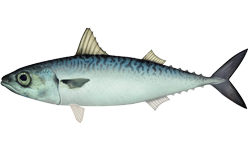
Like the other mackerels of the genus, it has an elongate, rounded body, a pointed snout, the eye partly covered by an adipose eyelid, two well separated dorsal fins, and 5 finlets behind the second dorsal and another 5 behind the anal [2]. At the base of the tail it has two small keels on each side, but no central keel between them [2].
The first dorsal has 9 or 10 spines, the gap between the two dorsals is shorter than the base of the first, and the anal fin spine is visible and joined to the rays by a membrane [2]. Unlike some other mackerels, it has a swim bladder [2]. The back is steel blue with oblique zigzag lines, and in Pacific populations the belly is silvery and unmarked, whereas in Atlantic ones it bears spots or wavy lines [2].
It reaches 50 cm fork length, although about 30 cm is usual; a fish of 47.6 cm weighed 1.1 kg [2]. In Peru, the asymptotic length estimated from the 1996 to 1998 landings was 40.2 to 42.2 cm fork length [5].
Similar species
- Sarda chiliensis: Sarda chiliensis has 17 to 19 spines in the first dorsal and usually 8 dorsal finlets, whereas Scomber japonicus has 9 or 10 spines in that fin and 5 dorsal finlets [2].
Distribution and habitat
It is a cosmopolitan species of the warm and temperate transition waters of the Atlantic, Indian and Pacific oceans [2]. It lives mainly near the coast, in the water column, and to a lesser extent over the continental slope, from the surface to about 250 or 300 m depth [2]. Its seasonal migrations can be long, and in the southern hemisphere they usually run opposite to those in the north [2].
In Peruvian waters it is associated with the Equatorial Surface Waters, and its distribution and concentration depend on which water mass dominates [6]. IMARPE's fishery monitoring programme sampled it between 1994 and 2017 along the coast, between 3°23' S and 18°21' S [3].
Biology
It spawns in batches, preferably when the water is between 15 and 20 °C; off Peru, FAO placed spawning from January to May and in September, and each female can produce between 100 and 400 thousand eggs in total [2]. Monthly samples from 1990 to 1993 between 3°23' S and 14° S showed that in Peru it spawns all year round, most intensely in summer [7]. During the 1992 and 1993 El Niño the gonadosomatic index rose, while body and gonad weight fell [7].
With 25912 females measured by IMARPE between 1994 and 2017 in the November to March season, half of the females were estimated to be mature when they measure 24.8 cm to the fork, although that value varied between periods from 20.4 to 27.0 cm [3]. The lowest values coincided with the El Niño events of 1997 to 1999 and 2015 to 2016, and size at maturity was positively related to spawning biomass [3].
For the 1996 to 1998 landings, a growth coefficient of 0.38 to 0.39 per year, an annual natural mortality of 0.52 to 0.53 and a longevity of slightly over 7 years were calculated [5].
Ecology
It forms schools by size from about 3 cm long, and adult schools are the most compact [2]. It feeds opportunistically, from copepods and other crustaceans to fish and squid, and is preyed on by tunas, billfishes, sharks, sea lions and pelicans, among others [2].
In Peru, the 1982 and 1983 El Niño affected it little, while the 1997 and 1998 event favoured it through the stronger inflow of Equatorial Surface Waters: single-species schools appeared, it occupied a very wide area and it was found down to 100 m depth [6].
Conservation
Its global category on the IUCN Red List is Least Concern [4].
For the Peruvian landings of 1996 to 1998, a fishing mortality of 1.16 to 2.78 per year and an exploitation rate of 0.68 to 0.84 were estimated [5]. In the 1994 to 2017 series, size at maturity showed no trend, so it could not be attributed to fishing pressure, although the highest fishing mortality and the lowest sizes at maturity coincided between 1997 and 2000 [3].
Human relevance
It is a resource of great importance worldwide: around 1981 it supported commercial fisheries in 6 of the 11 FAO fishing areas, and among the countries catching it Chile and Peru ranked third and fourth [2]. It is caught mainly with purse seines [2].
In Peru it is fished mainly by the industrial purse-seine fleet and used for direct human consumption; landings peaked in the late 90s at about 380 thousand tonnes, and in the 3 years before 2017 they averaged around 90 thousand tonnes [3]. A record 383 thousand tonnes was landed in 1998, after a year 1997 with good catches [6].
Where to see it in Peru
It is an open-water schooling fish known mostly through fishing: between 1994 and 2017 IMARPE sampled it in landings along the coast, between 3°23' S and 18°21' S [3]. Its distribution depends on which water mass dominates, and during the 1997 and 1998 El Niño it occupied a very wide area of the Peruvian sea [6].
References (7)
- Froese, R., Pauly, D. (2026). Scomber japonicus Houttuyn, 1782. World Register of Marine Species. https://www.marinespecies.org/aphia.php?p=taxdetails&id=127022 (accessed 2026-10-25)
- Collette, B.B., Nauen, C.E. (1983). FAO species catalogue Vol. 2. Scombrids of the world. An annotated and illustrated catalogue of tunas, mackerels, bonitos and related species known to date. FAO Fisheries Synopsis No. 125, Vol. 2. FAO, Rome, 51-58. https://www.fao.org/docrep/pdf/009/ac478e/ac478e08.pdf (accessed 2026-10-25)
- Torrejón Magallanes, E.J., Sánchez Espinoza, J., Mori Ponce, J. et al. (2017). Estimación y variabilidad temporal de talla de madurez gonadal de la caballa (Scomber japonicus peruanus, Jordán & Hubb, 1925) en el litoral peruano. Revista Peruana de Biología, 391. doi:10.15381/rpb.v24i4.13741 (accessed 2026-10-25)
- Collette, B.B., Nakatsuka, S., Suzuki, J. (2022). Scomber japonicus: Collette, B.B., Nakatsuka, S. & Suzuki, J. The IUCN Red List of Threatened Species 2022: e.T170306A170083106. doi:10.2305/IUCN.UK.2023-1.RLTS.T170306A170083106.en (accessed 2026-10-25)
- Caramantin-Soriano, H., Vega-Pérez, L.A., Ñiquen, M. (2008). Growth parameters and mortality rate of the Scomber japonicus peruanus (Jordán & Hubb, 1925) along the Peruvian coast, South Pacific. Brazilian Journal of Oceanography, 201-210. doi:10.1590/S1679-87592008000300005 (accessed 2026-10-25)
- Dioses, T., Dávalos, R., Zuzunaga, J. (2002). El Niño 1982-1983 and 1997-1998: Effects on Peruvian Jack Mackerel and Peruvian Chub Mackerel. Investigaciones Marinas. doi:10.4067/S0717-71782002030100077 (accessed 2026-10-25)
- Caramantin-Soriano, H., Vega-Pérez, L.A., Ñiquen, M. (2009). The influence of the 1992-1993 El Niño on the reproductive biology of Scomber japonicus peruanus (Jordán & Hubb, 1925). Brazilian Journal of Oceanography, 263-272. doi:10.1590/S1679-87592009000400002 (accessed 2026-10-25)
More pictures
Where it has been recorded
- Filled: scientific records, or confirmed by a curator
- Hatched: isolated record
- Dotted outline: no scientific records and no curator's confirmation (an ORKA sighting is not drawn here)
- Tropical northern sea
Scientific records (1 record)
- Tropical–cold transition zone
Scientific records (34 records)
- Cold central sea
Scientific records (32 records)
- Cold southern sea
Scientific records (27 records)
From openly licensed OBIS and GBIF records (CC0 or CC BY). How each list is built.
Related species
From the same family.

Black skipjack
Euthynnus lineatus
IUCN status: LC · Least Concern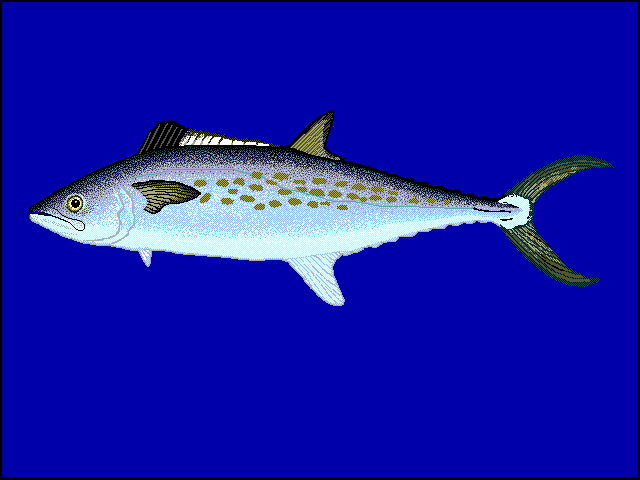
Pacific sierra
Scomberomorus sierra
IUCN status: LC · Least Concern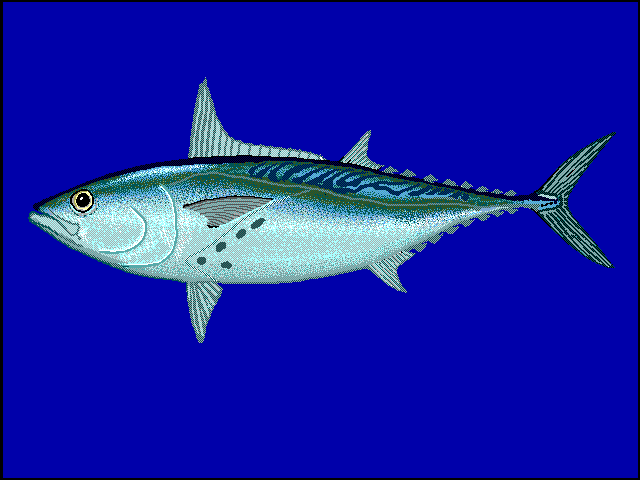
Little tunny
Euthynnus alletteratus
IUCN status: LC · Least Concern
Skipjack tuna
Katsuwonus pelamis
IUCN status: LC · Least Concern
Pacific bonito
Sarda chiliensis
IUCN status: LC · Least Concern
Yellowfin tuna
Thunnus albacares
IUCN status: LC · Least Concern
Atlantic bluefin tuna
Thunnus thynnus
IUCN status: LC · Least Concern
Wahoo
Acanthocybium solandri
IUCN status: LC · Least Concern
Names and sources
In Spanish
- Caballa — Peru; SERNANP (2024). Plan Maestro de la Reserva Nacional Dorsal de Nasca 2024-2029. RP N.° 000040-2024-SERNANP, p. 25 of the PDF; fishbase; Wikidata · main name
- Barat — Wikidata
- Beguihaundi — Wikidata
- Biret — Wikidata
- Biso — Wikidata
- Bisol — Wikidata
- Bissu — Wikidata
- Caballa Mora — Wikidata
- Caballa verle — Peru; fishbase; Wikidata
- Cachorreta — Wikidata
- Carite — Wikidata
- Cavalla Vera — Wikidata
- Cuervas — Wikidata
- Estornino — Peru; fishbase; Wikidata; WoRMS
- Gallimo — Wikidata
- Macarela — Wikidata
- Macarela Del Pacífico — Wikidata
- Macarela Estornino — Wikidata; WoRMS
- Magrú — Wikidata
- Morenillo — Wikidata
- Perilla — Wikidata
- Pintada — Wikidata
- Salmonete — Wikidata
- Verdel — Wikidata
- Verle — Peru; fishbase; Wikidata
- Vissu — Wikidata
In English
- Chub mackerel — WoRMS; Wikidata
- Atlantic chub mackerel — Wikidata; WoRMS
- Pacific Chub Mackerel — Wikidata; WoRMS
- Pacific mackerel — Wikidata
- Spanish mackerel — Wikidata; WoRMS
- Tinker mackerel — Wikidata
Classification
Learn more
Conservation status: Least Concern (IUCN Red List, according to Wikidata). Taxonomy: PeRMS / WoRMS (CC BY 4.0).