
Bony fishes · Labridae
Bumphead parrotfish
Scarus perrico Jordan & Gilbert, 1882
Spanish: Pez loro verde
- Names in Peru
- Pez loro verde · Perico
- Peruvian Register of Marine Species
- Listed in PeRMS (IMARPE)
Species account
Summary
Scarus perrico is a parrotfish of the family Labridae described by Jordan and Gilbert in 1882 [1]. In Peru it is called «pez loro verde» [2]. It is the only Scarus endemic to the tropical eastern Pacific and comes from an Atlantic lineage that was cut off in the Pacific when the Isthmus of Panama rose [3]. Globally the IUCN assesses it as Least Concern [4], whereas the management plan of the Mar Tropical de Grau National Reserve counts it among the highly threatened rocky-reef species and bans its extraction in three of the reserve's sectors [2],[2],[2],[2].
Identification and similar species
It is a large parrotfish, reaching 76 cm in total length [5]. The biggest fish in each school typically have a large hump on the nape and, according to the authors of a genetic study, are probably males [3]. In large adults the head has a sharp notch in front of the eyes that sets the snout apart from the upper head, and in the terminal phase the pectoral and anal fins have a dark blue edge [3].
Compared with Scarus ghobban and Scarus rubroviolaceus, it consistently has fewer cheek scales and fewer scales ahead of the dorsal fin, and fewer pectoral-fin rays [3]. In this species, the colour differences between mid-sized and large individuals are slight [3].
Similar species
- Scarus ghobban: In the terminal phase its head is triangular and symmetrical, without the notch in front of the eyes seen in large Scarus perrico [3].
- Scarus rubroviolaceus: Its terminal phase has a bullet-shaped head with no notch on the forehead, and the species lives in territorial harems, which Scarus perrico does not form [3].
- Scarus compressus: According to a genetic analysis, almost all fish identified under this name are hybrids of Scarus perrico with Scarus ghobban or with Scarus rubroviolaceus. Terminal-phase offspring of Scarus ghobban have a pale turquoise body with brown scales towards the tail, the dark blue edge on the pectoral and anal fins, an orange stripe on the dorsal-fin membrane and the same forehead notch; offspring of Scarus rubroviolaceus have a bright blue, bullet-shaped head without that notch [3].
Distribution and habitat
It lives in the eastern Pacific, from the central Gulf of California to Peru, including the Galapagos Islands; it is a reef fish recorded at depths of 3 to 36 m [5]. In the region it shares shallow rocky reefs, under 50 m, with three other Scarus species, and it is endemic to the tropical eastern Pacific, whereas two of those species range across the Indian and Pacific oceans [3].
Its origin differs from that of the other parrotfishes in the region. It belongs to a lineage that some 6 million years ago, in the late Miocene, split from an Indo-Pacific ancestor by colonising the early Caribbean, and that was later divided between the Atlantic and the Pacific when the Isthmus of Panama emerged; its sister species, Scarus hoefleri, lives only in West Africa [3].
In Peru, a 2015–2016 survey of parasites of marine fishes examined 4 specimens [6], and the gill worm described from them has its type locality in Tumbes, at 3°29′ S and 80°24′ W [7]. At the Lobos de Afuera Islands the species appears in the historical records, but it was found neither in the baseline studies nor in the environmental DNA sampling published in 2022 [8]. According to the management plan of the Mar Tropical de Grau National Reserve, in Peruvian waters it only restocks in El Niño years, when its larvae arrive from Ecuador [2].
Biology
According to a genetic study, it probably changes colour and sex with size, as other wrasses do [3]. The management plan of the Mar Tropical de Grau National Reserve states that these parrotfishes are all born female and turn male only as large adults [2]. Of 64 fish dissected at La Ventana, in Baja California, and at Pixvae, in Panama, sex could be told from the gonads in only 22 (34%): 5 males and 17 females, all in the initial phase, of which 2 males and 11 females were reproductively active; the sample included none of the very large humped individuals [3].
It often crosses with two other species of its genus. In a genetic analysis, 89.8% of the fish identified as Scarus compressus turned out to be first-generation hybrids of Scarus perrico with Scarus ghobban or with Scarus rubroviolaceus [3]. Their mitochondrial DNA shows that in these crosses the mother usually belongs to the other species and the father is a Scarus perrico; the authors suggest its males tell partners apart poorly because for millions of years it was the region's only Scarus [3].
It does not form harems, which makes it easier for several males to join a single spawning and for non-territorial initial-phase males to intrude on the spawning of territorial males [3].
Ecology
It feeds by scraping hard surfaces: it eats coralline red algae and perhaps coral polyps too; it is seen in small groups over the reef [5]. It is an excavating parrotfish with powerful jaws, and the authors of a genetic study suggest that this strength lets it tear encrusting organisms off smooth rock, an advantage in the tropical eastern Pacific, where nearly all grazing happens on rock benches and boulders and actively growing coral reefs are scarce [3].
In the Mar Tropical de Grau National Reserve it is recognised, together with the surgeonfishes known as viringos, as a key reef herbivore: it cleans the rocks, keeps algae from running wild and controls invasive organisms such as polychaetes that build sand tubes [2]. At night it shelters in reef patches; at Playa Lagarto, in Costa Rica, divers who fish at night with hookah gear know these refuges and spear it there with ease [9].
Conservation
The IUCN Red List classifies it as Least Concern [4]. In Peru, the management plan of the Mar Tropical de Grau National Reserve lists it among the rocky-reef species considered highly threatened by spearfishing and other fishing gear [2].
The same document explains that, because spearfishers seek it so keenly, it is killed while still small, before it changes sex, and that this has made it vanish quickly from Peruvian waters; even most of those arriving as larvae in El Niño years are hunted before they become adults [2].
The plan forbids catching or collecting it in the recovery zone of the Arrecifes de Punta Sal sector [2] and extracting it in that sector's direct-use zone [2], throughout the Cabo Blanco – El Ñuro sector [2] and in the Isla Foca sector [2]. Spearfishing competitions are not allowed in Cabo Blanco – El Ñuro or Isla Foca either [2],[2].
Outside Peru, at Playa Lagarto, Costa Rica, the parrotfish catch of free divers fell sharply between the 2007-2008 and 2011-2012 seasons, and the authors suggest it may have been caused by heavy pressure from hookah diving, by day and by night, on nearby reef patches; given the lack of data on the state of the population, they recommend a precautionary approach with a closed season that also covers it [9].
Human relevance
It is fished commercially and is also traded as an aquarium fish [5]. At Playa Lagarto, Costa Rica, parrotfishes — Scarus perrico together with Scarus ghobban — were in the 2007-2008 and 2011-2012 seasons one of the three categories that weighed most in the landings of artisanal divers, alongside green lobster and octopus; they are sold as fillets and also eaten locally [9]. In Peru it is one of the favourite targets of spearfishing [2].
Where to see it in Peru
According to the 2026 management plan of the Mar Tropical de Grau National Reserve, it occurs on the rocky reefs of the Arrecifes de Punta Sal, Cabo Blanco – El Ñuro and Isla Foca sectors, and extracting it is forbidden in all three [2],[2],[2],[2]. In the recovery zone of Punta Sal, which holds most of the sector's large rocky reefs, recreational diving is only occasional [2]. The same document warns that spearfishing has made it vanish quickly from Peruvian waters [2].
References (9)
- WoRMS Editorial Board (2026). Scarus perrico Jordan & Gilbert, 1882. World Register of Marine Species. https://www.marinespecies.org/aphia.php?p=taxdetails&id=276057 (accessed 2026-10-20)
- Servicio Nacional de Áreas Naturales Protegidas por el Estado (2026). Plan Maestro de la Reserva Nacional Mar Tropical de Grau 2026–2031. Anexo de la Resolución de Presidencia Ejecutiva N.° 000052-2026-SERNANP/PE. https://cdn.www.gob.pe/uploads/document/file/9468842/7752998-5-pm_2026-2031_rnmtg-f-f-f-f.pdf (accessed 2026-10-20)
- Carlon, D.B., Robertson, D.R., Barron, R.L. et al. (2021). The origin of the parrotfish species Scarus compressus in the Tropical Eastern Pacific: region-wide hybridization between ancient species pairs. BMC Ecology and Evolution. doi:10.1186/s12862-020-01731-3 (accessed 2026-10-20)
- Allen, G., Robertson, R., Rivera, R. et al. (2007). Scarus perrico: Allen, G., Robertson, R., Rivera, R., Edgar, G., Merlen, G., Zapata, F., Barraza, E., Lea, B. & Rocha, L.A. The IUCN Red List of Threatened Species 2012: e.T183839A17897573. doi:10.2305/IUCN.UK.2012.RLTS.T183839A17897573.en (accessed 2026-10-20)
- Froese, R., Pauly, D. (2026). Scarus perrico Jordan & Gilbert, 1882. Bumphead parrotfish. FishBase. https://www.fishbase.se/summary/8392 (accessed 2026-10-20)
- Cruces, C.L., Chero, J.D., Sáez, G. et al. (2017). Dactylogyrids (Monogenea) parasitic on marine fish from Peru including the description of a new species of Haliotrema Johnston & Tiegs, 1922 and two new species of Parancylodiscoides Caballero & C. & Bravo-Hollis, 1961. Zootaxa. doi:10.11646/zootaxa.4311.1.7 (accessed 2026-10-20)
- Santillán, L.A., Cruces, C.L., Sáez, G.M. et al. (2024). An Annotated Checklist of Monogeneans (Platyhelminthes, Monogenea) from Aquatic Vertebrates in Peru: A Review of Diversity, Hosts and Geographical Distribution. Animals, 1542. doi:10.3390/ani14111542 (accessed 2026-10-20)
- Alfaro-Cordova, E., Ortiz-Alvarez, C., Alfaro-Shigueto, J. et al. (2022). What lies beneath? Revealing biodiversity through eDNA analysis in Lobos de Afuera Islands, Peru. Latin American Journal of Aquatic Research, 642-659. doi:10.3856/vol50-issue4-fulltext-2782 (accessed 2026-10-20)
- Naranjo Madrigal, H., Salas Márquez, S. (2014). Dinámica espacio-temporal del esfuerzo en una pesquería de buceo artesanal multiespecífica y sus efectos en la variabilidad de las capturas: Implicaciones para el manejo sostenible. Revista de Biología Tropical, 1565-1586. doi:10.15517/rbt.v62i4.13614 (accessed 2026-10-20)
More pictures
If you come across it
Protected or threatened species. Watch it without touching, feeding, chasing or taking it, and keep the recommended viewing distances.extraction prohibited in the sector — SERNANP (2026). Plan Maestro de la Reserva Nacional Mar Tropical de Grau 2026–2031. RPE N.° 000052-2026-SERNANP, p. 128 of the PDF
Related species
From the same genus (Scarus) and from the same family (Labridae).
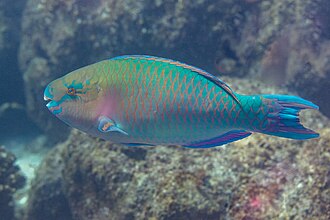
Bluechin parrotfish
Scarus ghobban
IUCN status: LC · Least Concern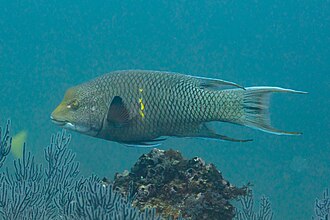
Mexican hogfish
Bodianus diplotaenia
IUCN status: LC · Least ConcernBrown hogfish
Bodianus eclancheri
IUCN status: LC · Least ConcernProtected in Peru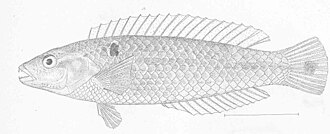
Chameleon wrasse
Halichoeres dispilus
IUCN status: LC · Least ConcernBanded wrasse
Halichoeres notospilus
IUCN status: LC · Least Concern
Loosetooth parrotfish
Nicholsina denticulata
IUCN status: LC · Least ConcernCortez rainbow wrasse
Thalassoma lucasanum
IUCN status: LC · Least Concern- No openly licensed image yet
Bodianus darwini
IUCN status: Not evaluated
Names and sources
In Spanish
- Pez loro verde — Peru; SERNANP (2026). Plan Maestro de la Reserva Nacional Mar Tropical de Grau 2026–2031. RPE N.° 000052-2026-SERNANP, p. 54 of the PDF · main name
- Loro — Wikidata
- Loro Guacamaya — Wikidata
- Loro Jorobado — Wikidata; WoRMS
- Perico — Peru; fishbase; Wikidata
In English
- Bumphead parrotfish — WoRMS; Wikidata
Classification
Learn more
Conservation status: Least Concern (IUCN Red List, according to Wikidata). Taxonomy: PeRMS / WoRMS (CC BY 4.0).