
Sharks, rays and chimaeras · Carcharhinidae
Pacific sharpnose shark
Rhizoprionodon longurio (Jordan & Gilbert, 1882)
Spanish: Tiburón hocicón
- Names in Peru
- Tiburón hocicón
- Peruvian Register of Marine Species
- Listed in PeRMS (IMARPE)
Species account
Summary
Rhizoprionodon longurio is a small shark of the family Carcharhinidae [1]. It lives close to shore, over the continental shelf of the eastern Pacific, between southern California and Peru [2]. In Peru it is called «tiburón hocicón» [3]. It is the only member of its genus in that region, it has a particularly long snout, and the studies of its biology cover only a small part of its range [4]. The IUCN lists it as Vulnerable (VU) [5].
Etymology
Jordan and Gilbert described it in 1882 as Carcharias longurio, placing it in the subgenus Scoliodon, from 3 syntypes taken on the Pacific coast of Mexico and kept at the United States National Museum of Natural History; the type locality is Mazatlán [2]. It was later also called Scoliodon longurio, and the 1984 catalogue lists no synonyms for it [2]. The English common name refers to the elongated snout that the whole genus shares [4].
Identification and similar species
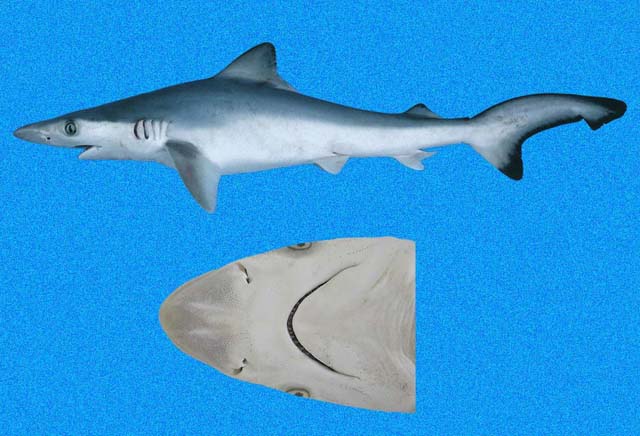
It is grey or grey-brown above and white below; the pectoral fins have pale edges and the dorsal fins dusky tips [2]. The snout, measured to the nostrils, takes up 4.5 to 6 % of total length, and the upper labial furrows are long, 2.1 to 2.6 % [2]. Behind the corner of the mouth there is a row of enlarged pores, usually more than 16 in total counting both sides [2].
Adult teeth have serrated edges and are the same in males and females; there are usually 27 to 29 rows in the upper jaw and 26 to 28 in the lower [2]. The first dorsal fin starts over the rear tips of the pectorals or slightly ahead of them, and the second dorsal starts above the last third of the anal fin base [2]. Compared with the other sharks of its genus, it stands out for its higher tooth count, a particularly long rostrum and teeth that do not differ between the sexes [4].
In the eastern Pacific it is the only shark of its family that combines long labial furrows with a second dorsal fin starting well behind the origin of the anal fin [2]. It reaches at least 110 cm and possibly 154 cm according to the 1984 catalogue [2], while more recent work puts its maximum at about 170 cm [4].
Similar species
- Carcharhinus cerdale: The 1984 catalogue treated Carcharhinus cerdale as a synonym of Carcharhinus porosus, and under the latter name described a small, grey, long-snouted shark, but with short labial furrows, inconspicuous pores behind the mouth and a second dorsal fin starting over the middle of the anal fin base [2]; in Rhizoprionodon longurio the furrows are long and the second dorsal starts further back [2].
Distribution and habitat
It occurs in the coastal waters of the tropical eastern Pacific, from southern California to Peru [2],[4]. It is the only species of Rhizoprionodon in that region, and the only one in the genus that shares its range with no relative [4].
It lives on the continental shelf, from the intertidal zone down to at least 27 m according to the 1984 catalogue [2]. It swims near the bottom and is associated with sand and mud [4]. Off southern Sinaloa, Mexico, it is caught on bottom longlines that the small-scale fleet sets between 18 and 91 m over soft sediments [6].
Pups and juveniles appear to use nursery grounds: shallow, sheltered bays, mangroves and coastal lagoons where they would find food and fewer predators [4]. Habitat use in the southern part of its range, which includes Peru, has not been studied [4].
Biology
It is a placental live-bearer, like the other sharks of its genus [4]. Along the mainland coast of the Gulf of California it breeds once a year: females carrying full-term embryos and developing eggs are common from December to May, and births take place from April to July, mostly in June [7]. Gestation lasts 10 to 12 months and each litter holds 1 to 12 pups, 7.4 on average, a high number for the genus [4]. Pups are born at 33 to 34 cm [2].
A study of 590 animals landed between 2005 and 2009 in Sinaloa and Sonora found that half of the males are mature at 100.61 cm total length and half of the females at 92.9 cm; for pregnant females the figure was 106.4 cm [7]. These are the largest sizes at maturity reported for the genus, and it is striking that males mature larger than females in a live-bearing species [4]. The 1984 catalogue gave smaller figures, with males maturing from 58 to 69 cm [2].
The mother passes nutrients and also trace elements to the embryos through the placenta, though not all in the same proportion [4]. Embryo size varies a good deal within a single litter, and no link is known between the mother's size and the number of pups [4].
Ecology
It is a high-level predator that eats mainly bony fishes, crustaceans and cephalopods; the weight of each group changes with place and season, and its prey are mostly bottom animals, though open-water prey also turn up, which suggests it rises through the water column to hunt [4].
In 235 stomachs with contents from animals landed at Mazatlán between December 2007 and March 2008, cephalopods dominated the diet, above all argonauts of the genus Argonauta, with an index of relative importance of 92.9 %; fishes added 5.9 %, chiefly leatherjacks of the genus Oligoplites [6]. The authors put this down to argonauts being locally abundant while they sampled [6].
On the coast of Sinaloa it is present only between November and March or April, a pattern perhaps linked to temperature [6]. A seasonal northward migration has been proposed in the Gulf of California, but it rests only on fishery records and a few tagged animals, and it is not known whether all sizes take part [4].
Conservation
The IUCN lists it as Vulnerable (VU) [5].
In Mexico it is fished intensively [6], and the small-scale fleet takes it with gillnets and longlines in a season running from November to July [7]. An analysis of three decades of catches at the mouth of the Gulf of California rated it the most productive of the 3 shark species studied and found apparently stable populations; under a more conservative natural mortality, however, all 3 came out as low productivity, and the authors called for quantitative assessments to set catch levels [8]. Its large litters are thought to be the main reason for that capacity to recover [4].
In Peru it appears among the sharks cited for the national fishery, but with no landings recorded in official statistics and no minimum catch size of its own [9].
Health, toxicological and chemical relevance
Not medical advice. For a sting, a poisoning or an allergy, seek medical care.
In northwestern Mexico, adult muscle held on average 0.92 mg of total mercury per kg, and across all the samples in that study, which also included Sphyrna lewini, 7 % exceeded the limit of 1 mg per kg for human consumption [10]. In 28 juveniles sampled in September 2019 in the southeastern Gulf of California, by contrast, mercury and cadmium stayed below the maximum limits, and no risk to consumers was found, although mercury is of more concern than cadmium [11].
Near the Santa Rosalía mining area in Baja California Sur, the average levels of iron, zinc, copper, manganese, cadmium and silver in 57 muscle samples stayed below the limits for human consumption [12]. In 20 pregnant females, mercury was highest in the mother's blood, followed by the umbilical cord, the placenta and the embryos' livers, and the authors conclude that the metal reaches the young across the placenta [13].
Human relevance
In the Gulf of California it is one of the most abundant inshore sharks, and it is used fresh or frozen for human food and also for fishmeal [2]. In Mexico it is exploited by coastal communities, mostly with small-scale fleets, along a stretch of coast that runs south as far as Puerto Madero, Chiapas, starting at the Gulf of California [7]. In Sinaloa it is, together with the pups and juveniles of Sphyrna lewini, one of the main targets of the small-scale fishery for small sharks [6].
It is rarely seen at diving or nature-tourism sites, which has held back the study of its behaviour [4].
Where to see it in Peru
The literature on the species in Peru is scant: the 2015 checklist of cartilaginous fishes bases its presence on publications from 2001 and 2014 [14], and the analysis of the shark fishery from 1950 to 2010 includes it among the species cited for the country, though with no recorded landings [9]. Peru lies at the southern end of its range, and that part of the range has no habitat studies [2],[4].
References (14)
- WoRMS Editorial Board (2026). Rhizoprionodon longurio (Jordan & Gilbert, 1882). World Register of Marine Species. https://www.marinespecies.org/aphia.php?p=taxdetails&id=271327 (accessed 2026-10-20)
- Compagno, L.J.V. (1984). FAO species catalogue. Vol. 4. Sharks of the world. An annotated and illustrated catalogue of shark species known to date. Part 2. Carcharhiniformes. FAO Fisheries Synopsis No. 125, Vol. 4, Part 2. FAO, Rome, 496-497, 525, 528-529. https://www.fao.org/4/ad123e/ad123e00.htm (accessed 2026-10-20)
- Froese, R., Pauly, D. (2026). Common names of Rhizoprionodon longurio. FishBase. https://www.fishbase.se/comnames/CommonNamesList.php?ID=901 (accessed 2026-10-20)
- Gayford, J.H., Whitehead, D.A. (2023). The biology and ecology of the Pacific sharpnose shark Rhizoprionodon longurio. Ecology and Evolution 13, e10600. doi:10.1002/ece3.10600 (accessed 2026-10-20)
- Pollom, R., Avalos, C., Bizzarro, J. et al. (2020). Rhizoprionodon longurio: Pollom, R., Avalos, C., Bizzarro, J., Burgos-Vázquez, M.I., Cevallos, A., Espinoza, M., González, A., Mejía-Falla, P.A., Morales-Saldaña, J.M., Navia, A.F., Pérez Jiménez, J.C., Sosa-Nishizaki, O. & Velez-Zuazo, X. The IUCN Red List of Threatened Species 2020: e.T161662A124524022. doi:10.2305/IUCN.UK.2020-3.RLTS.T161662A124524022.en (accessed 2026-10-20)
- Osuna-Peralta, Y.R., Voltolina, D., Morán-Angulo, R.E. et al. (2014). Stomach contents of the Pacific sharpnose shark, Rhizoprionodon longurio (Carcharhiniformes, Carcharhinidae) in the southeastern Gulf of California. Latin American Journal of Aquatic Research 42(3), 438-444. doi:10.3856/vol42-issue3-fulltext-5 (accessed 2026-10-20)
- Corro-Espinosa, D., Márquez-Farías, J.F., Muhlia-Melo, A.F. (2011). Size at maturity of the Pacific sharpnose shark Rhizoprionodon longurio in the Gulf of California, Mexico. Ciencias Marinas 37(2), 201-214. doi:10.7773/cm.v37i2.1934 (accessed 2026-10-20)
- Furlong-Estrada, E., Tovar-Ávila, J., Pérez-Jiménez, J.C. et al. (2015). Resilience of Sphyrna lewini, Rhizoprionodon longurio, and Carcharhinus falciformis at the entrance to the Gulf of California after three decades of exploitation. Ciencias Marinas 41(1), 49-63. doi:10.7773/cm.v41i1.2442 (accessed 2026-10-20)
- Gonzalez-Pestana, A., Kouri J., C., Velez-Zuazo, X. (2016). Shark fisheries in the Southeast Pacific: A 61-year analysis from Peru. F1000Research 3, 164. doi:10.12688/f1000research.4412.2 (accessed 2026-10-20)
- Hurtado-Banda, R., Gomez-Alvarez, A., Márquez-Farías, J.F. et al. (2012). Total Mercury in Liver and Muscle Tissue of Two Coastal Sharks from the Northwest of Mexico. Bulletin of Environmental Contamination and Toxicology 88, 971-975. doi:10.1007/s00128-012-0623-x (accessed 2026-10-20)
- Zamora-Arellano, N., Ruelas-Inzunza, J., Amezcua, F. et al. (2022). Bioaccumulation of cd and hg in Muscle of Juvenile Pacific Sharpnose Shark Rhizoprionodon longurio from the SE Gulf of California. Bulletin of Environmental Contamination and Toxicology 109, 459-463. doi:10.1007/s00128-022-03550-2 (accessed 2026-10-20)
- Martínez-Ayala, J.C., Galván-Magaña, F., Tripp-Valdez, A. et al. (2022). Heavy metal concentrations in the Pacific sharpnose shark Rhizoprionodon longurio from the Santa Rosalia mining zone, Baja California Sur, Mexico. Marine Pollution Bulletin 182, 114018. doi:10.1016/j.marpolbul.2022.114018 (accessed 2026-10-20)
- Frías-Espericueta, M.G., Zamora-Sarabia, F.K.G., Márquez-Farías, J.F. et al. (n.d.). Total mercury in female Pacific sharpnose sharks Rhizoprionodon longurio and their embryos. Latin American Journal of Aquatic Research 43(3), 2015, 534-538. doi:10.3856/vol43-issue3-fulltext-14 (accessed 2026-10-20)
- Cornejo, R., Vélez-Zuazo, X., González-Pestana, A. et al. (2015). An updated checklist of Chondrichthyes from the southeast Pacific off Peru. Check List 11(6), 1809. doi:10.15560/11.6.1809 (accessed 2026-10-20)
More pictures
If you come across it
Protected or threatened species. Watch it without touching, feeding, chasing or taking it, and keep the recommended viewing distances.
Where it has been recorded
- Filled: scientific records, or confirmed by a curator
- Hatched: isolated record
- Dotted outline: no scientific records and no curator's confirmation (an ORKA sighting is not drawn here)
- Tropical northern sea
Scientific records (5 records)
- Tropical–cold transition zone
Scientific records (2 records)
From openly licensed OBIS and GBIF records (CC0 or CC BY). How each list is built.
Related species
From the same family.

Copper shark
Carcharhinus brachyurus
IUCN status: VU · Vulnerable
Pacific smalltail shark
Carcharhinus cerdale
IUCN status: CR · Critically Endangered
Silky shark
Carcharhinus falciformis
IUCN status: VU · Vulnerable
Oceanic whitetip shark
Carcharhinus longimanus
IUCN status: CR · Critically Endangered
Blue shark
Prionace glauca
IUCN status: NT · Near Threatened
Bignose shark
Carcharhinus altimus
IUCN status: NT · Near Threatened
Galapagos shark
Carcharhinus galapagensis
IUCN status: LC · Least Concern
Bull shark
Carcharhinus leucas
IUCN status: VU · Vulnerable
Names and sources
In Spanish
- Tiburón hocicón — Peru; fishbase · main name
- Cazon Bironche — Wikidata; WoRMS
- Cazon Picudo del Pacífico — Wikidata
In English
- Pacific sharpnose shark — WoRMS; Wikidata
Classification
Learn more
Conservation status: Vulnerable (IUCN Red List, according to Wikidata). Taxonomy: PeRMS / WoRMS (CC BY 4.0).