
Seabirds · Procellariidae
Buller's shearwater
Puffinus bulleri Salvin, 1888
- Peruvian Register of Marine Species
- Listed in PeRMS (IMARPE)

Species account
Summary
Puffinus bulleri breeds only on the Poor Knights Islands off the north-eastern coast of New Zealand, and spends the rest of the year in the Pacific Ocean, reaching it after crossing the equator [1]. Outside the breeding season the birds reach subarctic waters of the North Pacific in June, and many, presumably non-breeders, remain off the west coast of North America until late October or early November [2].
Etymology
Walter Buller found a storm-tossed female on Waikanae Beach in October 1884, and in 1888 Salvin formally described the species as Puffinus bulleri, in honour of its finder [1]. Its breeding place stayed unknown for 30 more years, until William Fraser found it in December 1915; R. A. Falla published the discovery in 1924 [1]. The Maori name of the species is rako [1]. The WoRMS taxonomic register accepts the name Puffinus bulleri Salvin, 1888 [3].
Identification and similar species
It is a slender-bodied shearwater with relatively broad wings and a long wedge-shaped tail; the upperparts show a brown and grey pattern, and the underparts are all white [1]. A bird in good condition has a wingspan of just under a metre (995 mm), a total length of about 476 mm and a weight of about 412 g, about half that of Puffinus griseus, a similarly sized shearwater [1].
Its nearest living relative is the wedge-tailed shearwater (Puffinus pacificus); the two once made up the subgenus Thyellodroma, because of their long, wedge-shaped tails, nearly half the length of the wing [1]. Harper quotes Falla's (1934) description of chicks with down of a neutral grey, only slightly darker above than below, and notes that fledglings show considerable dark flecking on the tips of the undertail coverts, a feature absent in adults [1].
Distribution and habitat
The only known breeding place is the Poor Knights Islands, 24 km off the east coast of Northland, where they use 7 of the 12 islands, islets and rock stacks; around 1981 the world population was roughly 2,500,000 birds [1]. They dig burrows in the soil among tree roots, between 0.6 and 3.2 m long, or use earth-floored caverns under large slabs of rock; they also nest in caves, rock crevices and gaps in stone walls [1].
After breeding, the young and the breeding adults leave the colonies in May and migrate across the equator to the central North Pacific, where they arrive mainly in June and spread slowly north and east [4]. By August birds are found across almost the whole North Pacific as far as the Gulf of Alaska, and many, presumably non-breeders, stay off the west coast of North America, between British Columbia and the south of California, into late October or early November [2].
Back in the Southern Hemisphere, the birds reappear in New Zealand waters in early September and are usually back by the middle of that month; by the end of May almost all have gone [5]. Harper also reports moulting birds with breeding-condition gonads collected off Valparaiso, Chile, between 24 February and 12 March 1914, that is, in Humboldt Current waters during the austral summer [1].
Biology
In 1981 the first birds came ashore on Aorangi on the night of 10 September, and by 18 September birds were everywhere, investigating or refurbishing burrows [1]. Copulation was widespread in the colonies about 26 October, and soon afterwards almost all birds left the islands for about 30 days while the females formed their eggs [1].
Laying by burrow-holding birds begins on 26 November and is almost finished by 30 November; the egg averages 65.44 x 42.96 mm and weighs 66.76 g [1]. Incubation lasts about 51 days and is shared by both sexes, with a median shift of 4 nights; hatching takes place around 19 January and most fledglings leave the islands in May [1].
By Harper's own estimate, between 40 and 50 % of the Aorangi population has no nest or fails early, and these birds without territory arrive at night in great numbers at the colonies, where they are conspicuous and noisy [1]. Adult mortality at the colonies is low: in 14 visits between 1963 and 1981, 24 dead birds were recorded, most caught in saplings, and the limited banding records suggest that the birds are long-lived [1].
Ecology
In the New Zealand colonies the birds take small prey at the surface, dipping the head and neck into the water; on only 2 of 211 observations of feeding birds was a brief plunge seen [1]. Of 30 regurgitations collected from October to January, 23 held only the euphausiid Nyctiphanes australis and the rest a mixture of small fish flesh and euphausiids [1].
In the North Pacific the diet is highly specialised: in 60 digestive tracts from birds salvaged from driftnets in 1991, the epipelagic fish Cololabis saira made up 71 % of prey mass, and the rest was a few crustaceans, small fishes and squids [4]. In New Zealand coastal waters, from December to February, they tend to concentrate off capes and peninsulas; Jenkins attributes this, as his own belief, to calmer water for feeding there [6].
On the Poor Knights it is an aggressive coloniser: on Aorangi it rose from about 100 pairs in 1938 to about 200000 in 1981, at the expense of other seabirds, among them the fluttering shearwater (Puffinus gavia) and the grey-faced petrel (Pterodroma macroptera) [1]. Eggs laid on the ground by females without nests are not incubated and are eaten by tuatara and small lizards [1].
Conservation
The whole breeding population lives in a single island group, and Harper pointed out the risk of such a restriction; he still judged the future promising, especially if the islands stayed free of rats [1]. In 1983 the Poor Knights were a nature reserve [1]; the last feral pig on Aorangi was shot in 1936 and soon afterwards the forest regenerated and the seabirds recolonised the island [1].
At sea, high-seas driftnets cause mortality: Gould and colleagues, citing an estimate by other authors, report that 5881 birds of the species were estimated to have drowned in such nets in the central North Pacific in 1990 [4]. On the west coast of North America, the number of birds observed has increased since the mid-1960s [2].
Human relevance
Before 1823 the Maori occupied the Poor Knights and traded preserved chicks of rako with people from the mainland, a bird more prized than the other petrel taken there; according to William Fraser's informants, the Maori protected the nesting places and the adult birds [1]. After the massacre of the inhabitants in December 1823, the islands were declared tapu, that is, forbidden [1].
References (6)
- Harper, P.C. (1983). Biology of the Buller’s shearwater (Puffinus bulleri) at the Poor Knights Islands, New Zealand. Notornis, 299-318. doi:10.63172/721845smzaiv (accessed 2026-10-25)
- Wahl, T.R. (1985). The distribution of Buller’s shearwater (Puffinus bulleri) in the North Pacific Ocean. Notornis, 109-117. doi:10.63172/849781kgzsvy (accessed 2026-10-25)
- WoRMS Editorial Board (2026). Puffinus bulleri Salvin, 1888. World Register of Marine Species. https://www.marinespecies.org/aphia.php?p=taxdetails&id=225986 (accessed 2026-10-25)
- Gould, P., Ostrom, P., Walker, W. (1998). Foods of Buller’s shearwaters (Puffinus bulleri) associated with driftnet fisheries in the central North Pacific Ocean. Notornis, 81-93. doi:10.63172/700077tqfxir (accessed 2026-10-25)
- Jenkins, J.A.F. (1988). The distribution of Buller’s shearwater (Puffinus bulleri) in New Zealand coastal waters and in the Tasman Sea. Notornis, 202-215. doi:10.63172/018659fdpwhw (accessed 2026-10-25)
- Jenkins, J.A.F. (1974). Local distribution and feeding habits of Buller’s shearwater (Puffinus bulleri). Notornis, 109-120. doi:10.63172/008495gdyzbl (accessed 2026-10-25)
More pictures
Where it has been recorded
- Filled: scientific records, or confirmed by a curator
- Hatched: isolated record
- Dotted outline: no scientific records and no curator's confirmation (an ORKA sighting is not drawn here)
- Tropical–cold transition zone
Scientific records (4 records)
- Cold central sea
Scientific records (6 records)
- Cold southern sea
Scientific records (28 records)
From openly licensed OBIS and GBIF records (CC0 or CC BY). How each list is built.
Related species
From the same genus (Puffinus) and from the same family (Procellariidae).
Sooty shearwater
Puffinus griseus
IUCN status: Not evaluatedArdenna creatopus
IUCN status: Not evaluatedProtected in Peru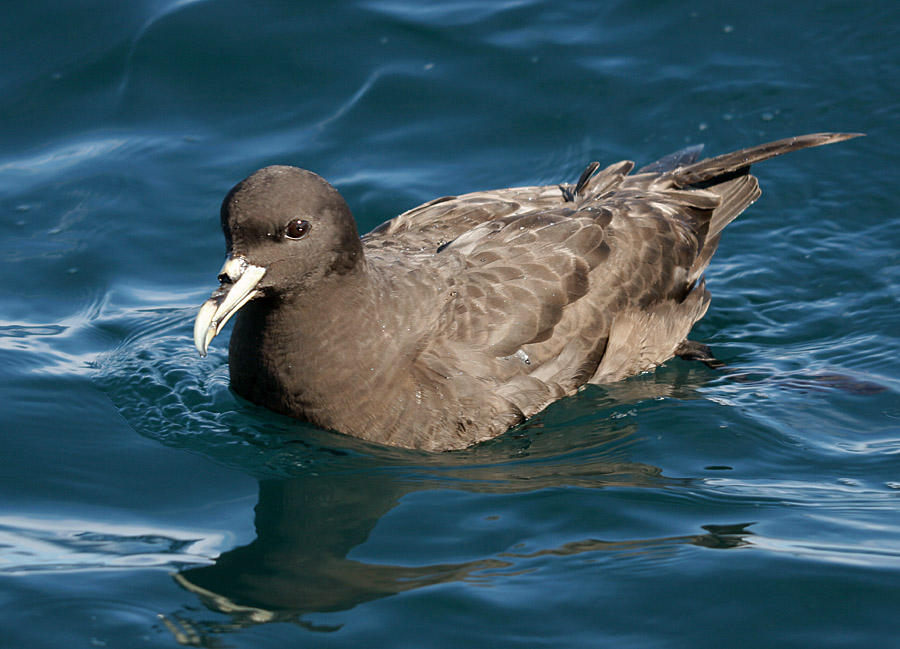
White-chinned petrel
Procellaria aequinoctialis
IUCN status: VU · VulnerableProtected in Peru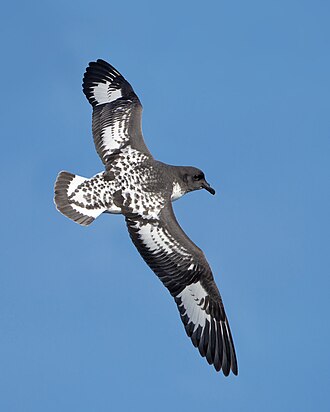
Pintado petrel
Daption capense
IUCN status: LC · Least Concern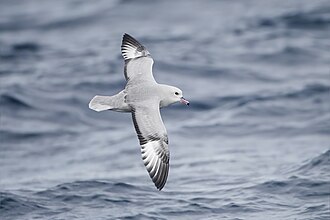
Southern fulmar
Fulmarus glacialoides
IUCN status: LC · Least Concern
Southern giant petrel
Macronectes giganteus
IUCN status: LC · Least ConcernProtected in Peru
Northern giant petrel
Macronectes halli
IUCN status: LC · Least ConcernProtected in Peru
Thin-billed prion
Pachyptila belcheri
IUCN status: LC · Least Concern
Names and sources
In English
- Buller's shearwater — WoRMS; Wikidata
- Grey-backed shearwater — WoRMS
- New Zealand shearwater — WoRMS
Classification
Learn more
Conservation status: no data (IUCN). Taxonomy: PeRMS / WoRMS (CC BY 4.0).