
Seabirds · Procellariidae
Galapagos petrel
Pterodroma phaeopygia (Salvin, 1876)
Spanish: Petrel de las Galápagos
- Names in Peru
- Petrel de las Galápagos
- Peruvian Register of Marine Species
- Listed in PeRMS (IMARPE)
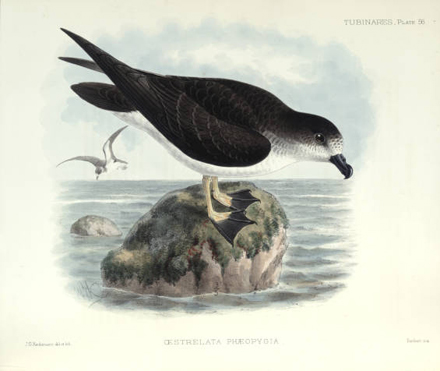
Species account
Summary
Pterodroma phaeopygia is a petrel of the family Procellariidae, described by Salvin in 1876 [1]. Peru's list of threatened wildlife calls it «petrel de las Galápagos» [2]. It is endemic to the Galápagos archipelago, Ecuador, and breeds only in the highlands of 5 islands: Santa Cruz, Floreana, San Cristóbal, Isabela and Santiago [3]. It feeds over oceanic waters of the eastern tropical Pacific, and one of the adults tracked by satellite while breeding entered the far northern edge of Peru's exclusive economic zone [3]. The IUCN Red List classifies it as Critically Endangered [4], and Peru's official list, approved in 2014, also places it in the Critically Endangered category [2].
Identification and similar species
It is a medium-sized petrel. On Santa Cruz, measured adults averaged a wing of 307 mm, a tail of 141 mm and a weight of 389 g, and size changes from island to island: Floreana birds turned out the largest, and Santa Cruz birds, together with those of one of the 2 San Cristóbal groups, the smallest [5]. On San Cristóbal, 41 adults weighed 386.8 g on average [6].
The black-and-white pattern on the forehead and the sides of the neck differs a great deal between individuals, from almost white foreheads to very dark or speckled ones, and it does not reveal which island a bird comes from [5]. Petrels reach their colonies only at night; during that study they flew in near silence until about 3 hours before dawn, when they began calling in the air, and the authors propose that males and females give different calls [5].
Similar species
Distribution and habitat
It nests in the humid highlands, where vegetation is dense [6]. On San Cristóbal every nest lay in ravines running down towards the south-south-east coast, between 400 and 690 m above sea level; 96.7 % of the burrows were dug in soft clay, and the endemic shrub Miconia robinsoniana occurred in 85.7 % of the plots around nests [6]. On Floreana, by contrast, nests are mostly in Scalesia forest, and on Santiago in more open, stony ground [6].
At sea, 19 adults feeding chicks on Santa Cruz and Floreana, tracked by satellite in 2009 and 2010, used an area of about 1.4 million km², between 2° N and 10° S [3]. They spent most of their time in Ecuador's exclusive economic zone, also entered those of Colombia, Costa Rica and Peru, and spent 37 % of the time on the high seas, outside any protected area [3].
That area is less than 20 % of the marine range known from ship-based surveys, about 7.8 million km², which also takes in immature birds and adults that are not breeding [3]. In those surveys, petrels off South America were linked to slightly cooler and saltier water, a shallower thermocline, stronger winds and higher waves [3].
Biology
They breed once a year and lay a single egg, which they do not replace if it is damaged or lost [5]. Timing differs widely between islands: on Santa Cruz the mean laying date was 4 July in 1978 and 5 July in 1979, with laying tightly bunched, whereas on Floreana eggs appeared from January to June and on San Cristóbal from November to August, with 2 peaks that point to 2 groups breeding at different times [5].
On San Cristóbal, in 2002 and 2003, pairs spent weeks cleaning out and digging their burrow and then stayed away for 35.4 days on average before laying [6]. The egg is white; 3 eggs weighed early in incubation averaged 58.17 g, about 15 % of an adult's weight [6]. Both members of the pair incubated and tended the chick; incubation lasted 50.8 days on average and the chick stayed in the nest for 103.7 days, and at 72 days old the chick reached 563.1 g, more than an adult [6].
Differences between islands in breeding timing, size, eggs and calls suggest that each island may hold a separate population, and genetic analyses recognised at least 3, and possibly 5, distinct populations in the archipelago [6].
Ecology
While feeding their chicks, adults combined short trips, 3.2 days on average and up to 670.6 km from the colony, with long trips of 10.8 days that took them as far as 1034 km; the briefest lasted 0.6 days and the longest 18.8 days [3]. The total distance flown was closely tied to the length of each trip, with a mean speed that varied little between individuals, a sign that they search for food along the way rather than flying straight to a known spot [3].
They are thought to feed mainly at night and to make partial use of prey that tuna and other predators drive towards the surface [3]. The waters they used most, south and west of Isabela Island, are highly productive, above all from July to September during strong La Niña events, and many cetaceans also gather there [3].
Conservation
Its global category is Critically Endangered [4]. In Peru it is also classified as Critically Endangered, and the regulation that lists it prohibits the hunting, capture, possession, trade, transport and export for commercial purposes of the species included [2].
There were optimistic estimates of up to 100 000 pairs in Galápagos, but in 1991 the authors of this study noted that recent research pointed to about 7500 breeding pairs as the more likely figure [5].
On San Cristóbal, in 2002 and 2003, only 23.6 % of breeding attempts ended in success; rats, which took both eggs and chicks, caused 72.2 % of failures, and every chick they killed was under 21 days old; in addition, feral dogs killed 2 chicks that were nearly ready to fly [6]. On that island more than 90 % of nests sit on private farms, outside the national park, and the introduced bramble Rubus niveus can close off burrow entrances [6].
In 4 San Cristóbal colonies checked in June 2013, the black rat Rattus rattus was the commonest rodent, with 43 captures, alongside the house mouse and the Norway rat; no petrel remains turned up in their stomachs, although the authors do not rule out that rats eat the bird [7].
At sea, protection is incomplete: some local tuna fisheries have been allowed inside the Galápagos Marine Reserve, and part of the waters the petrel uses overlaps with the huge fleet that fishes the squid Dosidicus gigas at night under lights near the southern edge of the Galápagos economic zone [3]. There is no direct evidence that this fishery catches petrels, but the authors call for regional cooperation, for example between Ecuador and Peru, and for more monitoring [3].
Where to see it in Peru
On 14 cruises made between 1980 and 1995 in waters within 370 km of the coast of Peru and Chile, between 3° S and 50° S, 25 birds recorded as Pterodroma phaeopygia were counted [8]. Those scarce records, of birds of unknown age and breeding status at the outer edge of the Humboldt Current, may have been Galápagos petrels that were not breeding [3]. Of the adults tracked by satellite in 2009 and 2010, only one entered the far northern part of Peru's exclusive economic zone, for less than 4 days [3].
References (8)
- WoRMS Editorial Board (2026). Pterodroma phaeopygia (Salvin, 1876). World Register of Marine Species. https://www.marinespecies.org/aphia.php?p=taxdetails&id=343980 (accessed 2026-10-20)
- Ministerio de Agricultura y Riego (2014). Decreto Supremo N.° 004-2014-MINAGRI: actualización de la lista de clasificación y categorización de las especies amenazadas de fauna silvestre legalmente protegidas. El Peruano (08-04-2014); ficha en SINIA, Ministerio del Ambiente. https://sinia.minam.gob.pe/normas/lista-especies-amenazadas-fauna-silvestre-legalmente-protegidas (accessed 2026-10-20)
- Proaño, C.B., Cruz, S., Adams, J. et al. (2026). Satellite tracking of Galapagos Petrel Pterodroma phaeopygia reveals distribution and movements during chick rearing. Marine Ornithology, 63-74. doi:10.5038/2074-1235.54.1.1678 (accessed 2026-10-20)
- BirdLife International (2018). Pterodroma phaeopygia: BirdLife International. The IUCN Red List of Threatened Species 2018: e.T22698020A132619647. doi:10.2305/IUCN.UK.2018-2.RLTS.T22698020A132619647.en (accessed 2026-10-20)
- Tomkins, R.J., Milne, B.J. (1991). Differences among dark-rumped petrel (Pterodroma phaeopygia) populations within the Galapagos archipelago. Notornis, 1-35. doi:10.63172/161635zuontj (accessed 2026-10-20)
- Cruz-Delgado, F., González, J.A., Wiedenfeld, D.A. (2010). Breeding biology of the Critically Endangered Galapagos Petrel Pterodroma phaeopygia on San Cristóbal Island: conservation and management implications. Bird Conservation International, 306-319. doi:10.1017/S095927091000002X (accessed 2026-10-20)
- Riofrío-Lazo, M., Páez-Rosas, D. (2015). Feeding Habits of Introduced Black Rats, Rattus rattus, in Nesting Colonies of Galapagos Petrel on San Cristóbal Island, Galapagos. PLOS ONE, e0127901. doi:10.1371/journal.pone.0127901 (accessed 2026-10-20)
- Spear, L.B., Ainley, D.G. (2008). The Seabird Community of the Peru Current, 1980-1995, with Comparisons to Other Eastern Boundary Currents. Marine Ornithology, 125-144. doi:10.5038/2074-1235.36.2.781 (accessed 2026-10-20)
More pictures
If you come across it
Protected or threatened species. Watch it without touching, feeding, chasing or taking it, and keep the recommended viewing distances.national category: Critically Endangered (CR) — Supreme Decree No. 004-2014-MINAGRI, classification of threatened wild fauna species (El Peruano, 8 April 2014), p. 6 of the PDF
Where it has been recorded
- Filled: scientific records, or confirmed by a curator
- Hatched: isolated record
- Dotted outline: no scientific records and no curator's confirmation (an ORKA sighting is not drawn here)
- Tropical northern sea
Scientific records (102 records)
- Tropical–cold transition zone
Scientific records (89 records)
- Cold central sea
Scientific records (49 records)
- Cold southern sea
Scientific records (10 records)
From openly licensed OBIS and GBIF records (CC0 or CC BY). How each list is built.
Related species
From the same genus (Pterodroma) and from the same family (Procellariidae).
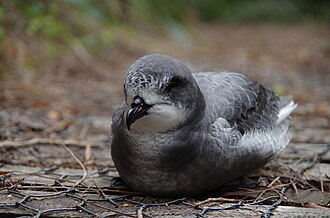
Cook's petrel
Pterodroma cookii
IUCN status: VU · Vulnerable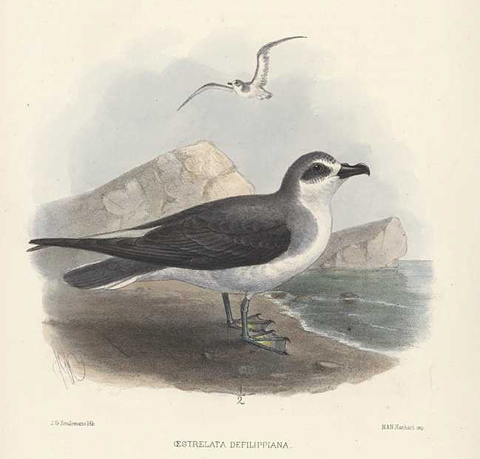
Masatierra petrel
Pterodroma defilippiana
IUCN status: VU · Vulnerable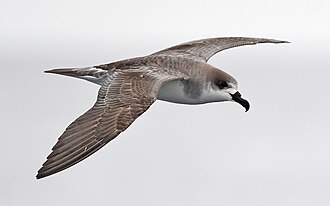
Juan Fernandez petrel
Pterodroma externa
IUCN status: VU · Vulnerable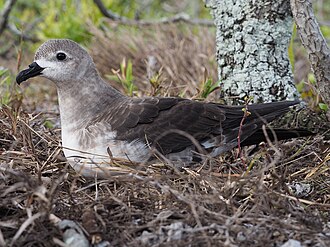
Kermadec petrel
Pterodroma neglecta
IUCN status: LC · Least ConcernStejneger's petrel
Pterodroma longirostris
IUCN status: VU · VulnerableArdenna creatopus
IUCN status: Not evaluatedProtected in Peru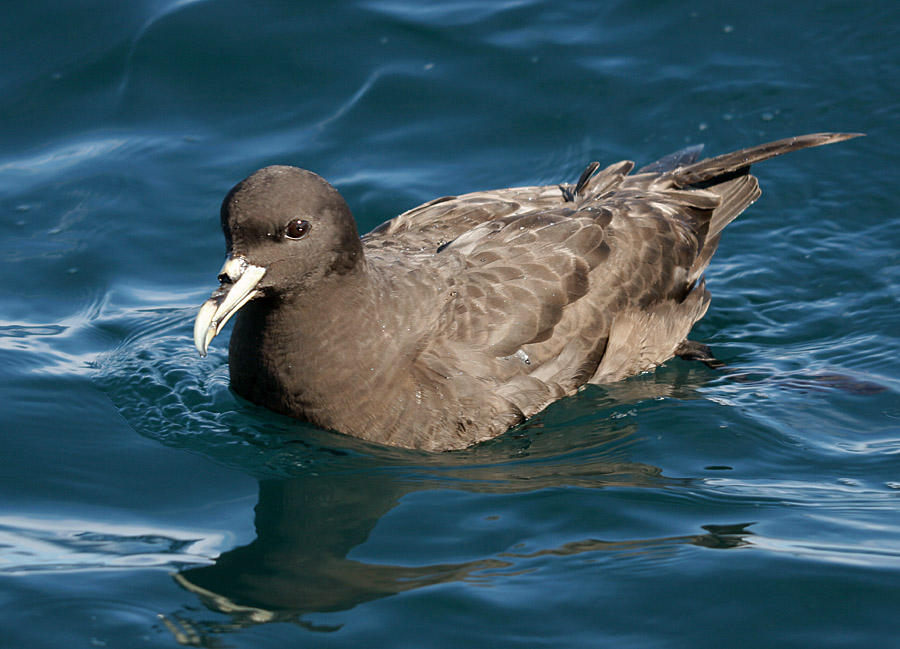
White-chinned petrel
Procellaria aequinoctialis
IUCN status: VU · VulnerableProtected in Peru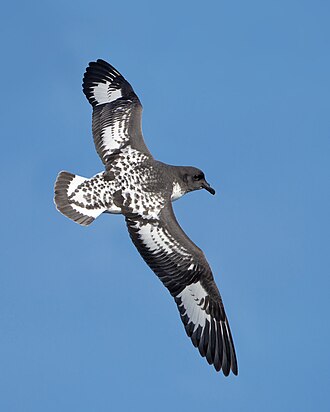
Pintado petrel
Daption capense
IUCN status: LC · Least Concern
Names and sources
In Spanish
- Petrel de las Galápagos — Peru; D.S. N.° 004-2014-MINAGRI, categorización de especies amenazadas de fauna silvestre (El Peruano, 08-04-2014), p. 6 of the PDF · main name
- Petrel de Galápagos — Wikidata
In English
- Galapagos petrel — WoRMS; Wikidata
- Dark-rumped Petrel — Wikidata; WoRMS
Classification
Learn more
Conservation status: Critically Endangered (IUCN Red List, according to Wikidata). Taxonomy: PeRMS / WoRMS (CC BY 4.0).