
Seabirds · Procellariidae
Juan Fernandez petrel
Pterodroma externa (Salvin, 1875)
Spanish: Peterel de las Juan Fernádez
- Peruvian Register of Marine Species
- Listed in PeRMS (IMARPE)

Species account
Summary
Pterodroma externa is a petrel of the family Procellariidae, described by Salvin in 1875 [1]. It breeds only on Alejandro Selkirk Island, in the Juan Fernández archipelago off the central coast of Chile, and spends the rest of the year ranging over the Pacific Ocean [2]. The IUCN Red List classifies it as Vulnerable [3]. Off Peru, hypothetical records at sea are cited [2].
Identification and similar species
It is a petrel about 43 cm long with a wingspan of 95 to 97 cm. It has a grey-brown cap that surrounds the eye and the sides of the head, a silvery-grey back, darker wings and tail, and white underparts except for the wingtips [2]. A dark M is drawn across the back from wingtip to wingtip and, under each wing, a small black patch at the bend, like a comma [2].
The tail is slate grey with white feather bases, which in worn plumage form a whitish U over the rump, and the legs are flesh pink with the outer side of the toes dark [2]. Measured birds weighed between 310 and 555 g, and females are on average somewhat smaller than males [2].
Similar species
- Pterodroma cervicalis: It has a similar size, weight and flight, but its black cap contrasts with the white nape more than the grey-brown cap of Pterodroma externa does, and its dark patch under the wing is larger [2].
Distribution and habitat
The species breeds only on Alejandro Selkirk Island, in the Juan Fernández archipelago [2]. Its nests are on grassy slopes between 600 and 1150 m above sea level, in burrows or under tufts of vegetation [2].
Outside the breeding season it lives almost always on the open sea and rarely comes to land [2]. Seven birds carrying geolocators, followed between 2020 and 2022, travelled as far as 5781 km from the colony before laying and as far as 4298 km during incubation, in subtropical and sub-Antarctic waters of the south-eastern Pacific [4]. Once not breeding, they scattered over the central and eastern Pacific: from waters off Peru in the south to Mexico and Hawaii in the north [4].
The species has been noted from Mexico to near Japan, and in moderate numbers around Rapa and Marotiri, in Polynesia, mostly over seamounts and beside flocks of feeding seabirds [2]. On cruises made between September 2014 and September 2017 between the coast of Chile and Easter Island it was present in the austral summer, when it breeds, and dispersed across the Pacific afterwards [5].
There are also records of single birds very far from its range, such as those found in New Zealand, on the Chatham Islands and on Tristan da Cunha [2]. In South America, hypothetical records at sea off Colombia and Peru are also cited [2].
Biology
The breeding season runs from December to May [2]. Birds seen on Pacific islands during those months would be immatures that do not yet breed, or adults travelling before laying [2].
Geolocators showed that each bird repeats its migration strategy from one year to the next, but that they do not concentrate in a single region: each went through 3 to 8 residency periods, of 15 to 80 days each [4]. The return to the colony followed looping routes across the South Pacific, which probably take advantage of the mid-latitude westerly winds [4].
Flight time was lower outside breeding (45% of the time) than during it (73 to 77%), and rose around the full moon, both at night (20%) and by day (51%), which the authors link to possible lunar effects on prey availability [4].
In strong winds it can reach about 200 km/h, which lets it cover enormous distances and would explain why some individuals turn up far from their usual route [2].
Ecology
In the tropical sea, seabirds like this one often feed alongside tuna, and the authors of the tracking study note that, outside breeding, the species overlaps substantially with industrial tuna fisheries using longlines and purse seines, although their sample was small [4].
On cruises across the south-eastern Pacific it was the most common species, making up 30.63% of 6697 birds counted [5].
Around Rapa and Marotiri it was seen over seamounts and beside flocks of seabirds in full feeding frenzy [2].
Conservation
The IUCN Red List classifies it as Vulnerable because of its extremely small breeding area, despite a population estimated at about 3 million individuals with no apparent decline [3],[2]. About 85000 individuals have been recorded at sea [2].
The threats named are the arrival of introduced species and the degradation of habitat on the breeding island [2]. Outside breeding, exposure to the tuna fleets of the eastern Pacific is a possible source of risk, still to be quantified at population scale [4].
In February 2024, during the breeding season, a live adult female appeared in a schoolyard in São José dos Campos, Brazil, about 63 km from the coast; she died on 6 May in a rehabilitation centre [2]. The authors suggest it was a vagrant, perhaps disoriented by abnormal disturbances of atmospheric and oceanic circulation [2].
References (5)
- WoRMS Editorial Board (2026). Pterodroma externa (Salvin, 1875). World Register of Marine Species. https://www.marinespecies.org/aphia.php?p=taxdetails&id=225933 (accessed 2026-10-21)
- Barbosa, C.B., Sánchez-Sarmiento, A.M., Ferioli, R.B. et al. (2024). First record of Juan Fernández Petrel Pterodroma externa (Salvin, 1875) in Brazil. Papéis Avulsos de Zoologia, e202464037. doi:10.11606/1807-0205/2024.64.037 (accessed 2026-10-21)
- BirdLife International (2018). Pterodroma externa: BirdLife International. The IUCN Red List of Threatened Species 2018: e.T22698030A132620783. doi:10.2305/IUCN.UK.2018-2.RLTS.T22698030A132620783.en (accessed 2026-10-21)
- Brooke, M. de L., Clay, T.A. (2026). Dispersive migration of breeding Juan Fernández Petrels Pterodroma externa across the eastern Pacific Ocean and overlap with tropical tuna fisheries. Emu - Austral Ornithology, 133-146. doi:10.1080/01584197.2026.2630916 (accessed 2026-10-21)
- Serratosa, J., Hyrenbach, K.D., Miranda-Urbina, D. et al. (2020). Environmental Drivers of Seabird At-Sea Distribution in the Eastern South Pacific Ocean: Assemblage Composition Across a Longitudinal Productivity Gradient. Frontiers in Marine Science, 838. doi:10.3389/fmars.2019.00838 (accessed 2026-10-21)
More pictures
If you come across it
Protected or threatened species. Watch it without touching, feeding, chasing or taking it, and keep the recommended viewing distances.
Where it has been recorded
- Filled: scientific records, or confirmed by a curator
- Hatched: isolated record
- Dotted outline: no scientific records and no curator's confirmation (an ORKA sighting is not drawn here)
- Cold southern sea
Scientific records (48 records)
From openly licensed OBIS and GBIF records (CC0 or CC BY). How each list is built.
Related species
From the same genus (Pterodroma) and from the same family (Procellariidae).
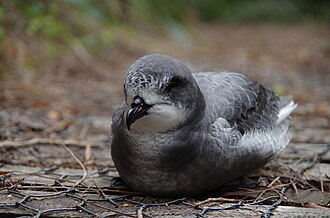
Cook's petrel
Pterodroma cookii
IUCN status: VU · Vulnerable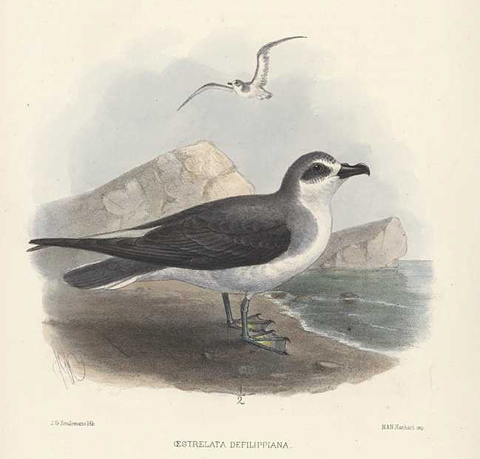
Masatierra petrel
Pterodroma defilippiana
IUCN status: VU · Vulnerable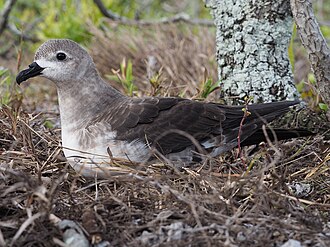
Kermadec petrel
Pterodroma neglecta
IUCN status: LC · Least Concern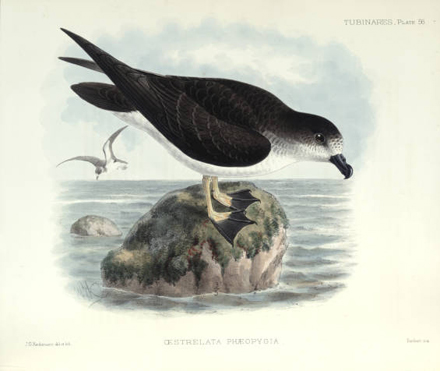
Galapagos petrel
Pterodroma phaeopygia
IUCN status: CR · Critically EndangeredProtected in PeruStejneger's petrel
Pterodroma longirostris
IUCN status: VU · VulnerableArdenna creatopus
IUCN status: Not evaluatedProtected in Peru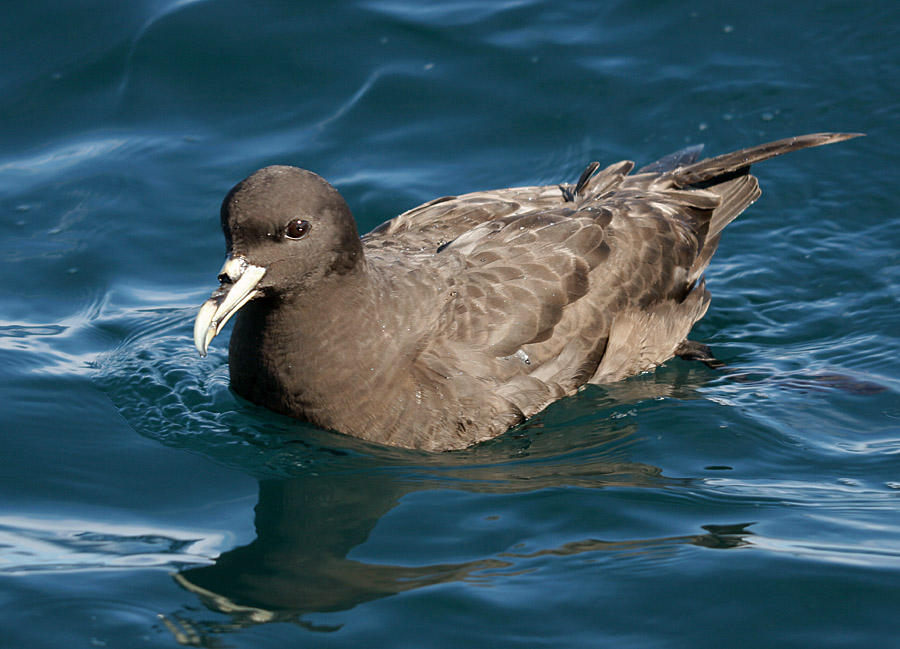
White-chinned petrel
Procellaria aequinoctialis
IUCN status: VU · VulnerableProtected in Peru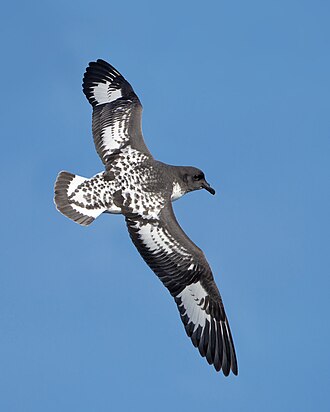
Pintado petrel
Daption capense
IUCN status: LC · Least Concern
Names and sources
In Spanish
- Peterel de las Juan Fernádez — Wikidata · main name
- Petrel de las Juan Fernández — Wikidata
In English
- Juan Fernandez petrel — WoRMS; Wikidata
- White-necked petrel — WoRMS
Classification
Learn more
Conservation status: Vulnerable (IUCN Red List, according to Wikidata). Taxonomy: PeRMS / WoRMS (CC BY 4.0).