
Seabirds · Procellariidae
Cook's petrel
Pterodroma cookii (Gray, 1843)
Spanish: Petrel de Cook
- Peruvian Register of Marine Species
- Listed in PeRMS (IMARPE)

Species account
Summary
Pterodroma cookii is a petrel of the family Procellariidae described by Gray in 1843 [1]. It breeds only on two New Zealand islands, Little Barrier and Codfish, but spends much of the year outside the breeding season crossing the Pacific Ocean [2]. Birds from Codfish migrate through the South Pacific and reach the Humboldt Current off the coast of Peru, at about 15° S [2]. The IUCN Red List classifies it as Vulnerable [3].
Etymology
Gray described the species as Procellaria cookii in 1843, in Dieffenbach's work on New Zealand, from the only Procellaria among the 37 birds that Ernst Dieffenbach collected and that the New Zealand Company presented to the British Museum in 1842 [4]. Gray did not say where the specimen had been taken, and over the years the type locality was given, vaguely, as just New Zealand [4].
Medway argues that the only specimen of the species that Dieffenbach obtained in New Zealand was the one his Maori guide dug out of a burrow on the banks of the Mangaoraka Stream, on the lower northern slopes of Mount Egmont, on 8 December 1839, and which Maori called titi [4]. He therefore proposed correcting the type locality to the vicinity of Kaimiro, in north Taranaki; it is now pasture farmed for dairying, although in 1839 it was covered with dense native forest [4].
Identification and similar species
It weighs about 200 g and lives far from land, over open ocean; it belongs to a group of 10 small petrel taxa that are often brought together in the subgenus Cookilaria [5]. Birds from the two breeding islands differ in size and in body mass [2].
Around 1929, Murphy separated two forms by size and plumage: the smaller, Pterodroma cookii cookii, represented by North Pacific specimens that he attributed to the Little Barrier population, and the larger, Pterodroma cookii orientalis, found south of the equator off the coast of Peru and then of unknown breeding origin [2]. Falla later noticed that the plumage and shape of Pterodroma cookii orientalis were compatible with those of juveniles from the Codfish population, which was discovered in 1934 [2].
Distribution and habitat
It breeds on Little Barrier (36° S) and on Codfish (46° S), two islands about 1000 km apart [5]. In the past it was also widespread on the main islands of New Zealand [5].
Outside the breeding season it is a transequatorial migrant. Birds from Little Barrier move north, to the California and North Pacific currents, at about 35° N; those from Codfish, in contrast, follow the Humboldt Current to their main non-breeding area off the coast of Peru, at about 15° S, which they reached after about 19 days of travel [2]. Codfish birds started their post-breeding migration on average on 8 April and their pre-breeding migration on 20 October [2].
This pattern is not only recent: all 10 skins collected in 1913 at about 11° S and 79° W, in the Humboldt Current, shared with present-day Codfish birds the diagnostic genetic change (a single-nucleotide polymorphism), and 7 of them also had the same mitochondrial haplotype [2]. Present-day Codfish birds followed with loggers used colder (17.29 °C on average versus 20.11 °C) and more productive waters (0.73 versus 0.16 mg of chlorophyll a per m³) in the non-breeding season than Little Barrier birds in the North Pacific [2].
Biology
It nests in burrows, and the populations of the two islands have breeding calendars that differ by about a month; birds from Little Barrier start their migrations earlier [2]. During the non-breeding period they moult, and adults stop attending their chicks up to two weeks before the chicks fly [2].
While rearing chicks, adults go out to feed on trips of 2 to 11 days from Little Barrier and 2 to 12 days from Codfish, with a mean of 5.9 and 5.0 days, respectively [5]. Chicks were almost always fed between 22:00 and 02:00 h, and the mean meal per visit was 37.9 g at Codfish and 36.8 g at Little Barrier, with no significant difference [5].
Ecology
Immersion loggers show that it spends a similar fraction of time on the water by day and by night, which suggests that much of its feeding is nocturnal [5]. An earlier description of the diet at Little Barrier, cited in that study, ranks the prey from most to least important as cephalopods, fish, crustaceans and tunicates; blood isotopes point to a diet with more crustaceans at Codfish [5].
In the breeding season, Little Barrier birds forage over shallower and warmer water (18.6 °C on average) than Codfish birds (15.8 °C), which feed in deeper, colder seas associated with the subtropical convergence [5]. Outside that season, isotope analyses of feathers indicate that the two populations eat prey of a similar trophic level, although in different oceanic regions [2].
Conservation
The species' global category on the IUCN Red List is Vulnerable [3]. The breeding population has been estimated at about 286,000 pairs on Little Barrier and about 6000 on Codfish [5].
Genetic analyses of museum skins indicate that the two populations have been genetically differentiated for at least 100 years, and the authors regard gene flow between them as highly restricted [2]. The Codfish population, the smaller of the two, is the one that reaches Peruvian waters [5],[2].
References (5)
- WoRMS Editorial Board (2026). Pterodroma cookii (Gray, 1843). World Register of Marine Species. https://www.marinespecies.org/aphia.php?p=taxdetails&id=225943 (accessed 2026-10-21)
- Rayner, M.J., Hauber, M.E., Steeves, T.E. et al. (2011). Contemporary and historical separation of transequatorial migration between genetically distinct seabird populations. Nature Communications, 2:332. doi:10.1038/ncomms1330 (accessed 2026-10-21)
- BirdLife International (2018). Pterodroma cookii: BirdLife International. The IUCN Red List of Threatened Species 2018: e.T22697975A132616449. doi:10.2305/IUCN.UK.2018-2.RLTS.T22697975A132616449.en (accessed 2026-10-21)
- Medway, D.G. (2004). The type localities of Cook's petrel (Pterodroma cookii), reef heron (Egretta sacra sacra) and wandering tattler (Tringa incana). Notornis, 155-158. doi:10.63172/735813ganjui (accessed 2026-10-21)
- Rayner, M.J., Hauber, M.E., Clout, M.N. et al. (2008). Foraging ecology of the Cook's petrel Pterodroma cookii during the austral breeding season: a comparison of its two populations. Marine Ecology Progress Series, 271-284. doi:10.3354/meps07660 (accessed 2026-10-21)
More pictures
If you come across it
Protected or threatened species. Watch it without touching, feeding, chasing or taking it, and keep the recommended viewing distances.
Where it has been recorded
- Filled: scientific records, or confirmed by a curator
- Hatched: isolated record
- Dotted outline: no scientific records and no curator's confirmation (an ORKA sighting is not drawn here)
- Cold central sea
Scientific records (14 records)
- Cold southern sea
Scientific records (127 records)
From openly licensed OBIS and GBIF records (CC0 or CC BY). How each list is built.
Related species
From the same genus (Pterodroma) and from the same family (Procellariidae).
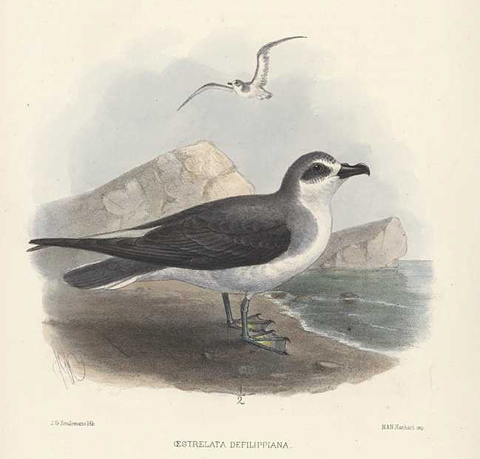
Masatierra petrel
Pterodroma defilippiana
IUCN status: VU · Vulnerable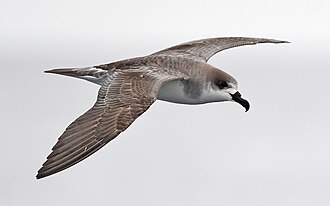
Juan Fernandez petrel
Pterodroma externa
IUCN status: VU · Vulnerable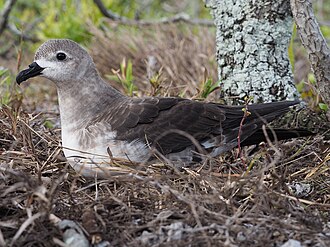
Kermadec petrel
Pterodroma neglecta
IUCN status: LC · Least Concern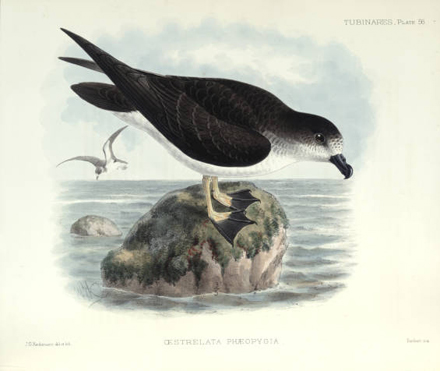
Galapagos petrel
Pterodroma phaeopygia
IUCN status: CR · Critically EndangeredProtected in PeruStejneger's petrel
Pterodroma longirostris
IUCN status: VU · VulnerableArdenna creatopus
IUCN status: Not evaluatedProtected in Peru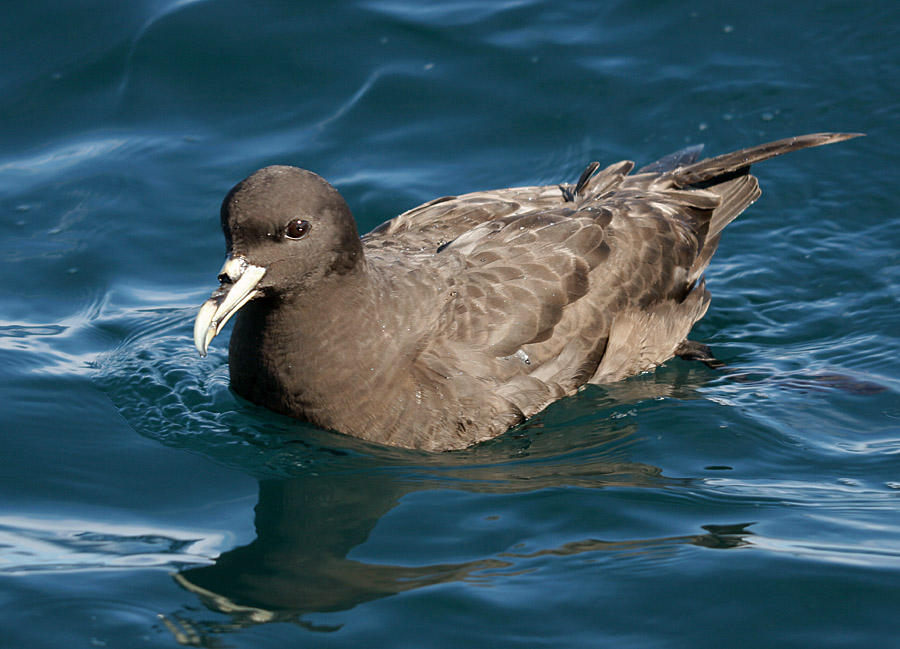
White-chinned petrel
Procellaria aequinoctialis
IUCN status: VU · VulnerableProtected in Peru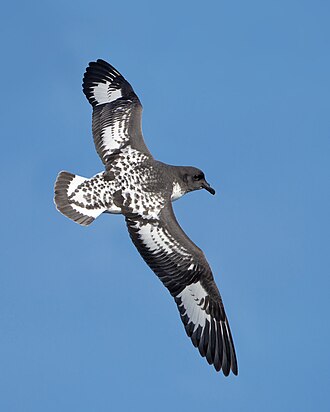
Pintado petrel
Daption capense
IUCN status: LC · Least Concern
Names and sources
In Spanish
- Petrel de Cook — Wikidata · main name
In English
- Cook's petrel — WoRMS; Wikidata
Classification
Learn more
Conservation status: Vulnerable (IUCN Red List, according to Wikidata). Taxonomy: PeRMS / WoRMS (CC BY 4.0).