
Marine mammals · Delphinidae
False killer whale
Pseudorca crassidens (Owen, 1846)
Spanish: Orca falsa
- Names in Peru
- Orca falsa
- Peruvian Register of Marine Species
- Listed in PeRMS (IMARPE)
Species account
Summary
Pseudorca crassidens, the false killer whale, is a big, nearly all-black dolphin found across the warm seas of every ocean [1]. In Peru, the MINCETUR marine wildlife watching manual includes it among the minor cetaceans [2].
The IUCN lists it as Near Threatened in its 2018 global assessment, and names bycatch in fisheries and, in some areas, directed hunting as the main threats [3].
Identification and similar species
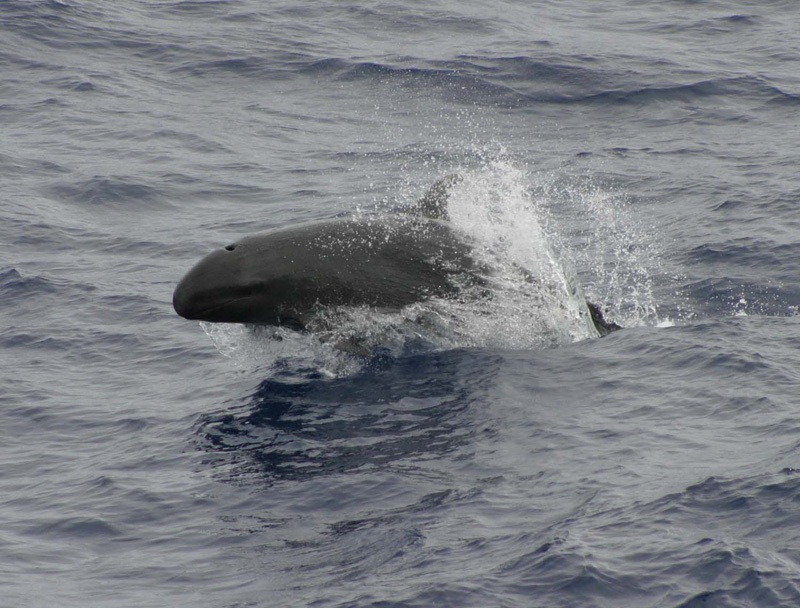
It is an almost entirely black dolphin, with black body, dorsal fin, flippers and flukes, sometimes with a pale grey area on the sides of the head and a pale anchor-shaped belly patch between the throat and the flippers [1]. The dorsal fin is falcate, can exceed 40 cm in height, and the flipper has a broad hump on its front edge that sets it apart from other large dolphins [1].
The head has no distinct beak, and males have a somewhat more prominent forehead than females [1]. The teeth are massive, conical and round in cross-section; in 8 animals stranded in Magallanes, one tooth row per animal was counted: 16 maxillary and 18 mandibular teeth in 5 males, and 16 to 18 maxillary and 18 mandibular teeth in 3 females [4]. The largest recorded length is 5.96 m in a male and 5.06 m in a female of unspecified origin [1]; in Magallanes adult males reached 5.47 m and one female 5.10 m [4].
Distribution and habitat
The species has been recorded in all tropical, subtropical and warm temperate seas, largely from strandings, and its continuous range is one of the widest among cetaceans [1]. In the eastern Pacific it is known from Alaska to Chile, and the description of Orca destructor has Paita, Peru, as its type locality [1].
It lives mostly in deep offshore water, although it comes close to shore around oceanic islands, and its density is highest in the tropics [3]. It has been seen in water from 9 to 30.8 °C, more often in the warmer part of that range [1]. In Chile there are 5 documented strandings and 22 sightings, mostly on the central-northern coast [4].
Biology
Females mature at 340 to 380 cm in length, at 8 to 11 years of age, and males later: in Japan fully mature males measured more than 429 cm [1]. Gestation lasts between 15.1 and 15.7 months, a single calf of about 175 cm is born and lactation lasts 18 to 24 months [1].
The mean interval between births is estimated at 6.9 years, and estimated longevity reaches 57.5 years in males and 62.5 years in females [1]. Females over 45 years of age may stop reproducing [1].
Ecology
It feeds mainly on fishes and squids, by day and by night, and food sharing between individuals has been observed [1]. In Hawaii, large pelagic fishes such as mahimahi, tunas and billfishes make up most of the diet, and on longline catches it prefers billfishes, wahoo and tunas [3].
It is a social species: mean group size off Japan was 55 individuals, ranging from 2 to 200, and it is sometimes associated with other cetaceans, most often bottlenose dolphins [1]. Many mass strandings have been recorded; 14 of them averaged 180 animals, with a maximum of 835 [1]. The one in February 2013 in the Strait of Magellan involved 46 animals; in 7 necropsies the internal organs showed no apparent signs of disease [4].
Conservation
The 2018 global IUCN assessment lists it as Near Threatened [3]. The sum of available abundance estimates is 59,157 animals, although the two largest are more than 25 years old and there are no data for much of the range, so the true total is thought to be higher [3].
The main threats are bycatch in fisheries, especially longline and hook-and-line gear, and directed hunting in some regions; the only population assessed quantitatively, the main Hawaiian Islands stock, declined by more than 50 % in less than two generations [3]. It is listed in CITES Appendix II and under the Convention on Migratory Species, and incidental catches of small numbers in gillnets have been documented in Peru [3].
Health, toxicological and chemical relevance
Not medical advice. For a sting, a poisoning or an allergy, seek medical care.
Two stranded animals in British Columbia had liver mercury at 728 and more than 1,600 ppm, among the highest levels recorded in cetaceans, and blubber DDE at 1,400 ppm [1]. Its parasites include nematodes of the genus Anisakis, as well as trematodes and crustaceans [1].
Human relevance
It is not taken by standard whaling operations, but some drive and harpoon fisheries do take it, and there is small-scale incidental catch in gillnets and longlines worldwide [1]. In Japan, directed catches were probably large enough to reduce nearshore populations [3].
The species has been kept in captivity and is noted for observational learning and imitation [1]. It also takes bait and catch from longline gear, which exposes it more to bycatch [3].
Where to see it in Peru
The MINCETUR good-practice manual includes the false killer whale in its list of minor cetaceans, for which it sets a minimum approach distance of 50 m, or 150 m when they are feeding or socialising [2]. The manual applies other distances to cetaceans longer than 5 m, and this species can exceed that size [2],[1].
References (4)
- Stacey, P.J., Leatherwood, S., Baird, R.W. (1994). Pseudorca crassidens. Mammalian Species 456: 1-6, 1-6. doi:10.2307/3504208 (accessed 2026-10-25)
- Ministerio de Comercio Exterior y Turismo (2026). Manual de buenas prácticas de gestión de servicio turístico para la actividad de observación de fauna marina, 3.ª ed. MINCETUR. https://cdn.www.gob.pe/uploads/document/file/10041919/8184632-mbp_faunamarina_3ra.pdf (accessed 2026-10-25)
- Baird, R.W. (2018). Pseudorca crassidens: Baird, R.W. The IUCN Red List of Threatened Species 2018: e.T18596A50371251. doi:10.2305/IUCN.UK.2018-2.RLTS.T18596A50371251.en (accessed 2026-10-25)
- Haro, D. (2015). Nuevo varamiento masivo de orca falsa, Pseudorca crassidens, en el Estrecho de Magallanes, Chile. Revista de Biología Marina y Oceanografía 50(1): 149-155, 149-155. doi:10.4067/s0718-19572015000100013 (accessed 2026-10-25)
More pictures
If you come across it
Protected or threatened species. Watch it without touching, feeding, chasing or taking it, and keep the recommended viewing distances.
Related species
From the same family.

Orca
Orcinus orca
IUCN status: DD · Data Deficient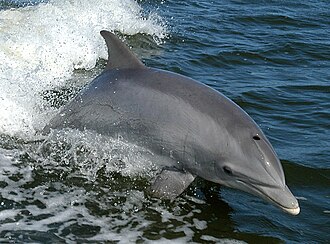
Bottlenose dolphin
Tursiops truncatus
IUCN status: LC · Least Concern
Short-beaked common dolphin
Delphinus delphis
IUCN status: LC · Least Concern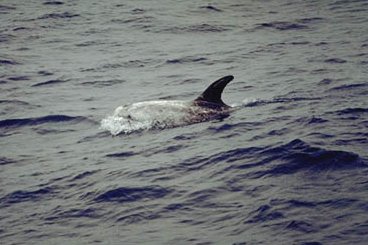
Gray grampus
Grampus griseus
IUCN status: LC · Least Concern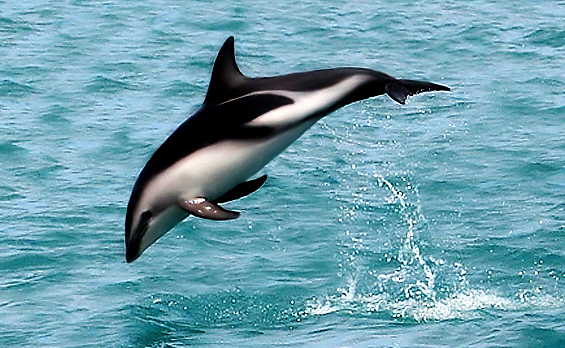
Dusky dolphin
Lagenorhynchus obscurus
IUCN status: LC · Least Concern
Blackfish
Globicephala macrorhynchus
IUCN status: LC · Least Concern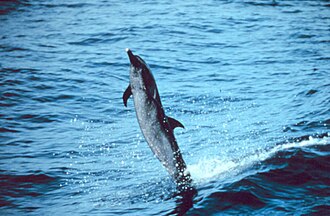
Narrow-snouted dolphin
Stenella attenuata
IUCN status: LC · Least Concern
Slender blackfish
Feresa attenuata
IUCN status: LC · Least Concern
Names and sources
In Spanish
- Orca falsa — Peru; MINCETUR (2026). Manual de buenas prácticas para la actividad de observación de fauna marina, 3.ª ed., p. 25 of the PDF; Wikidata; WoRMS · main name
- Delfin chato — WoRMS
- Falsa orca comun — WoRMS
- Orca bastarda — WoRMS
- Orca negra — WoRMS
In English
- False killer whale — WoRMS; Wikidata
- Blackfish — WoRMS
- Bubble — WoRMS
- False killer whale, pfalse killer — Wikidata
- False Pilot Whale — Wikidata
Classification
Learn more
Conservation status: Near Threatened (IUCN Red List, according to Wikidata). Taxonomy: PeRMS / WoRMS (CC BY 4.0).