
Seabirds · Procellariidae
White-chinned petrel
Procellaria aequinoctialis Linnaeus, 1758
Spanish: Petrel de mentón blanco
- Names in Peru
- Petrel de mentón blanco
- Peruvian Register of Marine Species
- Listed in PeRMS (IMARPE)
Species account
Summary
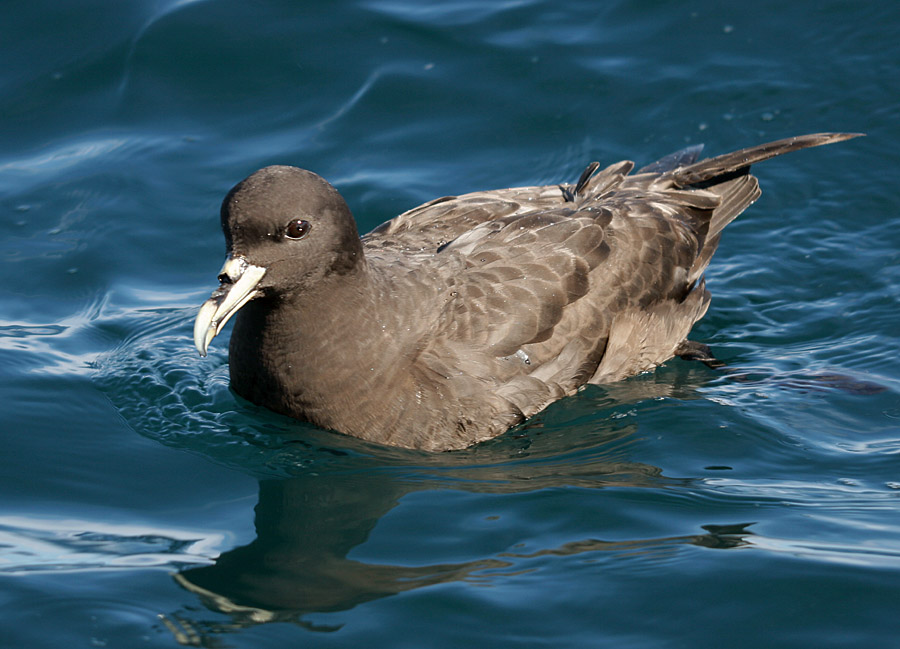
Procellaria aequinoctialis is a seabird of the family Procellariidae described by Linnaeus in 1758 [1]. It is known in Peru as «petrel de mentón blanco» [2]. It breeds on sub-Antarctic islands [3] and reaches Peruvian waters as a southern hemisphere migrant; in at-sea surveys carried out between 1980 and 1995 off Peru and Chile it was the third most abundant species of the Peru Current, averaging summer and winter [4]. The IUCN Red List classifies it as Vulnerable in its 2018 assessment [5], and Peru's official list of threatened wildlife, approved in 2014, also places it in the Vulnerable category [2].
Identification and similar species
It is the largest of the petrels that nest in burrows [6]. In breeding adults killed as bycatch in New Zealand, mean right wing chord was 383.6 mm in birds assigned to the Auckland Islands and 398.3 mm in those from the Antipodes Islands, and culmen length 51.8 mm and 54.0 mm respectively; in both groups males and females differed in their measurements [7]. To estimate bird biomass in the Peru Current a body mass of 1.15 kg was used for this species [4].
The white chin patch is highly variable. In the New Zealand region the white is usually scant, and none of the 1091 bycatch birds checked in New Zealand waters up to 2008 had a patch as large as that of an adult seen off Kaikoura, which also carried a white patch about 1.5 cm across on each cheek; birds with a lot of white on the face are known mainly from the populations breeding on the Kerguelen and Crozet Islands, in the southern Indian Ocean [8]. The nail of the bill is yellowish green [4].
Similar species
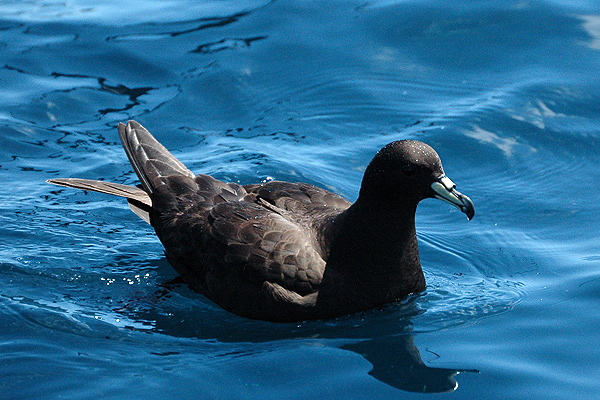
- Procellaria parkinsoni: Its bill has a black nail, not a yellowish-green one. On the 1980 to 1995 cruises off Peru and Chile, dark-nailed Procellaria seen north of 12° S were assigned to this species, which was frequent between 3° S and 6° S, with individuals as far as 12° 32′ S [4].
- Procellaria westlandica: It also has a black bill nail and, according to the authors, differs from Procellaria parkinsoni only in its clearly larger size; dark-nailed Procellaria seen south of 20° S were assigned to it, and it was occasional between 20° S and 45° S [4].
- Procellaria conspicillata: A very close relative that breeds on Inaccessible Island, in the Tristan da Cunha group of the South Atlantic, and carries plenty of white plumage on the face [8].
Distribution and habitat
It breeds on sub-Antarctic islands of France, New Zealand and South Africa, as well as South Georgia and the Falkland Islands (Malvinas); in the Pacific, its colonies are on the Auckland, Antipodes and Campbell island groups [3].
10 birds from South Georgia were followed with geolocators for 226 to 664 days. Outside the breeding season all of them went to the Patagonian Shelf and its edge, centred east of the River Plate estuary; 2 of them moved in midwinter to the Humboldt Current off Chile and from there went straight back to the colony [9]. When raising chicks, by contrast, they ranged on average some 610 km from the island [9].
In the Peru Current, within a band up to 370 km from the coast between 3° S and 50° S, 2299 individuals were counted on 14 cruises made from 1980 to 1995; mean density was 30.7 birds per 100 km² in summer and 55.8 in winter [4]. It belongs to the set of Antarctic and sub-Antarctic birds that move north outside their breeding season and keep to the colder waters [4].
Off southern Peru, between October 2015 and April 2017, observers recorded it over the continental slope (56 % of birds), the Peru-Chile Trench (15 %) and the abyssal plain (29 %), and saw none over the continental shelf [10].
Biology
It nests in burrows in tussock grassland on the sub-Antarctic islands [11]. At Bird Island, South Georgia, pairs breed practically every year and their breeding success stayed close to 44 % [11].
Its diet was studied at South Georgia in the summers of 1996 and 1998. By weight the most important prey was Antarctic krill Euphausia superba (41-42 %), followed by fish (29-39 %) and squid (19-25 %) [12]. Krill was plentiful throughout 1996 but apparently scarce at the start of the 1998 season: that year the meals adults brought weighed about the same (119 g, against 110 g in 1996), yet chicks got them 46 % less often, so they received 19 % less food [12].
Despite this, it bred with a success of 44 % in both years, whereas in 1998 two South Georgia albatrosses, the black-browed and the grey-headed, failed almost completely [12]. The authors suggest that what lets it cushion a krill shortage is its range of fishing methods, its better diving, its ability to feed at night and the size of the area it searches [12].
Ecology
It forages at night as well as by day, and beside fishing vessels it often fights over bait, offal and discards [9]. In the Peru Current it groups with the species that arrive from the south in winter and that eat mostly carrion or prey taken at the surface, such as Thalassarche melanophris, Thalassarche salvini, Fulmarus glacialoides and Daption capense; the study's highest bird biomass in oceanic waters, that of the southern sector (25° S to 35° S, off Chile) in winter, was due mainly to this species and Thalassarche melanophris [4].
Off southern Peru it was the most numerous bird around the small-scale boats that fish for Humboldt squid (Dosidicus gigas) at dawn and dusk, with 181 of the 300 birds recorded (60.3 %) [10]. Most birds rested on the water near the boats, probably waiting for offal discards, and about 17 % of all birds observed fed on those discards [10].
Conservation
Its global category is Vulnerable [5]. In Peru it is classified as Vulnerable, and the regulation that lists it prohibits the hunting, capture, possession, trade, transport and export for commercial purposes of the species included [2].
It is the seabird killed in greatest numbers on longlines in the Southern Ocean [13]. In the Crozet archipelago, in the southern Indian Ocean, the number of breeding pairs dropped by about 37 % in 21 years; there, the greater the fishing effort on toothfish and hake, the fewer young birds joined the population, and El Niño events reduced adult survival with a delay of 3 years [13].
At Bird Island, South Georgia, occupied burrows were estimated to have decreased by 28 % between 1981 and 1998; occupancy bore no relation to the habitat changes caused by fur seals, so the decrease would point to factors acting away from the colony, such as fishing [11]. At sea, South Georgia birds coincide with several large fisheries known or suspected to have high seabird bycatch [9].
On Santa Catarina Island, in southern Brazil, 72 stranded birds turned up between August 2015 and July 2016; 31 of them arrived between late December 2015 and early January 2016, and 12 of those 31 showed signs of human interaction, including hooks of the type used by the Itaipava fleet [3].
In the small-scale Humboldt squid fishery of southern Peru, no capture of this species was recorded on 16 observed fishing trips; the only bird hooked was a Chatham albatross, which was released [10].
Where to see it in Peru
Between October 2015 and April 2017, El Niño years, it was the most numerous bird beside the squid boats sailing mainly from Lomas, Atico, La Planchada, Quilca and Matarani in southern Peru; observations were made aboard those boats well offshore, and all birds of this species were seen over the continental slope or deeper waters, none over the continental shelf [10]. In those years it was scarce in summer (15 % of records) and commoner in autumn and winter (about 25 % each) and in spring (35 %) [10].
On the cruises made between 1980 and 1995 off Peru and Chile, its density was higher in winter than in summer [4].
References (13)
- WoRMS Editorial Board (2026). Procellaria aequinoctialis Linnaeus, 1758. World Register of Marine Species. https://www.marinespecies.org/aphia.php?p=taxdetails&id=212651 (accessed 2026-10-20)
- Ministerio de Agricultura y Riego (2014). Decreto Supremo N.° 004-2014-MINAGRI: actualización de la lista de clasificación y categorización de las especies amenazadas de fauna silvestre legalmente protegidas. El Peruano (08-04-2014); ficha en SINIA, Ministerio del Ambiente. https://sinia.minam.gob.pe/normas/lista-especies-amenazadas-fauna-silvestre-legalmente-protegidas (accessed 2026-10-20)
- Kolesnikovas, C.K.M., Ferreira, E.C., Assumpção, C.C.A. et al. (2021). Unusual Mass Stranding Event of White-chinned Petrels Procellaria aequinoctialis in Santa Catarina State, Southern Brazil. Marine Ornithology, 183-187. doi:10.5038/2074-1235.49.2.1422 (accessed 2026-10-20)
- Spear, L.B., Ainley, D.G. (2008). The Seabird Community of the Peru Current, 1980-1995, with Comparisons to Other Eastern Boundary Currents. Marine Ornithology, 125-144. doi:10.5038/2074-1235.36.2.781 (accessed 2026-10-20)
- BirdLife International (2018). Procellaria aequinoctialis: BirdLife International. The IUCN Red List of Threatened Species 2018: e.T22698140A132628887. doi:10.2305/IUCN.UK.2018-2.RLTS.T22698140A132628887.en (accessed 2026-10-20)
- Hall, A.J. (1987). The breeding biology of the white-chinned petrel Procellaria aequinoctialis at South Georgia. Journal of Zoology, 605-617. doi:10.1111/j.1469-7998.1987.tb05959.x (accessed 2026-10-20)
- Mischler, C.P., Robertson, C.J.R., Bell, E.A. (2015). Gender and geographic variation in morphometrics of white-chinned petrels (Procellaria aequinoctialis) in New Zealand and their foraging activities as determined from fisheries bycatch. Notornis, 63-70. doi:10.63172/358396rtpbsp (accessed 2026-10-20)
- Miskelly, C.M. (2009). A very white-chinned petrel (Procellaria aequinoctialis) off Kaikoura. Notornis, 46-48. doi:10.63172/905635vnyban (accessed 2026-10-20)
- Phillips, R.A., Silk, J.R.D., Croxall, J.P. et al. (2006). Year-round distribution of white-chinned petrels from South Georgia: Relationships with oceanography and fisheries. Biological Conservation, 336-347. doi:10.1016/j.biocon.2005.10.046 (accessed 2026-10-20)
- Moreno, C., Quiñones, J. (2022). Albatross and Petrel Interactions with an Artisanal Squid Fishery in Southern Peru during El Niño, 2015-2017. Marine Ornithology, 49-56. doi:10.5038/2074-1235.50.1.1459 (accessed 2026-10-20)
- Berrow, S.D., Croxall, J.P., Grant, S.D. (2000). Status of white-chinned petrels Procellaria aequinoctialis Linnaeus 1758, at Bird Island, South Georgia. Antarctic Science, 399-405. doi:10.1017/S0954102000000468 (accessed 2026-10-20)
- Berrow, S.D., Croxall, J.P. (1999). The diet of white-chinned petrels Procellaria aequinoctialis, Linnaeus 1758, in years of contrasting prey availability at South Georgia. Antarctic Science, 283-292. doi:10.1017/S0954102099000371 (accessed 2026-10-20)
- Barbraud, C., Marteau, C., Ridoux, V. et al. (2008). Demographic response of a population of white-chinned petrels Procellaria aequinoctialis to climate and longline fishery bycatch. Journal of Applied Ecology, 1460-1467. doi:10.1111/j.1365-2664.2008.01537.x (accessed 2026-10-20)
More pictures
If you come across it
Protected or threatened species. Watch it without touching, feeding, chasing or taking it, and keep the recommended viewing distances.national category: Vulnerable (VU) — Supreme Decree No. 004-2014-MINAGRI, classification of threatened wild fauna species (El Peruano, 8 April 2014), p. 8 of the PDF
Where it has been recorded
- Filled: scientific records, or confirmed by a curator
- Hatched: isolated record
- Dotted outline: no scientific records and no curator's confirmation (an ORKA sighting is not drawn here)
- Tropical northern sea
Scientific records (101 records)
- Tropical–cold transition zone
Scientific records (135 records)
- Cold central sea
Scientific records (376 records)
- Cold southern sea
Scientific records (696 records)
From openly licensed OBIS and GBIF records (CC0 or CC BY). How each list is built.
Related species
From the same genus (Procellaria) and from the same family (Procellariidae).
Black petrel
Procellaria parkinsoni
IUCN status: VU · VulnerableProtected in PeruArdenna creatopus
IUCN status: Not evaluatedProtected in Peru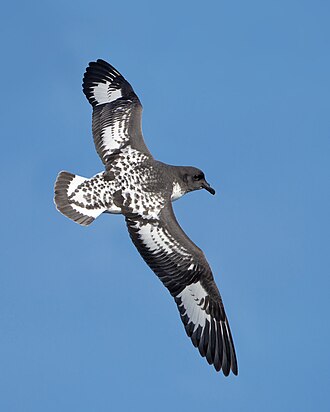
Pintado petrel
Daption capense
IUCN status: LC · Least Concern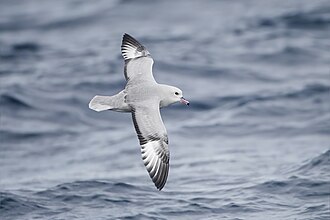
Southern fulmar
Fulmarus glacialoides
IUCN status: LC · Least Concern
Southern giant petrel
Macronectes giganteus
IUCN status: LC · Least ConcernProtected in Peru
Northern giant petrel
Macronectes halli
IUCN status: LC · Least ConcernProtected in Peru
Thin-billed prion
Pachyptila belcheri
IUCN status: LC · Least Concern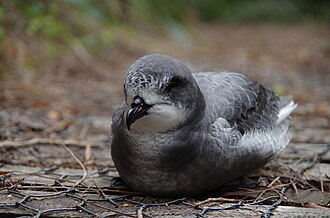
Cook's petrel
Pterodroma cookii
IUCN status: VU · Vulnerable
Names and sources
In Spanish
- Petrel de mentón blanco — Peru; D.S. N.° 004-2014-MINAGRI, categorización de especies amenazadas de fauna silvestre (El Peruano, 08-04-2014), p. 8 of the PDF · main name
- Pardela Gorgiblanca — Wikidata
- Pardela gorjiblanca — Wikidata
- Petrel barba blanca — Wikidata
In English
- White-chinned petrel — WoRMS; Wikidata
- Cape hen — WoRMS
- Shoemaker — WoRMS
Classification
Learn more
Conservation status: Vulnerable (IUCN Red List, according to Wikidata). Taxonomy: PeRMS / WoRMS (CC BY 4.0).