
Sharks, rays and chimaeras · Pristidae
Common sawfish
Pristis pristis (Linnaeus, 1758)
Spanish: Pez sierra
- Peruvian Register of Marine Species
- Listed in PeRMS (IMARPE)

Species account
Summary
Pristis pristis is a sawfish of the family Pristidae, order Rhinopristiformes [1]. It is one of the largest cartilaginous fishes, reaching about 656 cm total length, and lives in estuaries, rivers and shallow coastal waters [2]. In Peru it was long thought to be gone, but in 2014 and 2015 two large individuals were caught in gillnets off Tumbes [3]. Its global IUCN Red List category is Critically Endangered [4].
Identification and similar species
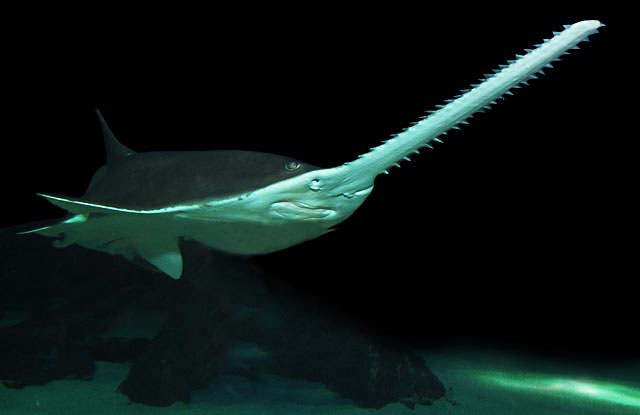
It is told from the other Pristis species by three features: the first dorsal fin begins ahead of the origin of the pelvic fins, the lower lobe of the tail is present at every stage of growth, and the rostrum, the toothed extension of the snout, is shorter and wider [3]. The two Tumbes individuals were identified by the position of the first dorsal fin and the lower caudal lobe, and a specialist confirmed this from photographs [3].
Adults are very large: the maximum known size is 656 cm total length, and females mature at about 300 cm and males at 280 to 300 cm [2]. At birth they measure 72 to 90 cm [2]. The Tumbes individuals measured about 350 cm, with a 100 cm rostrum, and about 600 cm [3].
Similar species
- Pristis pectinata: It has been listed for Peru in a fish catalogue, but the authors of the Tumbes records consider that probably a misidentification of Pristis pristis, because Pristis pectinata occurs only in the Atlantic [3].
Distribution and habitat
It is a tropical species that was once widespread, with four genetically distinct populations: eastern Atlantic, western Atlantic, eastern Pacific and western Indo-Pacific [3]. It was historically recorded in the coastal waters of 75 countries [2]. Juveniles live in fresh water and adults in the sea and estuaries, although in Lake Nicaragua even adults spent nearly all their lives in fresh water, and it has been found up to 1000 km inland in the Amazon basin [2].
The eastern Pacific population was formerly distributed from the Gulf of Mexico to Peru [3]. Peruvian records are concentrated on the north coast, between the Ecuadorian border and Cabo Blanco [3]. Those of 2014 and 2015 are from the department of Tumbes, whose coast has mangroves fed by the Tumbes and Zarumilla rivers [3]. Adults are usually in water less than 10 m deep, though they can reach more than 100 m, and are associated with mangroves or seagrass meadows [2].
Biology
It is a long-lived species: Pristis sawfishes live between 30 and more than 50 years, and a generation lasts between 14.6 and 17.2 years [2]. For Pristis pristis females are estimated to mature at 8 to 10 years and the mean litter is 7.3 pups, with a maximum of 13 [2]. Breeding is annual in the western Indo-Pacific population and biennial in the western Atlantic one [2].
The intrinsic rate of population increase is only 0.12 per year, so a depleted population recovers slowly [2]. In Tumbes, the female of about 350 cm caught on 22 January 2014 was gravid and carried yellow, spherical eggs [3].
Ecology
Juveniles spend much of their time in rivers and estuaries, and adults live in very shallow water tied to mangroves and seagrass, habitats that have lost between 20 and 35 % of their world cover in the case of mangroves since 1980 [2]. In the eastern Pacific, the loss of mangroves that serve as nursery, breeding and feeding grounds is among the main threats [3].
The three recent encounters in Peru took place between late January and early March, which could indicate a seasonal presence from a core area farther north, although a July record in Ecuador does not fit that idea [3]. More research is needed on its habitat use and phenology [3].
Conservation
Its global IUCN Red List category is Critically Endangered [4]. The causes are slow population growth, the ease with which it tangles in fishing gear and the high value of its products [2]. For the eastern Pacific population a contraction of its extent of occurrence of at least 80 % over three generations was inferred [3].
It is included in Appendix I of CITES and of the Convention on Migratory Species [3]. In Peru, according to the 2017 report, it was not protected by legislation, so catching and selling it was not illegal [3]. Gillnets are the main threat: all three recent individuals were caught in them, and many fishers leave nets set unattended for hours [3]. The authors call for more research, environmental education and full legal protection [3].
Human relevance
The rostral teeth of Central and South American sawfishes are the preferred material for the spurs used in cockfighting in Peru, and a pair of spurs was valued at 80 to 220 US dollars [2]. According to fishers from Cancas and Caleta La Cruz, these fish were abundant on the north coast of Peru and overfishing, driven by the value of the teeth, has almost eliminated them [3].
The fins of a large sawfish are among the most valuable fishery products, and although international trade has been banned since 2007, their value still gives fishers a reason to keep specimens [2]. In 2014 the teeth of the La Cruz individual were sold [3]. In 2015 fishers at Cancas released alive an individual of about 600 cm, in front of representatives of the fisheries authority and the coast guard [3].
Where to see it in Peru
It is not a species that can be seen easily. The 2014 and 2015 Tumbes records were incidental catches in gillnets [3]. Its distribution in Peru appears to extend from the Ecuadorian border to Cabo Blanco [3]. According to an informant cited by the authors, the last year sawfishes were seen in Peru before those records was 1999, and they add one individual landed dead at Máncora in March 2017 [3]. The published information concerns catches, not places to observe it [3].
References (4)
- WoRMS Editorial Board (2026). Pristis pristis (Linnaeus, 1758). World Register of Marine Species. https://www.marinespecies.org/aphia.php?p=taxdetails&id=105849 (accessed 2026-10-21)
- Dulvy, N.K., Davidson, L.N.K., Kyne, P.M. et al. (2016). Ghosts of the coast: global extinction risk and conservation of sawfishes. Aquatic Conservation: Marine and Freshwater Ecosystems, 134-153. doi:10.1002/aqc.2525 (accessed 2026-10-21)
- Mendoza, A., Kelez, S., Gonzales Cherres, W. et al. (2017). The Largetooth Sawfish, Pristis pristis (Linnaeus, 1758), is not extirpated from Peru: new records from Tumbes. Check List, 261-265. doi:10.15560/13.4.261 (accessed 2026-10-21)
- Kyne, P.M., Carlson, J., Smith, K. (2013). Pristis pristis: Kyne, P.M., Carlson, J. & Smith, K. The IUCN Red List of Threatened Species 2013: e.T18584848A18620395. doi:10.2305/iucn.uk.2013-1.rlts.t18584848a18620395.en (accessed 2026-10-21)
More pictures
If you come across it
Protected or threatened species. Watch it without touching, feeding, chasing or taking it, and keep the recommended viewing distances.
Related species
From the same genus (Pristis).
Names and sources
In Spanish
- Pez sierra — WoRMS · main name
- Pez sierra común — WoRMS
In English
- Common sawfish — WoRMS; Wikidata
- Largetooth Sawfish — Wikidata; WoRMS
Classification
Learn more
Conservation status: Critically Endangered (IUCN Red List, according to Wikidata). Taxonomy: PeRMS / WoRMS (CC BY 4.0).