
Sharks, rays and chimaeras · Pristidae
Smalltooth sawfish
Pristis pectinata Latham, 1794
Spanish: Pez rastrillo
- Names in Peru
- Pez rastrillo
- Peruvian Register of Marine Species
- Listed in PeRMS (IMARPE)
Species account
Summary
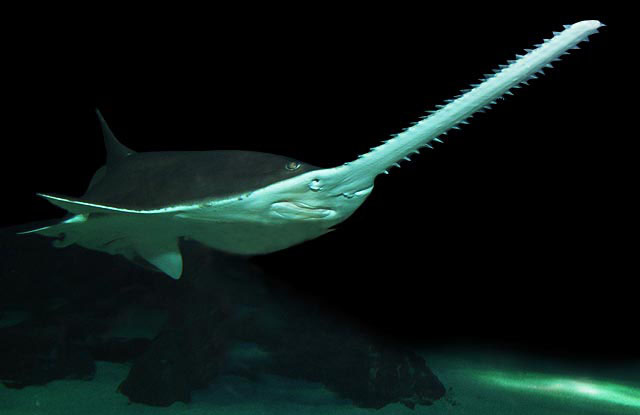
Pristis pectinata is a sawfish of the family Pristidae, order Rhinopristiformes; though it looks like a shark, it is a ray [1],[2]. It is recognised by its long, flat, tooth-edged snout, which it uses both to detect its prey and to immobilise it [2]. It is an Atlantic species: it is now considered absent from the Pacific, and its record from Peru, at the mouth of the Tumbes River, probably belonged to another sawfish [3],[4]. The IUCN Red List classifies it as Critically Endangered (CR) [5].
Etymology
Latham described it in 1794, in an essay on the species of sawfish published in the Transactions of the Linnean Society of London; the valid name today is Pristis pectinata Latham, 1794 [1]. The World Register of Marine Species groups under this name 11 other names that are no longer accepted, among them the spelling Pristis pectinatus, also credited to Latham in 1794, and Pristis granulosa and Pristis serra, both from 1801 [1]. FishBase records the name «pez rastrillo» for Peru [6].
Identification and similar species
Like all sawfishes, it has its gills and mouth on the underside of the body and its spiracles on top, just behind the eyes, which gives it away as a ray [2]. The back is olive grey or brown and the belly white [2]. It is told apart from the other sawfish species by three features: it has 22 to 29 rostral teeth on each side of the saw, its tail fin has no lower lobe, and the first dorsal fin lines up with the pelvic fins [2].
It is born at about 64 to 81 cm long and can reach about 16 feet, that is, close to 4.9 m [2]. At birth the pup's saw is covered by a clear, jelly-like sheath that keeps it from injuring the mother during birth and dissolves within a few hours or a few days [2].
Similar species
- Pristis pristis: The largetooth sawfish is the one that has actually been recorded in northern Peru: its first dorsal fin starts ahead of the origin of the pelvic fins, it keeps the lower lobe of the tail fin at every age, and its saw is shorter and wider [4]; in Pristis pectinata, by contrast, the first dorsal lines up with the pelvics and the tail has no lower lobe [2].
Distribution and habitat
In the past it was found on the tropical and subtropical coasts of the eastern and western Atlantic alike [7]. In the western Atlantic it was recorded from Brazil, through the Caribbean and Central America, to the Gulf of Mexico and the Atlantic coast of the United States; worldwide it now occupies less than 20 % of its former range, and in that region it is known only in the southeastern United States, the Bahamas, Cuba, Honduras and Belize [2]. In the Argentine-Uruguayan common fishing zone it did not turn up in 150 bottom-trawl cruises with 8490 hauls between 1981 and 2015, although interviews with fishers gathered 5 accounts of catches; the authors conclude that it was always an occasional visitor there [7]. In the Mexican Caribbean, environmental DNA samples tested positive in Yalahau Lagoon and Bahía del Espíritu Santo, which shows the species still persists in some refuges [8].
Old records from the Pacific coast of Central America are probably misidentifications of other sawfishes [9]. It lives in shallow coastal waters, estuaries and rivers, rarely deeper than 100 m, and tolerates a wide range of salinity; juveniles prefer salinities of 18 to 30 [2]. Those up to 220 cm stay in estuarine water less than 3 feet deep lined with red mangrove, while larger ones use anything from offshore reefs to shallow estuarine flats [2]. In the United States, water below 16 to 18 °C and the lack of mangrove shores limit its spread northwards, so beyond Florida it turns up mostly from May to August [2].
Biology
It is a yolk-sac live-bearer: fertilisation is internal, the embryos develop for about 12 months inside the mother, and females give birth every 2 years, with litters of 7 to 14 pups [2]. A genetic study in 2 nursery areas of Charlotte Harbor, Florida, reconstructed the parents of 349 juveniles sampled between 2004 and 2015: 45 of the 55 females identified came back to give birth in those same rivers, most of them every 2 years, and 9 of them had been doing so for 10 years or more [10].
It grows fast at first, reaching about 150 cm by the end of its first year and about 220 cm by the end of its second [2]. After that it matures slowly, between 7 and 11 years of age; males mature at about 340 cm and females at about 360 cm [2]. In 15 specimens from south Florida, the vertebrae gave ages of 0.4 to 14 years; the oldest, a 4.35 m female, was 14 years old, and the growth model estimated an asymptotic length of 4.48 m [11]. The authors consider it likely to live longer than 14 years [11].
Ecology
It feeds mainly on fish and uses its saw to detect and immobilise prey; observed prey include herrings and sardines (clupeids), jacks (carangids), mullets (mugilids), whiptail stingrays (dasyatids), the pinfish Lagodon rhomboides and shrimps of the genus Farfantepenaeus [2]. If it loses its saw, or much of it breaks, it probably starves [2].
The smallest pups, from birth to about 150 cm, stay for several months or up to a year in particular nursery areas and widen their range of activity as they grow [2]. In southwest Florida, the stretch running from Charlotte Harbor to the Everglades and the Florida Keys is the core of its abundance, past and present [2].
Conservation
The IUCN Red List classifies it globally as Critically Endangered (CR), according to its 2022 assessment [5]. All sawfishes are listed in CITES Appendix I [7], and the Convention on Migratory Species has included it in its Appendices I and II since 2014 [12].
In the United States, the Endangered Species Act has listed the country's population as endangered from 1 April 2003, and the population in the rest of the world from 12 December 2014 [2]. In 2009, 2 units of critical habitat were designated in southwest Florida, protecting the red mangrove and the shallow water where the pups live [2]. The main cause of its decline has been incidental capture in gillnets, trawls, trammel nets and seines [9].
In Peru, in 2017, the authors who documented the largetooth sawfish in Tumbes noted that sawfishes were not protected by Peruvian law, so catching and selling them was not illegal [4].
Health, toxicological and chemical relevance
Not medical advice. For a sting, a poisoning or an allergy, seek medical care.
An 1895 report on the fishes of Florida already warned that it can inflict serious wounds with its saw if disturbed [9]. In 1953 it was described as a nuisance to fishers, because it gets tangled in nets and trawls and is hard to free without being hurt by the saw [9].
Human relevance
In the United States there was never a large fishery aimed at this species, but it was often taken as bycatch: in Louisiana, landings by shrimp trawlers fell from 34,900 pounds in 1949 to less than 1500 pounds in most years after 1967, and across the Gulf of Mexico they went from about 5 t in 1950 to less than 0.2 t in 1978 [9]. Worldwide, sawfish fins are among the most valued for shark fin soup, and their saws have long been traded as curios [9].
Where to see it in Peru
There are no confirmed records in Peru. The 2001 catalogue of marine fishes by Chirichigno and Cornejo listed the species at the mouth of the Tumbes River, and the 2015 checklist of Peruvian chondrichthyans kept it on the basis of that literature review, with no new field data [3],[4]. A 2017 study concluded that the record was probably a largetooth sawfish, Pristis pristis, because Pristis pectinata lives only in the Atlantic; the 2 sawfishes caught in Tumbes in 2014 and 2015 that the study documented were of that other species [4].
References (12)
- WoRMS Editorial Board (2026). Pristis pectinata Latham, 1794. World Register of Marine Species. https://www.marinespecies.org/aphia.php?p=taxdetails&id=105848 (accessed 2026-10-20)
- NOAA Fisheries Southeast Region (2023). Smalltooth Sawfish and Smalltooth Sawfish Critical Habitat Consultation Framework. National Marine Fisheries Service, Southeast Regional Office, St. Petersburg (Florida), 1-5. https://www.fisheries.noaa.gov/s3/2023-03/Smalltooth-Sawfish-Section-7-Framework_final-2-8-23.pdf (accessed 2026-10-20)
- Cornejo, R., Vélez-Zuazo, X., González-Pestana, A. et al. (2015). An updated checklist of Chondrichthyes from the southeast Pacific off Peru. Check List, 1809. doi:10.15560/11.6.1809 (accessed 2026-10-20)
- Mendoza, A., Kelez, S., Gonzales Cherres, W. et al. (2017). The Largetooth Sawfish, Pristis pristis (Linnaeus, 1758), is not extirpated from Peru: new records from Tumbes. Check List, 261-265. doi:10.15560/13.4.261 (accessed 2026-10-20)
- Carlson, J., Blanco-Parra, M.P., Bonfil, R. et al. (2022). Pristis pectinata: Carlson, J., Blanco-Parra, MP, Bonfil, R., Charles, R., Charvet, P., Chevis, M., Dulvy, N.K., Espinoza, M., Faria, V., Ferretti, F., Fordham, S., Giovos, I., Graham, J., Grubbs, D., Pacoureau, N. & Phillips, N.M. The IUCN Red List of Threatened Species 2022: e.T18175A249881355. doi:10.2305/IUCN.UK.2022-2.RLTS.T18175A249881355.en (accessed 2026-10-20)
- Froese, R., Pauly, D. (2026). Common names of Pristis pectinata. FishBase. https://www.fishbase.se/comnames/CommonNamesList.php?ID=2057&GenusName=Pristis&SpeciesName=pectinata&StockCode=2252 (accessed 2026-10-20)
- Cuevas, J.M., García, M., Hozbor, N. et al. (2019). Tracing the occurrence of the Critically Endangered smalltooth sawfish Pristis pectinata at its southernmost distribution in the Southwest Atlantic Ocean. Endangered Species Research, 1-9. doi:10.3354/esr00932 (accessed 2026-10-20)
- Bonfil, R., Díaz-Jaimes, P., Palacios-Barreto, P. et al. (2024). Improved eDNA assay evidences further refugia for critically endangered smalltooth sawfish (Pristis pectinata) in Mexico. Frontiers in Marine Science, 1290661. doi:10.3389/fmars.2024.1290661 (accessed 2026-10-20)
- National Marine Fisheries Service (2018). Smalltooth Sawfish (Pristis pectinata) 5-Year Review: Summary and Evaluation of United States Distinct Population Segment of Smalltooth Sawfish. National Marine Fisheries Service, Southeast Regional Office, St. Petersburg (Florida). https://repository.library.noaa.gov/view/noaa/19253 (accessed 2026-10-20)
- Feldheim, K.A., Fields, A.T., Chapman, D.D. et al. (2017). Insights into reproduction and behavior of the smalltooth sawfish Pristis pectinata. Endangered Species Research, 463-471. doi:10.3354/esr00868 (accessed 2026-10-20)
- Scharer, R.M., Patterson III, W.F., Carlson, J.K. et al. (2012). Age and Growth of Endangered Smalltooth Sawfish (Pristis pectinata) Verified with LA-ICP-MS Analysis of Vertebrae. PLoS ONE, e47850. doi:10.1371/journal.pone.0047850 (accessed 2026-10-20)
- Convention on the Conservation of Migratory Species of Wild Animals (2026). Pristis pectinata. CMS, species page. https://www.cms.int/en/species/pristis-pectinata (accessed 2026-10-20)
More pictures
If you come across it
Protected or threatened species. Watch it without touching, feeding, chasing or taking it, and keep the recommended viewing distances.
Related species
From the same genus (Pristis).

Names and sources
In Spanish
- Pez rastrillo — Peru; fishbase · main name
- Pejepeine — Wikidata
- Pez peine — WoRMS
- Pez Sierra — Wikidata; WoRMS
- Pez sierra peine — WoRMS
- Sayyaf — Wikidata
- Sayyafah — Wikidata
In English
- Smalltooth sawfish — WoRMS; Wikidata
- Wide Sawfish — Wikidata
Classification
Learn more
Conservation status: Critically Endangered (IUCN Red List, according to Wikidata). Taxonomy: PeRMS / WoRMS (CC BY 4.0).