
Bony fishes · Scorpaenidae
Red scorpionfish
Pontinus furcirhinus Garman, 1899
Spanish: Lapón rojo
- Peruvian Register of Marine Species
- Listed in PeRMS (IMARPE)
Species account
Summary
Pontinus furcirhinus Garman, 1899 is the accepted name of a scorpionfish of the family Scorpaenidae [1]. It was described as a new species from the deep-sea fishes collected by the steamer Albatross in 1891 in the eastern Pacific [2]. It lives on deep bottoms and has been recorded from southern Baja California to Peru [3]. The IUCN classifies it as Least Concern [4].
Etymology
Garman chose the epithet furcirhinus for the forked look of the upper jaws, which comes from the large clusters of teeth at the front of the mouth [2].
Identification and similar species
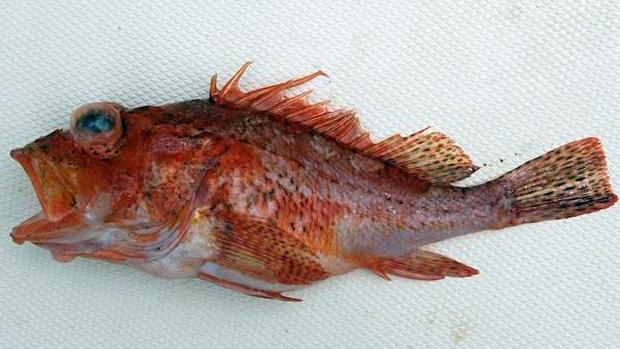
The body is moderately elongate and strongly compressed, tapering quickly behind the pectoral fins. It is deepest at the third or fourth dorsal spine, from which the profile slopes steeply to the snout; the depth is less than two sevenths of the total length. The head is large, one third of the total length, and rough with ridges and spines; the eye is large, almost a quarter of the head [2].
The teeth form fine bands that, at the front of the jaws, end in large rounded clusters; the snout is blunt and the mouth wide, with the maxilla reaching the rear edge of the orbit or a little beyond [2]. The scales are medium-sized and ctenoid; on large specimens they bear skin filaments, as do some of the spines, and the lateral-line scales form a longitudinal ridge. The species has 24 vertebrae [2].
The third dorsal spine is, in many specimens, much longer than the second and the fourth, about half the length of the head; in others it barely exceeds them. Some individuals have 13 dorsal spines, and the second anal spine is much stronger than the third [2]. The colour in life is rose, brownish red in alcohol, with brown flecks below the eye, on the side of the head, along the lateral line and at the base of the dorsal fin [2].
Distribution and habitat
It is an eastern Pacific species recorded from southern Baja California, in Mexico, to Peru. It is classed as bathydemersal, that is, tied to deep bottoms, with a depth limit of 300 m [3].
On the Albatross expedition it was caught between 66 and 210 fathoms, about 121 to 384 m. Garman considered it a member of the shore fauna, although it descends to 200 fathoms or more [2]. The bottoms at the stations where specimens were taken were rocky, broken shell, fine grey sand and green mud [2]. The two sources differ on the depth limit, so that figure should be taken as approximate [2],[3].
Biology
Of the internal anatomy, Garman noted only a few features: three pyloric appendages and a large swim bladder, besides the 24 vertebrae [2].
In the series of specimens, all those caught between 66 and 112 fathoms had a long third dorsal spine, and 17 from between 127 and 210 fathoms had a short one. But a lot of five specimens from 182 fathoms mixed the two forms, so depth does not fully explain it. The author thought a sexual difference possible, but could not test it with that material [2].
The maximum size cited is 27 cm total length, with 15 cm as the common size. The spines carry thick glandular tissue on their rear edge [3]. The FishBase page gives no data on diet or reproduction [3].
Ecology
The only observations of co-occurrence come from the Albatross hauls. At the station at 100 fathoms on rocky bottom, this species came up with Serranus bulleri, Peristedium crustosum and Symphurus varius; at the one at 66 fathoms, also rocky, with Anthias multifasciatus [2]. Garman also noted that the scorpionfishes that descend to between 100 and 250 fathoms are fairly numerous [2]. The sources consulted hold no data on feeding, predators or reproduction of this species [3].
Conservation
Health, toxicological and chemical relevance
Not medical advice. For a sting, a poisoning or an allergy, seek medical care.
FishBase marks the species as venomous to people, but presents as a mere supposition that the spines, which have glandular tissue on their rear edge, produce venom. It offers no clinical cases or toxicity data [3].
References (4)
- WoRMS Editorial Board (2026). Pontinus furcirhinus Garman, 1899. World Register of Marine Species. https://www.marinespecies.org/aphia.php?p=taxdetails&id=274685 (accessed 2026-10-25)
- Garman, S. (1899). Reports on an exploration off the west coasts of Mexico, Central and South America, and off the Galapagos Islands, in charge of Alexander Agassiz, by the U.S. Fish Commission Steamer Albatross, during 1891, Lieut. Commander Z.L. Tanner, U.S.N., commanding. 26. The fishes. Memoirs of the Museum of Comparative Zoölogy, at Harvard College, Cambridge, Mass., 1-431. doi:10.5962/bhl.part.27494 (accessed 2026-10-25)
- Froese, R., Pauly, D. (2026). Pontinus furcirhinus, Red scorpionfish. FishBase. https://fishbase.se/summary/14205 (accessed 2026-10-25)
- IUCN (2008). Pontinus furcirhinus: Iwamoto, T., Eschmeyer, W. & Alvarado, J. The IUCN Red List of Threatened Species. doi:10.2305/iucn.uk.2010-3.rlts.t183281a8086198.en (accessed 2026-10-25)
More pictures
Where it has been recorded
- Filled: scientific records, or confirmed by a curator
- Hatched: isolated record
- Dotted outline: no scientific records and no curator's confirmation (an ORKA sighting is not drawn here)
- Tropical northern sea
Scientific records (2 records)
- Tropical–cold transition zone
Scientific records (3 records)
- Cold central sea
Scientific records (6 records)
From openly licensed OBIS and GBIF records (CC0 or CC BY). How each list is built.
Related species
From the same genus (Pontinus) and from the same family (Scorpaenidae).
Speckled scorpionfish
Pontinus sierra
IUCN status: LC · Least ConcernMottled Scorpionfish
Pontinus clemensi
IUCN status: LC · Least Concern
Stone scorpionfish
Scorpaena mystes
IUCN status: LC · Least Concern
Peruvian Scorpionfish
Scorpaena afuerae
IUCN status: LC · Least Concern
Player scorpionfish
Scorpaena histrio
IUCN status: LC · Least ConcernReddish scorpionfish
Scorpaena russula
IUCN status: LC · Least ConcernRainbow scorpionfish
Scorpaenodes xyris
IUCN status: LC · Least Concern
Names and sources
In Spanish
- Lapón rojo — WoRMS; Wikidata · main name
- Diablico — Wikidata
- Rascacio Richichi — Wikidata
In English
- Red scorpionfish — WoRMS; Wikidata
Classification
Learn more
Conservation status: Least Concern (IUCN Red List, according to Wikidata). Taxonomy: PeRMS / WoRMS (CC BY 4.0).