
Crabs, lobsters and shrimps · Pinnotheridae
Pinnixa valdiviensis
Pinnixa valdiviensis Rathbun, 1907
Spanish: Cangrejito comensal
- Names in Peru
- Cangrejito comensal
- Peruvian Register of Marine Species
- Listed in PeRMS (IMARPE)
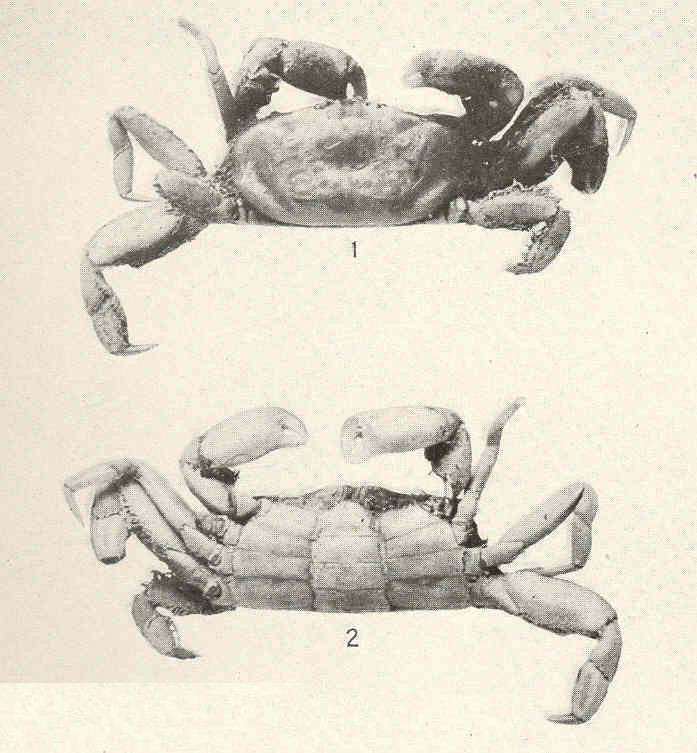
Species account
Summary
Pinnixa valdiviensis Rathbun, 1907 is a tiny crab of the family Pinnotheridae, accepted as a valid species in the World Register of Marine Species [1]. It does not live free: as an adult it is associated with other soft-bottom animals and has been found in the burrows of the ghost shrimp Callichirus garthi [2].
Its known range runs from the Chincha Islands in Peru to San Julián Bay in Argentina [3]. In Peru it has also been recorded on soft bottoms of the central coast, between 8 and 15 m deep [4].
Identification and similar species
In life the back is reddish, and the colour lightens toward the underside until it is almost white. The body and appendages are covered in dense hair. In San Julián Bay, 12 adult males averaged 9.15 mm carapace length and 17.40 mm width, and 6 adult females 8.40 mm and 18.30 mm; the carapace is therefore clearly wider than long [3].
The other characters Torres describes are: a shallow groove on the front, two short cardiac ridges and one transverse hepatic ridge; equal, robust claws with no difference between the sexes; the third pair of walking legs the largest, with five tubercle-crowned ridges on the dactyl; and a reduced sixth abdominal segment [3].
In the key to the decapods of Peru, Pinnixa valdiviensis and Pinnixa transversalis are grouped in one step because the carapace is much wider than long and the third pair of walking legs is the longest. Pinnixa valdiviensis has no cardiac ridge crossing the whole carapace (if ridges are present there are two, well separated), its third maxilliped has a long, narrow second palp segment, and the male abdomen takes up a third of the width of the sternum and narrows gradually [5].
Similar species
- Pinnixa transversalis: It has a ridge crossing almost the full width of the carapace at heart level, the second palp segment of the third maxilliped is short and thick, and the male abdomen is narrow along its whole length [5].
Distribution and habitat
Torres places its distribution between the Chincha Islands in Peru and San Julián Bay (49°17'S), in the Magellanic province of the southwestern Atlantic, where the species was new for Argentina. The author considers that the southern Atlantic decapod fauna derives from the South Pacific and that the species may extend farther north than the area studied, something he says must be confirmed [3].
In San Julián the specimens were collected by hand in the lower intertidal zone, turning over the substrate with a shovel to a depth of 30 cm; the author links them to infralittoral areas of fine sand (33.5 %) and silt-clay (64.2 %) [3]. In Peru, a macrofauna survey near a marine terminal 167 km south of Lima (13°15'S) recorded it on soft bottom between 8 and 15 m deep [4].
Biology
In a population from the southeastern Pacific, Baeza and Hernáez found that the crabs lived alone or in groups of up to 4 individuals per burrow. Few burrows held two crabs, either a male and a female or two females, so the species does not appear to live in male-female pairs as the few other studied members of the genus do [2].
Many females carrying embryos were alone in their burrow, and the population held more females than males. The authors interpret this as males perhaps moving between hosts to look for receptive females, and call for longer studies to clarify how the species mates [2].
Fecundity was 383 to 1052 eggs per female, with a mean of 774 eggs, and it rose with female size. Embryo volume, by contrast, did not vary with maternal size. Reproductive output averaged 5.74 % of the female's dry weight, a figure lower than that of other free-living or symbiotic crabs [2].
Ecology
Where to see it in Peru
The source consulted with field data in Peru is an inventory of the submerged macrofauna beside a marine terminal on the central coast, sampled between June 2011 and June 2015; the species came from soft sediment at 8 to 15 m, collected with a grab [4]. That source does not describe seeing it on a dive, and since it lives inside the burrows of other animals [2], what is on record is a find from sediment sampling [4],[2].
References (5)
- DecaNet eds. (2026). Pinnixa valdiviensis Rathbun, 1907. World Register of Marine Species. https://www.marinespecies.org/aphia.php?p=taxdetails&id=445067 (accessed 2026-10-25)
- Baeza, J.A., Hernáez, P. (2015). Population distribution, sexual dimorphism, and reproductive parameters in the crab Pinnixa valdiviensis Rathbun, 1907 (Decapoda: Pinnotheridae), a symbiont of the ghost shrimp Callichirus garthi (Retamal, 1975) in the southeastern Pacific. Journal of Crustacean Biology, 68-75. doi:10.1163/1937240x-00002294 (accessed 2026-10-25)
- Torres, E.R. (2006). Primer registro para Argentina de Pinnixa valdiviensis Rathbun, 1907(Decapoda, Pinnotheridae). Investigaciones Marinas, 175-179. doi:10.4067/s0717-71782006000200017 (accessed 2026-10-25)
- Tasso, V. (2018). Macrobenthic fauna from an upwelling coastal area of Peru (Warm Temperate South-eastern Pacific province -Humboldtian ecoregion). Biodiversity Data Journal. doi:10.3897/bdj.6.e28937 (accessed 2026-10-25)
- Moscoso, V. (2013). Clave para identificación de crustáceos decápodos y estomatópodos del Perú. Boletín del Instituto del Mar del Perú 28(1-2), 8-135. https://revistas.imarpe.gob.pe/index.php/boletin/article/download/110/103/199 (accessed 2026-10-25)
More pictures
Where it has been recorded
- Filled: scientific records, or confirmed by a curator
- Hatched: isolated record
- Dotted outline: no scientific records and no curator's confirmation (an ORKA sighting is not drawn here)
- Cold central sea
Scientific records (1 record)
- Cold southern sea
Scientific records (11 records)
From openly licensed OBIS and GBIF records (CC0 or CC BY). How each list is built.
Related species
From the same genus (Pinnixa) and from the same family (Pinnotheridae).
- No openly licensed image yet
Pinnixa bahamondei
IUCN status: Not evaluated - No openly licensed image yet
Pinnixa paitensis
IUCN status: Not evaluated 
Austinixa transversalis
IUCN status: Not evaluated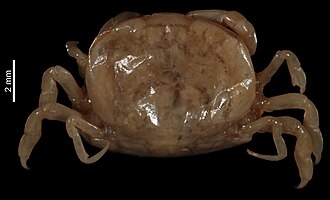
Calyptraeotheres politus
IUCN status: Not evaluated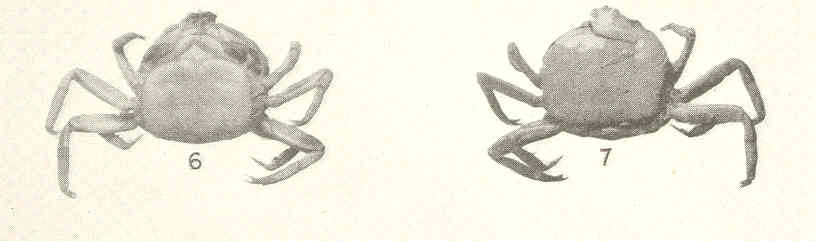
Dissodactylus nitidus
IUCN status: Not evaluatedHolothuriophilus pacificus
IUCN status: Not evaluatedPinnaxodes chilensis
IUCN status: Not evaluated
Names and sources
In Spanish
- Cangrejito comensal — Peru; sealifebase · main name
Classification
Learn more
Conservation status: no data (IUCN). Taxonomy: PeRMS / WoRMS (CC BY 4.0).