
Seabirds · Phalaropodidae
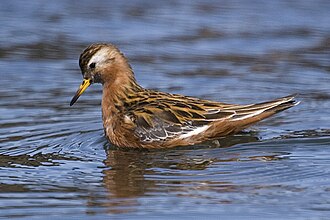
Red-necked phalarope
Phalaropus lobatus (Linnaeus, 1758)
Spanish: Falaropo picofino
- Peruvian Register of Marine Species
- Listed in PeRMS (IMARPE)

Species account
Summary
Phalaropus lobatus is a bird of the family Phalaropodidae, order Charadriiformes [1]. It breeds on freshwater tundra ponds in the Arctic and subarctic and spends the rest of the year at sea, in saline tropical waters [2].
North Atlantic birds followed with geolocators wintered in the northern Humboldt Current or off Central America [2]. In Peruvian waters it is a migrant that breeds in the northern hemisphere [3]. The IUCN lists it globally as Least Concern [4].
Distribution and habitat
It breeds on freshwater tundra ponds in Arctic and subarctic regions; the 2019 study covered 9 breeding sites, from East Greenland to western Siberia [2].
Outside the breeding season it is pelagic and lives in saline tropical ocean waters [2]. The North Atlantic breeders and those of Fennoscandia and Russia use different routes: the first travel about 10000 km over the sea to the Pacific and the second about 6000 km, largely overland, to the Arabian Sea [2].
In the Western Hemisphere, the main wintering area of the species is the Humboldt Current off Ecuador, Peru and northern Chile [5]. Of the 8 birds of the western route with complete tracks, 6 wintered in the northern Humboldt Current and 2 off Central America [2].
Biology
It has reversed sex roles and is polyandrous: males care for the eggs and the chicks [2]. Females are heavier than males: mean body mass was about 38 g in 170 females and about 33 g in 468 males [2].
Birds of the western route left the breeding areas on average on 9 July and reached the wintering area around 10 September, after about 74 days of travel; their longest stopover, about 12 days, was near 45° N in the Bay of Fundy, Canada [2]. In spring they left the wintering area on 8 May, in one documented case crossed the Caribbean in about 48 hours without stopping and were back on the breeding grounds around 1 June [2].
In the Pacific the birds spent about 240 days in the wintering area and moved about 1549 km in total, mostly at the beginning and end of winter [2].
Ecology
It feeds on zooplankton, which may not track the primary productivity of the sea closely [2].
Tracked birds were associated with waters of high primary productivity, in both the Pacific and the Arabian Sea [2]. The Humboldt Current has high and fairly constant primary productivity [2].
In 14 cruises made between 1980 and 1995 within 370 km of the coast between 3° S and 50° S, 407 Red-necked Phalaropes were counted among 93 recorded seabird species [3]. In the northern sector (3° S to 15° S) it ranked 14th over the continental shelf, at about 27 birds per 100 km², and 18th over the slope, at about 12.5 [3].
Conservation
The current IUCN assessment places it globally in the Least Concern category [4].
At Head Harbour, in the outer Bay of Fundy (Canada), the full migratory passage of the species was estimated at 1 to 2 million birds; the flocks began to decline in the mid-1980s and by 1990 had disappeared [5].
Nisbet and Veit (2015) linked the decline to the 1982/83 El Niño, which damaged marine ecosystems of the eastern tropical Pacific, where the wintering area lies [5]. Others have proposed that the birds changed route because of a local drop in prey, but Hunnewell and colleagues question this because Arctic breeding sites also declined after that event [5]. In Canada, COSEWIC designated it in 2014 as a species of Special Concern [5]. The authors of the 2019 study note that, as a diet and habitat specialist, the species may be vulnerable to habitat change [2].
Where to see it in Peru
In Peruvian waters the records of this bird come from ship-based observations at sea: in 14 cruises from 1980 to 1995 birds were registered within 370 km of the coast, over the shelf and slope of the northern sector (3° S to 15° S) [3]. Outside the breeding season it is pelagic [2].
Birds of the western route, which winter in the Pacific, spent on average about 240 days in the wintering area [2].
References (5)
- WoRMS Editorial Board (2026). Phalaropus lobatus (Linnaeus, 1758). World Register of Marine Species. https://www.marinespecies.org/aphia.php?p=taxdetails&id=137169 (accessed 2026-10-25)
- van Bemmelen, R.S.A., Kolbeinsson, Y., Ramos, R. et al. (2019). A Migratory Divide Among Red-Necked Phalaropes in the Western Palearctic Reveals Contrasting Migration and Wintering Movement Strategies. Frontiers in Ecology and Evolution, 86. doi:10.3389/fevo.2019.00086 (accessed 2026-10-25)
- Spear, L.B., Ainley, D.G. (2008). The Seabird Community of the Peru Current, 1980-1995, with Comparisons to Other Eastern Boundary Currents. Marine Ornithology 36, 125-144. doi:10.5038/2074-1235.36.2.781 (accessed 2026-10-25)
- IUCN (2020). Phalaropus lobatus: BirdLife International. The IUCN Red List of Threatened Species 2020: e.T22693490A166260001. doi:10.2305/iucn.uk.2021-3.rlts.t22693490a166260001.en (accessed 2026-10-25)
- Hunnewell, R.W., Diamond, A.W., Brown, S.C. (2016). Estimating the migratory stopover abundance of phalaropes in the outer Bay of Fundy, Canada. Avian Conservation and Ecology, 11. doi:10.5751/ACE-00926-110211 (accessed 2026-10-25)
More pictures
Where it has been recorded
- Filled: scientific records, or confirmed by a curator
- Hatched: isolated record
- Dotted outline: no scientific records and no curator's confirmation (an ORKA sighting is not drawn here)
- Tropical northern sea
Scientific records (39 records)
- Tropical–cold transition zone
Scientific records (26 records)
- Cold central sea
Scientific records (74 records)
- Cold southern sea
Scientific records (361 records)
From openly licensed OBIS and GBIF records (CC0 or CC BY). How each list is built.
Related species
From the same genus (Phalaropus).
Names and sources
In Spanish
- Falaropo picofino — WoRMS · main name
In English
- Red-necked phalarope — WoRMS; Wikidata
- Northern phalarope — WoRMS
Classification
Learn more
Conservation status: Least Concern (IUCN Red List, according to Wikidata). Taxonomy: PeRMS / WoRMS (CC BY 4.0).