
Seabirds · Phalacrocoracidae
Guanay cormorant
Phalacrocorax bougainvillii (Lesson, 1837)
Spanish: Guanay
- Names in Peru
- Guanay · Cormorán guanay
- ORKA's verified sightings
- 1 · last October 22, 2026
- Peruvian Register of Marine Species
- Listed in PeRMS (IMARPE)
Species account
Summary
Phalacrocorax bougainvillii is a cormorant of the family Phalacrocoracidae, described by Lesson in 1837 [1]. In Peru it is called «guanay»; it is one of the three cormorants that breed on the Peruvian coast and is endemic to the Humboldt Current [2]. Together with the Peruvian booby it is the main guano-producing bird, and it relies above all on the Peruvian anchovy, the same fish taken by the huge industrial fishery that turns it into fishmeal [3]. Peru's official list of threatened wildlife, approved in 2014, includes it as «cormorán guanay» in the Near Threatened category [4].
Identification and similar species
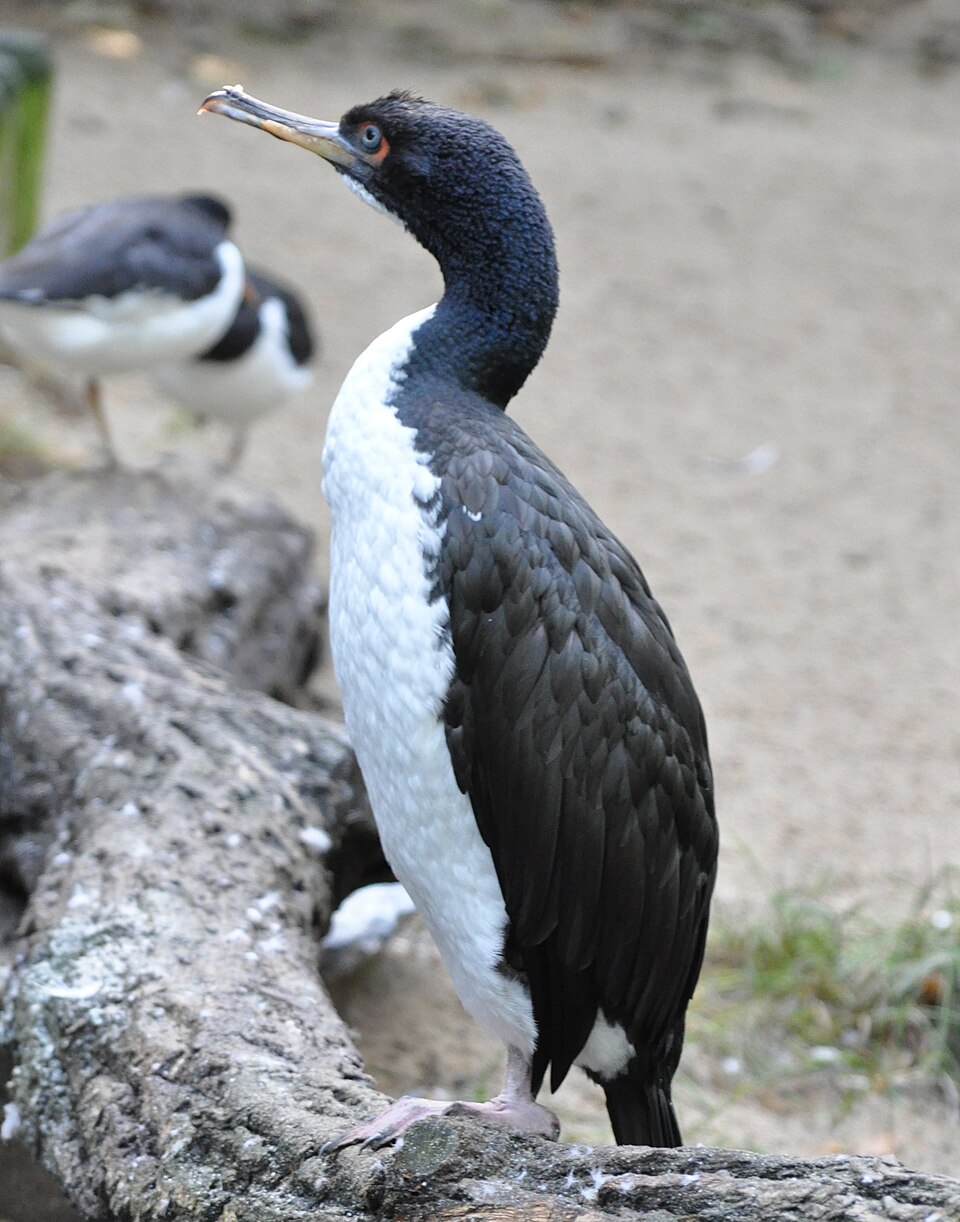
It is a two-toned seabird: the throat, breast and belly are white, while the head, back and wings are black [2]. The skin around the eye is bare and red, and the feet range from pink to black [2].
On Isla Pescadores, adults raising chicks weighed 2138 g on average and had a wing of 302 mm [3]. Males are larger than females (2292 g against 1983 g), so that study treated any bird heavier than 2100 g with a wing longer than 305 mm as a male; the species is also larger than the other cormorants that share its range [3].
Distribution and habitat
It nests on islands and rocky headlands covered in guano and bare of vegetation [2]. Its breeding range has been described as running from Lobos de Tierra Island in northern Peru to Mocha Island in central Chile, although its presence that far south is uncertain and the confirmed colony on Concón Island lies some 640 km further north; on the Atlantic coast of Argentina isolated pairs have been seen that will probably disappear by hybridising with other cormorants [2].
Its colonies shift along the coast following the anchovy: during the 1997-1998 El Niño they shrank on the Macabí and Guañape islands in the north while growing at Punta Coles in the south [2]. Even so, it has nested on the same islands for several thousand years, a sign of how much it depends on pelagic fish schools [3].
Biology
It lays up to 3 eggs, a clutch similar to that of other South American cormorants or those of other upwelling systems, despite the vast abundance of anchovy in good years [3]. On Isla Pescadores, between November and December 2008, the nests checked held 1 to 4 chicks, with a mean of 2.1 across 21 nests [3]. Its breeding success swings widely from one year to the next, because the anchovy available swings too [3].
Among the guano birds, the guanay included, nests with up to 4 chicks are found in times of plenty, but when food runs short the adults abandon nests and young altogether [2]. In this group breeding tends to be asynchronous, both within a single locality and between different localities [2].
Monitoring of 31 breeding sites on the Peruvian coast between 2003 and 2012 showed that the guanay breeds seasonally, though with a weaker pattern than the booby and the pelican [5]. In all three guano birds breeding mostly begins between the austral winter and the start of spring, a period when anchovy are scarce and in poor shape; the prey gets better afterwards, so the chicks take wing when food is at its best [5].
Ecology
Its main prey is the anchovy, although when it fishes close to shore it also takes other prey [3]. At Punta San Juan, in 1995 and 1996, Peruvian silverside and anchovy were what adults brought most to their chicks, making up 45 % and 29 % of the prey counted, followed by a third fish with 16 %, and the diet changed from one year to the other [6]. The diet of the guanay and the Peruvian booby can span more than 30 species of fish and squid [2].
It dives from the surface and feeds mainly by day [3]. On Isla Pescadores, between November and December 2008, adults raising chicks made trips of about 2 hours and went on average 18.9 km from the colony; most of their dives stayed between 2 and 8 m and none went beyond 32 m [3]. At Punta San Juan, in adults raising chicks, a mean maximum depth of 34 m and a dive of up to 74 m had been recorded in 1995 and 1996; there, a flock of some 140 thousand non-breeding birds usually left around 09:00 and came back around 16:00 [6].
It fishes in groups and forms endless columns linking the colony with the feeding grounds [3]. On leaving Isla Pescadores, each guanay circled the island and settled for a few seconds on a raft of birds on the water, 300 m to 2 km offshore, before choosing a direction; the raft kept shifting to line up with the biggest columns coming back, so it pointed to where the food was, like a compass [7].
Its way of feeding adjusts to the state of the sea. At Punta San Juan, birds fitted with loggers in January 2017, 2019 and 2020 made longer trips in 2019 and 2020, years with warmer water than 2017, with a mean range of 24.1 and 27.1 km against 16.5 km in 2017, probably because the anchovy schools were more scattered and deeper [2].
Conservation
In Peru it is listed in the Near Threatened category of the official list of threatened wildlife species [4].
According to a 2012 study, over some 50 years the guanay went from about 21 million to 2 million individuals, while the Peruvian booby stayed stable; the decline has been attributed to successive El Niño events and to competition with the industrial fishery that grew from the 1950s onward [3]. In September 2021, the census by Agrorural's island wardens counted fewer than 3 million guanays on the Peruvian coast [2].
Its numbers in Peru are tied to anchovy biomass, its breeding success drops when anchovy is scarce, and its population has fallen for a while after El Niño events [8]. A model of carbon flow to the three guano birds explained 94 % of the variation in their populations between 1925 and 2000: the rise between 1925 and 1955 would reflect higher ocean productivity, and the later fall, competition with the fishery, which came to take about 85 % of the anchovy [9].
H5N1 avian influenza struck Peruvian seabirds from late 2022, and the virus was confirmed in a guanay sampled in Piura that year [10]. By 6 February 2023, SERNANP had counted about 55 thousand dead birds in 8 coastal protected areas, mainly boobies, pelicans and guanays [11].
Health, toxicological and chemical relevance
Not medical advice. For a sting, a poisoning or an allergy, seek medical care.
The guanay is one of the 2 resident guano birds in which a study of the outbreak in Peru confirmed the H5N1 virus, and because guano is widely used to fertilise crops, its authors name this as another possible route for future infection of people [10]. During the epizootic, SERNANP asked people not to touch sick or dead animals inside protected areas and to alert the park rangers [11].
Human relevance
With the Peruvian booby, it is one of the two main guano-producing birds; in the nineteenth century that guano was one of the great sources of fertiliser, and it is still harvested industrially, though on a much smaller scale [3]. The guanay feeds on the same fish the fishery seeks: according to a model, before the fishery developed the guano birds consumed about 2.3 % of the system's new production, and afterwards only 0.3 % [9].
Where to see it in Peru
On the central coast, in late 2008, some 240 thousand guanays were breeding on Isla Pescadores, 7.5 km from the mainland [3], or some 190 thousand according to another study by the same team that season [7]. In the south, Punta San Juan is a 54-hectare headland in the Reserva Nacional Sistema de Islas, Islotes y Puntas Guaneras, cut off from the mainland by a 1.2 km wall; there, some 137 thousand breeding pairs were estimated in January 2017, 46 thousand in January 2019 and 20 thousand in January 2020, and studying the colony required permits from SERNANP [2].
References (11)
- WoRMS Editorial Board (2026). Phalacrocorax bougainvillii (Lesson, 1837). World Register of Marine Species. https://www.marinespecies.org/aphia.php?p=taxdetails&id=343938 (accessed 2026-10-20)
- Gonzales Del Carpio, D.D. (2022). Flexibilidad del comportamiento de forrajeo del cormorán guanay (Phalacrocorax bougainvillii) bajo un ambiente marino impredecible. Universidad Peruana Cayetano Heredia (tesis de licenciatura). https://hdl.handle.net/20.500.12866/13178 (accessed 2026-10-20)
- Weimerskirch, H., Bertrand, S., Silva, J. et al. (2012). Foraging in Guanay cormorant and Peruvian booby, the major guano-producing seabirds in the Humboldt Current System. Marine Ecology Progress Series, 231-245. doi:10.3354/meps09752 (accessed 2026-10-20)
- Ministerio de Agricultura y Riego (2014). Decreto Supremo N.° 004-2014-MINAGRI: actualización de la lista de clasificación y categorización de las especies amenazadas de fauna silvestre legalmente protegidas. El Peruano (08-04-2014); ficha en SINIA, Ministerio del Ambiente. https://sinia.minam.gob.pe/normas/lista-especies-amenazadas-fauna-silvestre-legalmente-protegidas (accessed 2026-10-20)
- Passuni, G., Barbraud, C., Chaigneau, A. et al. (2016). Seasonality in marine ecosystems: Peruvian seabirds, anchovy, and oceanographic conditions. Ecology, 182-193. doi:10.1890/14-1134.1 (accessed 2026-10-20)
- Zavalaga, C.B., Paredes, R. (1999). Foraging behaviour and diet of the guanay cormorant. South African Journal of Marine Science, 251-258. doi:10.2989/025776199784125980 (accessed 2026-10-20)
- Weimerskirch, H., Bertrand, S., Silva, J. et al. (2010). Use of Social Information in Seabirds: Compass Rafts Indicate the Heading of Food Patches. PLoS ONE, e9928. doi:10.1371/journal.pone.0009928 (accessed 2026-10-20)
- Crawford, R.J.M., Jahncke, J. (1999). Comparison of trends in abundance of guano-producing seabirds in Peru and southern Africa. South African Journal of Marine Science, 145-156. doi:10.2989/025776199784126006 (accessed 2026-10-20)
- Jahncke, J., Checkley, D.M., Hunt, G.L. (2004). Trends in carbon flux to seabirds in the Peruvian upwelling system: effects of wind and fisheries on population regulation. Fisheries Oceanography, 208-223. doi:10.1111/j.1365-2419.2004.00283.x (accessed 2026-10-20)
- Leguia, M., Garcia-Glaessner, A., Muñoz-Saavedra, B. et al. (2023). Highly pathogenic avian influenza A (H5N1) in marine mammals and seabirds in Peru. Nature Communications. doi:10.1038/s41467-023-41182-0 (accessed 2026-10-20)
- Servicio Nacional de Áreas Naturales Protegidas por el Estado (2023). Sernanp despliega protocolo de monitoreo ante casos de aves y lobos marinos afectados por influenza aviar en áreas naturales protegidas. Nota de prensa, SERNANP (06-02-2023). https://www.gob.pe/institucion/sernanp/noticias/697084-sernanp-despliega-protocolo-de-monitoreo-ante-casos-de-aves-y-lobos-marinos-afectados-por-influenza-aviar-en-areas-naturales-protegidas (accessed 2026-10-20)
More pictures
At ORKA's dive sites
Protected or threatened species. Watch it without touching, feeding, chasing or taking it, and keep the recommended viewing distances.national category: Near Threatened (NT) — Supreme Decree No. 004-2014-MINAGRI, classification of threatened wild fauna species (El Peruano, 8 April 2014), p. 9 of the PDF
- Muelle de Los Órganos
Seen by ORKA on verified outings (1)
Where it has been recorded
- Filled: scientific records, or confirmed by a curator
- Hatched: isolated record
- Dotted outline: no scientific records and no curator's confirmation (an ORKA sighting is not drawn here)
- Tropical–cold transition zone
Isolated record (1 record)
- Cold southern sea
Scientific records (3 records)
From openly licensed OBIS and GBIF records (CC0 or CC BY). How each list is built.
Related species
From the same genus (Phalacrocorax).
Names and sources
In Spanish
- Guanay — Peru; SERNANP (2026). Plan Maestro de la Reserva Nacional Mar Tropical de Grau 2026–2031. RPE N.° 000052-2026-SERNANP, p. 114 of the PDF; Wikidata · main name
- Cormorán guanay — Peru; D.S. N.° 004-2014-MINAGRI, categorización de especies amenazadas de fauna silvestre (El Peruano, 08-04-2014), p. 9 of the PDF
In English
- Guanay cormorant — WoRMS
Also cited as
- Leucocarbo bougainvillii
Classification
Learn more
Conservation status: no data (IUCN). Taxonomy: PeRMS / WoRMS (CC BY 4.0).